
分享
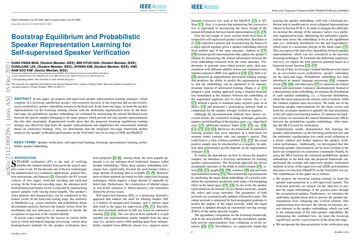
In this paper, we propose self-supervised speaker representation learning strategies, which comprise of a bootstrap equilibrium speaker representation learning in the front-end and an uncertainty-aware probabilistic speaker embedding training in the back-end. In the front-end stage, we learn the speaker representations via the bootstrap training scheme with the uniformity regularization term. In the back-end stage, the probabilistic speaker embeddings are estimated by maximizing the mutual likelihood score between the speech samples belonging to the same speaker, which provide not only speaker representations but also data uncertainty. Experimental results show that the proposed bootstrap equilibrium training strategy can effectively help learn the speaker representations and outperforms the conventional methods based on contrastive learning. Also, we demonstrate that the integrated two-stage framework further improves the speaker verification performance on the VoxCeleb1 test set in terms of EER and MinDCF.
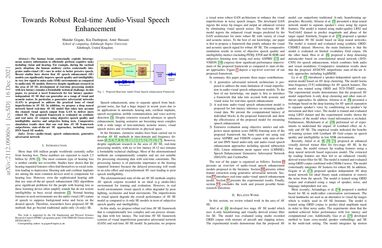
The human brain contextually exploits heterogeneous sensory information to efficiently perform cognitive tasks including vision and hearing. For example, during the cocktail party situation, the human auditory cortex contextually integrates audio-visual (AV) cues in order to better perceive speech. Recent studies have shown that AV speech enhancement (SE) models can significantly improve speech quality and intelligibility in very low signal to noise ratio (SNR) environments as compared to audio-only SE models. However, despite significant research in the area of AV SE, development of real-time processing models with low latency remains a formidable technical challenge. In this paper, we present a novel framework for low latency speaker-independent AV SE that can generalise on a range of visual and acoustic noises. In particular, a generative adversarial networks (GAN) is proposed to address the practical issue of visual imperfections in AV SE. In addition, we propose a deep neural network based real-time AV SE model that takes into account the cleaned visual speech output from GAN to deliver more robust SE. The proposed framework is evaluated on synthetic and real noisy AV corpora using objective speech quality and intelligibility metrics and subjective listing tests. Comparative simulation results show that our real time AV SE framework outperforms state-of-the-art SE approaches, including recent DNN based SE models.

We propose a method of simulating the human process of foreign accentuation using Generative Spoken Language Model (GSLM) only with native speech corpora. When one listens to spoken words of a foreign language and repeats them, the repeated speech is often with the accent of that listener's L1. This is said to be because the spoken words are mentally represented as a sequence of phonological units of the L1, and those units are used for oral reproduction. We simulate this process by inputting speech of language A into GSLM of language B to add B's accent onto the input speech. The process of running ASR of the L1 for foreign input speech and giving the ASR result to TTS of the L1 can be viewed as a naive implementation of this approach. The results of our experiments show that the synthesized accent of the output speech is highly natural, compared to real samples of A generated by speakers whose L1 is B, and that the degree of accentuation is controllable.

We propose in this paper a new family of kernels to handle times series, notably speech data, within the framework of kernel methods which includes popular algorithms such as the Support Vector Machine. These kernels elaborate on the well known Dynamic Time Warping (DTW) family of distances by considering the same set of elementary operations, namely substitutions and repetitions of tokens, to map a sequence onto another. Associating to each of these operations a given score, DTW algorithms use dynamic programming techniques to compute an optimal sequence of operations with high overall score. In this paper we consider instead the score spanned by all possible alignments, take a smoothed version of their maximum and derive a kernel out of this formulation. We prove that this kernel is positive definite under favorable conditions and show how it can be tuned effectively for practical applications as we report encouraging results on a speech recognition task.

This survey offers a comprehensive overview of recent advancements in Large Language Model (LLM) serving systems, focusing on research since the year 2023. We specifically examine system-level enhancements that improve performance and efficiency without altering the core LLM decoding mechanisms. By selecting and reviewing high-quality papers from prestigious ML and system venues, we highlight key innovations and practical considerations for deploying and scaling LLMs in real-world production environments. This survey serves as a valuable resource for LLM practitioners seeking to stay abreast of the latest developments in this rapidly evolving field.

Information retrieval methods often rely on a single embedding model trained on large, general-domain datasets like MSMARCO. While this approach can produce a retriever with reasonable overall performance, models trained on domain-specific data often yield better results within their respective domains. While prior work in information retrieval has tackled this through multi-task training, the topic of combining multiple domain-specific expert retrievers remains unexplored, despite its popularity in language model generation. In this work, we introduce RouterRetriever, a retrieval model that leverages multiple domain-specific experts along with a routing mechanism to select the most appropriate expert for each query. It is lightweight and allows easy addition or removal of experts without additional training. Evaluation on the BEIR benchmark demonstrates that RouterRetriever outperforms both MSMARCO-trained (+2.1 absolute nDCG@10) and multi-task trained (+3.2) models. This is achieved by employing our routing mechanism, which surpasses other routing techniques (+1.8 on average) commonly used in language modeling. Furthermore, the benefit generalizes well to other datasets, even in the absence of a specific expert on the dataset. To our knowledge, RouterRetriever is the first work to demonstrate the advantages of using multiple domain-specific expert embedding models with effective routing over a single, general-purpose embedding model in retrieval tasks.

Diffusion-based voice conversion (VC) techniques such as VoiceGrad have attracted interest because of their high VC performance in terms of speech quality and speaker similarity. However, a notable limitation is the slow inference caused by the multi-step reverse diffusion. Therefore, we propose FastVoiceGrad, a novel one-step diffusion-based VC that reduces the number of iterations from dozens to one while inheriting the high VC performance of the multi-step diffusion-based VC. We obtain the model using adversarial conditional diffusion distillation (ACDD), leveraging the ability of generative adversarial networks and diffusion models while reconsidering the initial states in sampling. Evaluations of one-shot any-to-any VC demonstrate that FastVoiceGrad achieves VC performance superior to or comparable to that of previous multi-step diffusion-based VC while enhancing the inference speed. Audio samples are available at https://www.kecl.ntt.co.jp/people/kaneko.takuhiro/projects/fastvoicegrad/.

Transferring linguistic knowledge from a pretrained language model (PLM) to an acoustic model has been shown to greatly improve the performance of automatic speech recognition (ASR). However, due to the heterogeneous feature distributions in cross-modalities, designing an effective model for feature alignment and knowledge transfer between linguistic and acoustic sequences remains a challenging task. Optimal transport (OT), which efficiently measures probability distribution discrepancies, holds great potential for aligning and transferring knowledge between acoustic and linguistic modalities. Nonetheless, the original OT treats acoustic and linguistic feature sequences as two unordered sets in alignment and neglects temporal order information during OT coupling estimation. Consequently, a time-consuming pretraining stage is required to learn a good alignment between the acoustic and linguistic representations. In this paper, we propose a Temporal Order Preserved OT (TOT)-based Cross-modal Alignment and Knowledge Transfer (CAKT) (TOT-CAKT) for ASR. In the TOT-CAKT, local neighboring frames of acoustic sequences are smoothly mapped to neighboring regions of linguistic sequences, preserving their temporal order relationship in feature alignment and matching. With the TOT-CAKT model framework, we conduct Mandarin ASR experiments with a pretrained Chinese PLM for linguistic knowledge transfer. Our results demonstrate that the proposed TOT-CAKT significantly improves ASR performance compared to several state-of-the-art models employing linguistic knowledge transfer, and addresses the weaknesses of the original OT-based method in sequential feature alignment for ASR.

This paper describes the USTC-KXDIGIT system submitted to the ASVspoof5 Challenge for Track 1 (speech deepfake detection) and Track 2 (spoofing-robust automatic speaker verification, SASV). Track 1 showcases a diverse range of technical qualities from potential processing algorithms and includes both open and closed conditions. For these conditions, our system consists of a cascade of a frontend feature extractor and a back-end classifier. We focus on extensive embedding engineering and enhancing the generalization of the back-end classifier model. Specifically, the embedding engineering is based on hand-crafted features and speech representations from a self-supervised model, used for closed and open conditions, respectively. To detect spoof attacks under various adversarial conditions, we trained multiple systems on an augmented training set. Additionally, we used voice conversion technology to synthesize fake audio from genuine audio in the training set to enrich the synthesis algorithms. To leverage the complementary information learned by different model architectures, we employed activation ensemble and fused scores from different systems to obtain the final decision score for spoof detection. During the evaluation phase, the proposed methods achieved 0.3948 minDCF and 14.33% EER in the close condition, and 0.0750 minDCF and 2.59% EER in the open condition, demonstrating the robustness of our submitted systems under adversarial conditions. In Track 2, we continued using the CM system from Track 1 and fused it with a CNN-based ASV system. This approach achieved 0.2814 min-aDCF in the closed condition and 0.0756 min-aDCF in the open condition, showcasing superior performance in the SASV system.

The majority of language model training builds on imitation learning. It covers pretraining, supervised fine-tuning, and affects the starting conditions for reinforcement learning from human feedback (RLHF). The simplicity and scalability of maximum likelihood estimation (MLE) for next token prediction led to its role as predominant paradigm. However, the broader field of imitation learning can more effectively utilize the sequential structure underlying autoregressive generation. We focus on investigating the inverse reinforcement learning (IRL) perspective to imitation, extracting rewards and directly optimizing sequences instead of individual token likelihoods and evaluate its benefits for fine-tuning large language models. We provide a new angle, reformulating inverse soft-Q-learning as a temporal difference regularized extension of MLE. This creates a principled connection between MLE and IRL and allows trading off added complexity with increased performance and diversity of generations in the supervised fine-tuning (SFT) setting. We find clear advantages for IRL-based imitation, in particular for retaining diversity while maximizing task performance, rendering IRL a strong alternative on fixed SFT datasets even without online data generation. Our analysis of IRL-extracted reward functions further indicates benefits for more robust reward functions via tighter integration of supervised and preference-based LLM post-training.

We consider the problem of learning causal information between random variables in directed acyclic graphs (DAGs) when allowing arbitrarily many latent and selection variables. The FCI (Fast Causal Inference) algorithm has been explicitly designed to infer conditional independence and causal information in such settings. However, FCI is computationally infeasible for large graphs. We therefore propose the new RFCI algorithm, which is much faster than FCI. In some situations the output of RFCI is slightly less informative, in particular with respect to conditional independence information. However, we prove that any causal information in the output of RFCI is correct in the asymptotic limit. We also define a class of graphs on which the outputs of FCI and RFCI are identical. We prove consistency of FCI and RFCI in sparse high-dimensional settings, and demonstrate in simulations that the estimation performances of the algorithms are very similar. All software is implemented in the R-package pcalg.

This paper presents the experiments and results for the CheckThat! Lab at CLEF 2024 Task 6: Robustness of Credibility Assessment with Adversarial Examples (InCrediblAE). The primary objective of this task was to generate adversarial examples in five problem domains in order to evaluate the robustness of widely used text classification methods (fine-tuned BERT, BiLSTM, and RoBERTa) when applied to credibility assessment issues. This study explores the application of ensemble learning to enhance adversarial attacks on natural language processing (NLP) models. We systematically tested and refined several adversarial attack methods, including BERT-Attack, Genetic algorithms, TextFooler, and CLARE, on five datasets across various misinformation tasks. By developing modified versions of BERT-Attack and hybrid methods, we achieved significant improvements in attack effectiveness. Our results demonstrate the potential of modification and combining multiple methods to create more sophisticated and effective adversarial attack strategies, contributing to the development of more robust and secure systems.