
分享
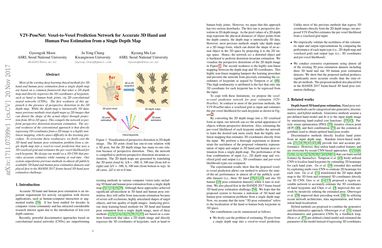
Most of the existing deep learning-based methods for 3D hand and human pose estimation from a single depth map are based on a common framework that takes a 2D depth map and directly regresses the 3D coordinates of keypoints, such as hand or human body joints, via 2D convolutional neural networks (CNNs). The first weakness of this approach is the presence of perspective distortion in the 2D depth map. While the depth map is intrinsically 3D data, many previous methods treat depth maps as 2D images that can distort the shape of the actual object through projection from 3D to 2D space. This compels the network to perform perspective distortion-invariant estimation. The second weakness of the conventional approach is that directly regressing 3D coordinates from a 2D image is a highly non-linear mapping, which causes difficulty in the learning procedure. To overcome these weaknesses, we firstly cast the 3D hand and human pose estimation problem from a single depth map into a voxel-to-voxel prediction that uses a 3D voxelized grid and estimates the per-voxel likelihood for each keypoint. We design our model as a 3D CNN that provides accurate estimates while running in real-time. Our system outperforms previous methods in almost all publicly available 3D hand and human pose estimation datasets and placed first in the HANDS 2017 frame-based 3D hand pose estimation challenge. The code is available in https://github.com/mks0601/V2V-PoseNet_RELEASE.
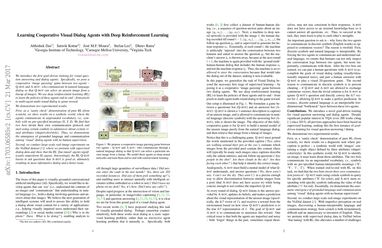
We introduce the first goal-driven training for visual question answering and dialog agents. Specifically, we pose a cooperative 'image guessing' game between two agents -- Qbot and Abot -- who communicate in natural language dialog so that Qbot can select an unseen image from a lineup of images. We use deep reinforcement learning (RL) to learn the policies of these agents end-to-end -- from pixels to multi-agent multi-round dialog to game reward. We demonstrate two experimental results. First, as a 'sanity check' demonstration of pure RL (from scratch), we show results on a synthetic world, where the agents communicate in ungrounded vocabulary, i.e., symbols with no pre-specified meanings (X, Y, Z). We find that two bots invent their own communication protocol and start using certain symbols to ask/answer about certain visual attributes (shape/color/style). Thus, we demonstrate the emergence of grounded language and communication among 'visual' dialog agents with no human supervision. Second, we conduct large-scale real-image experiments on the VisDial dataset, where we pretrain with supervised dialog data and show that the RL 'fine-tuned' agents significantly outperform SL agents. Interestingly, the RL Qbot learns to ask questions that Abot is good at, ultimately resulting in more informative dialog and a better team.
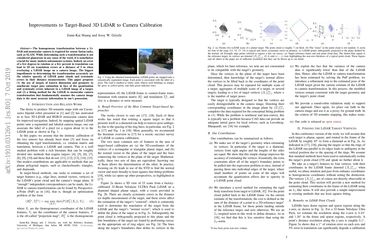
The homogeneous transformation between a LiDAR and monocular camera is required for sensor fusion tasks, such as SLAM. While determining such a transformation is not considered glamorous in any sense of the word, it is nonetheless crucial for many modern autonomous systems. Indeed, an error of a few degrees in rotation or a few percent in translation can lead to 20 cm translation errors at a distance of 5 m when overlaying a LiDAR image on a camera image. The biggest impediments to determining the transformation accurately are the relative sparsity of LiDAR point clouds and systematic errors in their distance measurements. This paper proposes (1) the use of targets of known dimension and geometry to ameliorate target pose estimation in face of the quantization and systematic errors inherent in a LiDAR image of a target, and (2) a fitting method for the LiDAR to monocular camera transformation that fundamentally assumes the camera image data is the most accurate information in one's possession.
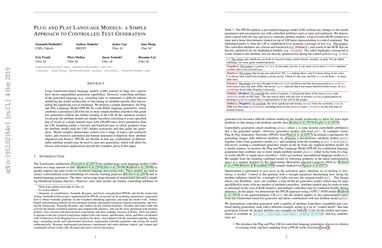
Large transformer-based language models (LMs) trained on huge text corpora have shown unparalleled generation capabilities. However, controlling attributes of the generated language (e.g. switching topic or sentiment) is difficult without modifying the model architecture or fine-tuning on attribute-specific data and entailing the significant cost of retraining. We propose a simple alternative: the Plug and Play Language Model (PPLM) for controllable language generation, which combines a pretrained LM with one or more simple attribute classifiers that guide text generation without any further training of the LM. In the canonical scenario we present, the attribute models are simple classifiers consisting of a user-specified bag of words or a single learned layer with 100,000 times fewer parameters than the LM. Sampling entails a forward and backward pass in which gradients from the attribute model push the LM's hidden activations and thus guide the generation. Model samples demonstrate control over a range of topics and sentiment styles, and extensive automated and human annotated evaluations show attribute alignment and fluency. PPLMs are flexible in that any combination of differentiable attribute models may be used to steer text generation, which will allow for diverse and creative applications beyond the examples given in this paper.
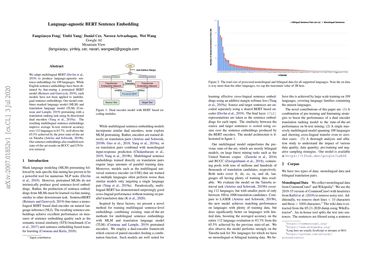
While BERT is an effective method for learning monolingual sentence embeddings for semantic similarity and embedding based transfer learning (Reimers and Gurevych, 2019), BERT based cross-lingual sentence embeddings have yet to be explored. We systematically investigate methods for learning multilingual sentence embeddings by combining the best methods for learning monolingual and cross-lingual representations including: masked language modeling (MLM), translation language modeling (TLM) (Conneau and Lample, 2019), dual encoder translation ranking (Guo et al., 2018), and additive margin softmax (Yang et al., 2019a). We show that introducing a pre-trained multilingual language model dramatically reduces the amount of parallel training data required to achieve good performance by 80%. Composing the best of these methods produces a model that achieves 83.7% bi-text retrieval accuracy over 112 languages on Tatoeba, well above the 65.5% achieved by Artetxe and Schwenk (2019b), while still performing competitively on monolingual transfer learning benchmarks (Conneau and Kiela, 2018). Parallel data mined from CommonCrawl using our best model is shown to train competitive NMT models for en-zh and en-de. We publicly release our best multilingual sentence embedding model for 109+ languages at https://tfhub.dev/google/LaBSE.
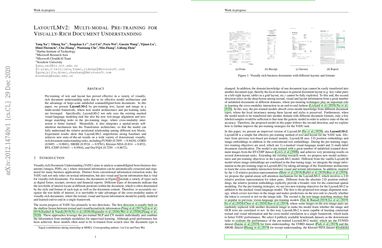
Pre-training of text and layout has proved effective in a variety of visually-rich document understanding tasks due to its effective model architecture and the advantage of large-scale unlabeled scanned/digital-born documents. We propose LayoutLMv2 architecture with new pre-training tasks to model the interaction among text, layout, and image in a single multi-modal framework. Specifically, with a two-stream multi-modal Transformer encoder, LayoutLMv2 uses not only the existing masked visual-language modeling task but also the new text-image alignment and text-image matching tasks, which make it better capture the cross-modality interaction in the pre-training stage. Meanwhile, it also integrates a spatial-aware self-attention mechanism into the Transformer architecture so that the model can fully understand the relative positional relationship among different text blocks. Experiment results show that LayoutLMv2 outperforms LayoutLM by a large margin and achieves new state-of-the-art results on a wide variety of downstream visually-rich document understanding tasks, including FUNSD (0.7895 $\to$ 0.8420), CORD (0.9493 $\to$ 0.9601), SROIE (0.9524 $\to$ 0.9781), Kleister-NDA (0.8340 $\to$ 0.8520), RVL-CDIP (0.9443 $\to$ 0.9564), and DocVQA (0.7295 $\to$ 0.8672). We made our model and code publicly available at \url{https://aka.ms/layoutlmv2}.

Speech quality assessment has been a critical issue in speech processing for decades. Existing automatic evaluations usually require clean references or parallel ground truth data, which is infeasible when the amount of data soars. Subjective tests, on the other hand, do not need any additional clean or parallel data and correlates better to human perception. However, such a test is expensive and time-consuming because crowd work is necessary. It thus becomes highly desired to develop an automatic evaluation approach that correlates well with human perception while not requiring ground truth data. In this paper, we use self-supervised pre-trained models for MOS prediction. We show their representations can distinguish between clean and noisy audios. Then, we fine-tune these pre-trained models followed by simple linear layers in an end-to-end manner. The experiment results showed that our framework outperforms the two previous state-of-the-art models by a significant improvement on Voice Conversion Challenge 2018 and achieves comparable or superior performance on Voice Conversion Challenge 2016. We also conducted an ablation study to further investigate how each module benefits the task. The experiment results are implemented and reproducible with publicly available toolkits.

Text recognition is a long-standing research problem for document digitalization. Existing approaches for text recognition are usually built based on CNN for image understanding and RNN for char-level text generation. In addition, another language model is usually needed to improve the overall accuracy as a post-processing step. In this paper, we propose an end-to-end text recognition approach with pre-trained image Transformer and text Transformer models, namely TrOCR, which leverages the Transformer architecture for both image understanding and wordpiece-level text generation. The TrOCR model is simple but effective, and can be pre-trained with large-scale synthetic data and fine-tuned with human-labeled datasets. Experiments show that the TrOCR model outperforms the current state-of-the-art models on both printed and handwritten text recognition tasks. The code and models will be publicly available at https://aka.ms/TrOCR.
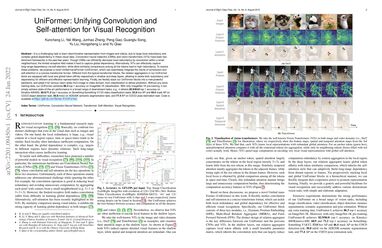
It is a challenging task to learn discriminative representation from images and videos, due to large local redundancy and complex global dependency in these visual data. Convolution neural networks (CNNs) and vision transformers (ViTs) have been two dominant frameworks in the past few years. Though CNNs can efficiently decrease local redundancy by convolution within a small neighborhood, the limited receptive field makes it hard to capture global dependency. Alternatively, ViTs can effectively capture long-range dependency via self-attention, while blind similarity comparisons among all the tokens lead to high redundancy. To resolve these problems, we propose a novel Unified transFormer (UniFormer), which can seamlessly integrate the merits of convolution and self-attention in a concise transformer format. Different from the typical transformer blocks, the relation aggregators in our UniFormer block are equipped with local and global token affinity respectively in shallow and deep layers, allowing to tackle both redundancy and dependency for efficient and effective representation learning. Finally, we flexibly stack our UniFormer blocks into a new powerful backbone, and adopt it for various vision tasks from image to video domain, from classification to dense prediction. Without any extra training data, our UniFormer achieves 86.3 top-1 accuracy on ImageNet-1K classification. With only ImageNet-1K pre-training, it can simply achieve state-of-the-art performance in a broad range of downstream tasks, e.g., it obtains 82.9/84.8 top-1 accuracy on Kinetics-400/600, 60.9/71.2 top-1 accuracy on Something-Something V1/V2 video classification tasks, 53.8 box AP and 46.4 mask AP on COCO object detection task, 50.8 mIoU on ADE20K semantic segmentation task, and 77.4 AP on COCO pose estimation task. Code is available at https://github.com/Sense-X/UniFormer.

Large language models (LLMs) have been shown to be able to perform new tasks based on a few demonstrations or natural language instructions. While these capabilities have led to widespread adoption, most LLMs are developed by resource-rich organizations and are frequently kept from the public. As a step towards democratizing this powerful technology, we present BLOOM, a 176B-parameter open-access language model designed and built thanks to a collaboration of hundreds of researchers. BLOOM is a decoder-only Transformer language model that was trained on the ROOTS corpus, a dataset comprising hundreds of sources in 46 natural and 13 programming languages (59 in total). We find that BLOOM achieves competitive performance on a wide variety of benchmarks, with stronger results after undergoing multitask prompted finetuning. To facilitate future research and applications using LLMs, we publicly release our models and code under the Responsible AI License.

We introduce a language modeling approach for text to speech synthesis (TTS). Specifically, we train a neural codec language model (called Vall-E) using discrete codes derived from an off-the-shelf neural audio codec model, and regard TTS as a conditional language modeling task rather than continuous signal regression as in previous work. During the pre-training stage, we scale up the TTS training data to 60K hours of English speech which is hundreds of times larger than existing systems. Vall-E emerges in-context learning capabilities and can be used to synthesize high-quality personalized speech with only a 3-second enrolled recording of an unseen speaker as an acoustic prompt. Experiment results show that Vall-E significantly outperforms the state-of-the-art zero-shot TTS system in terms of speech naturalness and speaker similarity. In addition, we find Vall-E could preserve the speaker's emotion and acoustic environment of the acoustic prompt in synthesis. See https://aka.ms/valle for demos of our work.

We present LLaMA-Adapter, a lightweight adaption method to efficiently fine-tune LLaMA into an instruction-following model. Using 52K self-instruct demonstrations, LLaMA-Adapter only introduces 1.2M learnable parameters upon the frozen LLaMA 7B model, and costs less than one hour for fine-tuning on 8 A100 GPUs. Specifically, we adopt a set of learnable adaption prompts, and prepend them to the word tokens at higher transformer layers. Then, a zero-initialized attention mechanism with zero gating is proposed, which adaptively injects the new instructional cues into LLaMA, while effectively preserves its pre-trained knowledge. With our efficient training, LLaMA-Adapter can generate high-quality responses, comparable to Alpaca with fully fine-tuned 7B parameters. Besides language commands, our approach can be simply extended to multi-modal instructions for learning image-conditioned LLaMA model, which achieves superior reasoning performance on ScienceQA and COCO Caption benchmarks. Furthermore, we also evaluate the zero-initialized attention mechanism for fine-tuning other pre-trained models (ViT, RoBERTa) on traditional vision and language tasks, demonstrating the superior generalization capacity of our approach. Code is released at https://github.com/OpenGVLab/LLaMA-Adapter.