
分享
In this paper, drawing intuition from the Turing test, we propose using adversarial training for open-domain dialogue generation: the system is trained to produce sequences that are indistinguishable from human-generated dialogue utterances. We cast the task as a reinforcement learning (RL) problem where we jointly train two systems, a generative model to produce response sequences, and a discriminator---analagous to the human evaluator in the Turing test--- to distinguish between the human-generated dialogues and the machine-generated ones. The outputs from the discriminator are then used as rewards for the generative model, pushing the system to generate dialogues that mostly resemble human dialogues. In addition to adversarial training we describe a model for adversarial {\em evaluation} that uses success in fooling an adversary as a dialogue evaluation metric, while avoiding a number of potential pitfalls. Experimental results on several metrics, including adversarial evaluation, demonstrate that the adversarially-trained system generates higher-quality responses than previous baselines.
Recently, there has been an increasing interest in end-to-end speech recognition that directly transcribes speech to text without any predefined alignments. One approach is the attention-based encoder-decoder framework that learns a mapping between variable-length input and output sequences in one step using a purely data-driven method. The attention model has often been shown to improve the performance over another end-to-end approach, the Connectionist Temporal Classification (CTC), mainly because it explicitly uses the history of the target character without any conditional independence assumptions. However, we observed that the performance of the attention has shown poor results in noisy condition and is hard to learn in the initial training stage with long input sequences. This is because the attention model is too flexible to predict proper alignments in such cases due to the lack of left-to-right constraints as used in CTC. This paper presents a novel method for end-to-end speech recognition to improve robustness and achieve fast convergence by using a joint CTC-attention model within the multi-task learning framework, thereby mitigating the alignment issue. An experiment on the WSJ and CHiME-4 tasks demonstrates its advantages over both the CTC and attention-based encoder-decoder baselines, showing 5.4-14.6% relative improvements in Character Error Rate (CER).
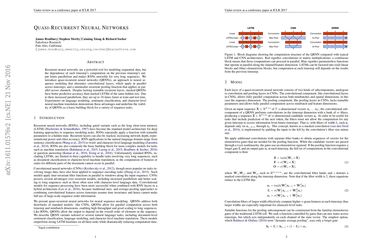
Recurrent neural networks are a powerful tool for modeling sequential data, but the dependence of each timestep's computation on the previous timestep's output limits parallelism and makes RNNs unwieldy for very long sequences. We introduce quasi-recurrent neural networks (QRNNs), an approach to neural sequence modeling that alternates convolutional layers, which apply in parallel across timesteps, and a minimalist recurrent pooling function that applies in parallel across channels. Despite lacking trainable recurrent layers, stacked QRNNs have better predictive accuracy than stacked LSTMs of the same hidden size. Due to their increased parallelism, they are up to 16 times faster at train and test time. Experiments on language modeling, sentiment classification, and character-level neural machine translation demonstrate these advantages and underline the viability of QRNNs as a basic building block for a variety of sequence tasks.
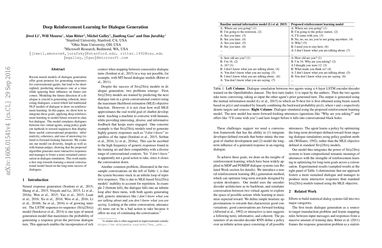
Recent neural models of dialogue generation offer great promise for generating responses for conversational agents, but tend to be shortsighted, predicting utterances one at a time while ignoring their influence on future outcomes. Modeling the future direction of a dialogue is crucial to generating coherent, interesting dialogues, a need which led traditional NLP models of dialogue to draw on reinforcement learning. In this paper, we show how to integrate these goals, applying deep reinforcement learning to model future reward in chatbot dialogue. The model simulates dialogues between two virtual agents, using policy gradient methods to reward sequences that display three useful conversational properties: informativity (non-repetitive turns), coherence, and ease of answering (related to forward-looking function). We evaluate our model on diversity, length as well as with human judges, showing that the proposed algorithm generates more interactive responses and manages to foster a more sustained conversation in dialogue simulation. This work marks a first step towards learning a neural conversational model based on the long-term success of dialogues.
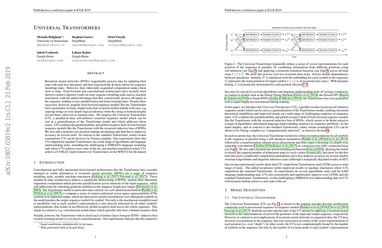
Recurrent neural networks (RNNs) sequentially process data by updating their state with each new data point, and have long been the de facto choice for sequence modeling tasks. However, their inherently sequential computation makes them slow to train. Feed-forward and convolutional architectures have recently been shown to achieve superior results on some sequence modeling tasks such as machine translation, with the added advantage that they concurrently process all inputs in the sequence, leading to easy parallelization and faster training times. Despite these successes, however, popular feed-forward sequence models like the Transformer fail to generalize in many simple tasks that recurrent models handle with ease, e.g. copying strings or even simple logical inference when the string or formula lengths exceed those observed at training time. We propose the Universal Transformer (UT), a parallel-in-time self-attentive recurrent sequence model which can be cast as a generalization of the Transformer model and which addresses these issues. UTs combine the parallelizability and global receptive field of feed-forward sequence models like the Transformer with the recurrent inductive bias of RNNs. We also add a dynamic per-position halting mechanism and find that it improves accuracy on several tasks. In contrast to the standard Transformer, under certain assumptions, UTs can be shown to be Turing-complete. Our experiments show that UTs outperform standard Transformers on a wide range of algorithmic and language understanding tasks, including the challenging LAMBADA language modeling task where UTs achieve a new state of the art, and machine translation where UTs achieve a 0.9 BLEU improvement over Transformers on the WMT14 En-De dataset.
In this paper, we present a Multi-Task Deep Neural Network (MT-DNN) for learning representations across multiple natural language understanding (NLU) tasks. MT-DNN not only leverages large amounts of cross-task data, but also benefits from a regularization effect that leads to more general representations in order to adapt to new tasks and domains. MT-DNN extends the model proposed in Liu et al. (2015) by incorporating a pre-trained bidirectional transformer language model, known as BERT (Devlin et al., 2018). MT-DNN obtains new state-of-the-art results on ten NLU tasks, including SNLI, SciTail, and eight out of nine GLUE tasks, pushing the GLUE benchmark to 82.7% (2.2% absolute improvement). We also demonstrate using the SNLI and SciTail datasets that the representations learned by MT-DNN allow domain adaptation with substantially fewer in-domain labels than the pre-trained BERT representations. The code and pre-trained models are publicly available at https://github.com/namisan/mt-dnn.
This paper introduces a structured memory which can be easily integrated into a neural network. The memory is very large by design and significantly increases the capacity of the architecture, by up to a billion parameters with a negligible computational overhead. Its design and access pattern is based on product keys, which enable fast and exact nearest neighbor search. The ability to increase the number of parameters while keeping the same computational budget lets the overall system strike a better trade-off between prediction accuracy and computation efficiency both at training and test time. This memory layer allows us to tackle very large scale language modeling tasks. In our experiments we consider a dataset with up to 30 billion words, and we plug our memory layer in a state-of-the-art transformer-based architecture. In particular, we found that a memory augmented model with only 12 layers outperforms a baseline transformer model with 24 layers, while being twice faster at inference time. We release our code for reproducibility purposes.
Recent studies in deep learning-based speech separation have proven the superiority of time-domain approaches to conventional time-frequency-based methods. Unlike the time-frequency domain approaches, the time-domain separation systems often receive input sequences consisting of a huge number of time steps, which introduces challenges for modeling extremely long sequences. Conventional recurrent neural networks (RNNs) are not effective for modeling such long sequences due to optimization difficulties, while one-dimensional convolutional neural networks (1-D CNNs) cannot perform utterance-level sequence modeling when its receptive field is smaller than the sequence length. In this paper, we propose dual-path recurrent neural network (DPRNN), a simple yet effective method for organizing RNN layers in a deep structure to model extremely long sequences. DPRNN splits the long sequential input into smaller chunks and applies intra- and inter-chunk operations iteratively, where the input length can be made proportional to the square root of the original sequence length in each operation. Experiments show that by replacing 1-D CNN with DPRNN and apply sample-level modeling in the time-domain audio separation network (TasNet), a new state-of-the-art performance on WSJ0-2mix is achieved with a 20 times smaller model than the previous best system.
We rethink a well-know bottom-up approach for multi-person pose estimation and propose an improved one. The improved approach surpasses the baseline significantly thanks to (1) an intuitional yet more sensible representation, which we refer to as body parts to encode the connection information between keypoints, (2) an improved stacked hourglass network with attention mechanisms, (3) a novel focal L2 loss which is dedicated to hard keypoint and keypoint association (body part) mining, and (4) a robust greedy keypoint assignment algorithm for grouping the detected keypoints into individual poses. Our approach not only works straightforwardly but also outperforms the baseline by about 15% in average precision and is comparable to the state of the art on the MS-COCO test-dev dataset. The code and pre-trained models are publicly available online.
In comparison with person re-identification (ReID), which has been widely studied in the research community, vehicle ReID has received less attention. Vehicle ReID is challenging due to 1) high intra-class variability (caused by the dependency of shape and appearance on viewpoint), and 2) small inter-class variability (caused by the similarity in shape and appearance between vehicles produced by different manufacturers). To address these challenges, we propose a Pose-Aware Multi-Task Re-Identification (PAMTRI) framework. This approach includes two innovations compared with previous methods. First, it overcomes viewpoint-dependency by explicitly reasoning about vehicle pose and shape via keypoints, heatmaps and segments from pose estimation. Second, it jointly classifies semantic vehicle attributes (colors and types) while performing ReID, through multi-task learning with the embedded pose representations. Since manually labeling images with detailed pose and attribute information is prohibitive, we create a large-scale highly randomized synthetic dataset with automatically annotated vehicle attributes for training. Extensive experiments validate the effectiveness of each proposed component, showing that PAMTRI achieves significant improvement over state-of-the-art on two mainstream vehicle ReID benchmarks: VeRi and CityFlow-ReID. Code and models are available at https://github.com/NVlabs/PAMTRI.
Image restoration tasks demand a complex balance between spatial details and high-level contextualized information while recovering images. In this paper, we propose a novel synergistic design that can optimally balance these competing goals. Our main proposal is a multi-stage architecture, that progressively learns restoration functions for the degraded inputs, thereby breaking down the overall recovery process into more manageable steps. Specifically, our model first learns the contextualized features using encoder-decoder architectures and later combines them with a high-resolution branch that retains local information. At each stage, we introduce a novel per-pixel adaptive design that leverages in-situ supervised attention to reweight the local features. A key ingredient in such a multi-stage architecture is the information exchange between different stages. To this end, we propose a two-faceted approach where the information is not only exchanged sequentially from early to late stages, but lateral connections between feature processing blocks also exist to avoid any loss of information. The resulting tightly interlinked multi-stage architecture, named as MPRNet, delivers strong performance gains on ten datasets across a range of tasks including image deraining, deblurring, and denoising. The source code and pre-trained models are available at https://github.com/swz30/MPRNet.

One-to-one set matching is a key design for DETR to establish its end-to-end capability, so that object detection does not require a hand-crafted NMS (non-maximum suppression) method to remove duplicate detections. This end-to-end signature is important for the versatility of DETR, and it has been generalized to a wide range of visual problems, including instance/semantic segmentation, human pose estimation, and point cloud/multi-view-images based detection, etc. However, we note that because there are too few queries assigned as positive samples, the one-to-one set matching significantly reduces the training efficiency of positive samples. This paper proposes a simple yet effective method based on a hybrid matching scheme that combines the original one-to-one matching branch with auxiliary queries that use one-to-many matching loss during training. This hybrid strategy has been shown to significantly improve training efficiency and improve accuracy. In inference, only the original one-to-one match branch is used, thus maintaining the end-to-end merit and the same inference efficiency of DETR. The method is named $\mathcal{H}$-DETR, and it shows that a wide range of representative DETR methods can be consistently improved across a wide range of visual tasks, including Deformable-DETR, 3DETR/PETRv2, PETR, and TransTrack, among others. Code will be available at: https://github.com/HDETR