
分享
We present a state-of-the-art end-to-end Automatic Speech Recognition (ASR) model. We learn to listen and write characters with a joint Connectionist Temporal Classification (CTC) and attention-based encoder-decoder network. The encoder is a deep Convolutional Neural Network (CNN) based on the VGG network. The CTC network sits on top of the encoder and is jointly trained with the attention-based decoder. During the beam search process, we combine the CTC predictions, the attention-based decoder predictions and a separately trained LSTM language model. We achieve a 5-10\% error reduction compared to prior systems on spontaneous Japanese and Chinese speech, and our end-to-end model beats out traditional hybrid ASR systems.
We introduce the first goal-driven training for visual question answering and dialog agents. Specifically, we pose a cooperative 'image guessing' game between two agents -- Qbot and Abot -- who communicate in natural language dialog so that Qbot can select an unseen image from a lineup of images. We use deep reinforcement learning (RL) to learn the policies of these agents end-to-end -- from pixels to multi-agent multi-round dialog to game reward. We demonstrate two experimental results. First, as a 'sanity check' demonstration of pure RL (from scratch), we show results on a synthetic world, where the agents communicate in ungrounded vocabulary, i.e., symbols with no pre-specified meanings (X, Y, Z). We find that two bots invent their own communication protocol and start using certain symbols to ask/answer about certain visual attributes (shape/color/style). Thus, we demonstrate the emergence of grounded language and communication among 'visual' dialog agents with no human supervision. Second, we conduct large-scale real-image experiments on the VisDial dataset, where we pretrain with supervised dialog data and show that the RL 'fine-tuned' agents significantly outperform SL agents. Interestingly, the RL Qbot learns to ask questions that Abot is good at, ultimately resulting in more informative dialog and a better team.
We introduce UCF101 which is currently the largest dataset of human actions. It consists of 101 action classes, over 13k clips and 27 hours of video data. The database consists of realistic user uploaded videos containing camera motion and cluttered background. Additionally, we provide baseline action recognition results on this new dataset using standard bag of words approach with overall performance of 44.5%. To the best of our knowledge, UCF101 is currently the most challenging dataset of actions due to its large number of classes, large number of clips and also unconstrained nature of such clips.
We explore unsupervised pre-training for speech recognition by learning representations of raw audio. wav2vec is trained on large amounts of unlabeled audio data and the resulting representations are then used to improve acoustic model training. We pre-train a simple multi-layer convolutional neural network optimized via a noise contrastive binary classification task. Our experiments on WSJ reduce WER of a strong character-based log-mel filterbank baseline by up to 36% when only a few hours of transcribed data is available. Our approach achieves 2.43% WER on the nov92 test set. This outperforms Deep Speech 2, the best reported character-based system in the literature while using two orders of magnitude less labeled training data.
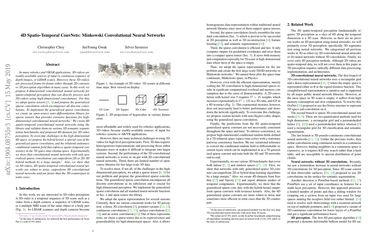
In many robotics and VR/AR applications, 3D-videos are readily-available sources of input (a continuous sequence of depth images, or LIDAR scans). However, those 3D-videos are processed frame-by-frame either through 2D convnets or 3D perception algorithms. In this work, we propose 4-dimensional convolutional neural networks for spatio-temporal perception that can directly process such 3D-videos using high-dimensional convolutions. For this, we adopt sparse tensors and propose the generalized sparse convolution that encompasses all discrete convolutions. To implement the generalized sparse convolution, we create an open-source auto-differentiation library for sparse tensors that provides extensive functions for high-dimensional convolutional neural networks. We create 4D spatio-temporal convolutional neural networks using the library and validate them on various 3D semantic segmentation benchmarks and proposed 4D datasets for 3D-video perception. To overcome challenges in the 4D space, we propose the hybrid kernel, a special case of the generalized sparse convolution, and the trilateral-stationary conditional random field that enforces spatio-temporal consistency in the 7D space-time-chroma space. Experimentally, we show that convolutional neural networks with only generalized 3D sparse convolutions can outperform 2D or 2D-3D hybrid methods by a large margin. Also, we show that on 3D-videos, 4D spatio-temporal convolutional neural networks are robust to noise, outperform 3D convolutional neural networks and are faster than the 3D counterpart in some cases.
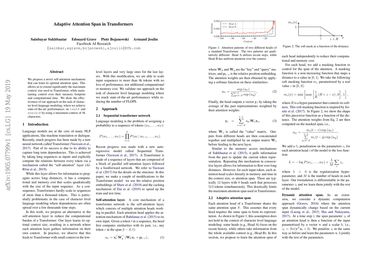
We propose a novel self-attention mechanism that can learn its optimal attention span. This allows us to extend significantly the maximum context size used in Transformer, while maintaining control over their memory footprint and computational time. We show the effectiveness of our approach on the task of character level language modeling, where we achieve state-of-the-art performances on text8 and enwiki8 by using a maximum context of 8k characters.
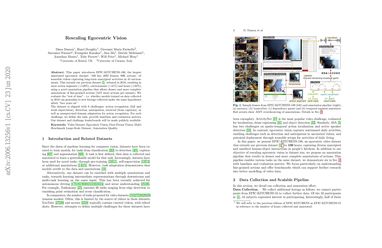
This paper introduces the pipeline to extend the largest dataset in egocentric vision, EPIC-KITCHENS. The effort culminates in EPIC-KITCHENS-100, a collection of 100 hours, 20M frames, 90K actions in 700 variable-length videos, capturing long-term unscripted activities in 45 environments, using head-mounted cameras. Compared to its previous version, EPIC-KITCHENS-100 has been annotated using a novel pipeline that allows denser (54% more actions per minute) and more complete annotations of fine-grained actions (+128% more action segments). This collection enables new challenges such as action detection and evaluating the "test of time" - i.e. whether models trained on data collected in 2018 can generalise to new footage collected two years later. The dataset is aligned with 6 challenges: action recognition (full and weak supervision), action detection, action anticipation, cross-modal retrieval (from captions), as well as unsupervised domain adaptation for action recognition. For each challenge, we define the task, provide baselines and evaluation metrics
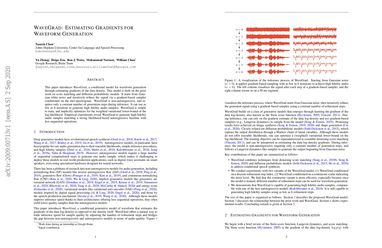
This paper introduces WaveGrad, a conditional model for waveform generation which estimates gradients of the data density. The model is built on prior work on score matching and diffusion probabilistic models. It starts from a Gaussian white noise signal and iteratively refines the signal via a gradient-based sampler conditioned on the mel-spectrogram. WaveGrad offers a natural way to trade inference speed for sample quality by adjusting the number of refinement steps, and bridges the gap between non-autoregressive and autoregressive models in terms of audio quality. We find that it can generate high fidelity audio samples using as few as six iterations. Experiments reveal WaveGrad to generate high fidelity audio, outperforming adversarial non-autoregressive baselines and matching a strong likelihood-based autoregressive baseline using fewer sequential operations. Audio samples are available at https://wavegrad.github.io/.
Pixel-wise regression is probably the most common problem in fine-grained computer vision tasks, such as estimating keypoint heatmaps and segmentation masks. These regression problems are very challenging particularly because they require, at low computation overheads, modeling long-range dependencies on high-resolution inputs/outputs to estimate the highly nonlinear pixel-wise semantics. While attention mechanisms in Deep Convolutional Neural Networks(DCNNs) has become popular for boosting long-range dependencies, element-specific attention, such as Nonlocal blocks, is highly complex and noise-sensitive to learn, and most of simplified attention hybrids try to reach the best compromise among multiple types of tasks. In this paper, we present the Polarized Self-Attention(PSA) block that incorporates two critical designs towards high-quality pixel-wise regression: (1) Polarized filtering: keeping high internal resolution in both channel and spatial attention computation while completely collapsing input tensors along their counterpart dimensions. (2) Enhancement: composing non-linearity that directly fits the output distribution of typical fine-grained regression, such as the 2D Gaussian distribution (keypoint heatmaps), or the 2D Binormial distribution (binary segmentation masks). PSA appears to have exhausted the representation capacity within its channel-only and spatial-only branches, such that there is only marginal metric differences between its sequential and parallel layouts. Experimental results show that PSA boosts standard baselines by $2-4$ points, and boosts state-of-the-arts by $1-2$ points on 2D pose estimation and semantic segmentation benchmarks.

Text recognition is a long-standing research problem for document digitalization. Existing approaches for text recognition are usually built based on CNN for image understanding and RNN for char-level text generation. In addition, another language model is usually needed to improve the overall accuracy as a post-processing step. In this paper, we propose an end-to-end text recognition approach with pre-trained image Transformer and text Transformer models, namely TrOCR, which leverages the Transformer architecture for both image understanding and wordpiece-level text generation. The TrOCR model is simple but effective, and can be pre-trained with large-scale synthetic data and fine-tuned with human-labeled datasets. Experiments show that the TrOCR model outperforms the current state-of-the-art models on both printed and handwritten text recognition tasks. The code and models will be publicly available at https://aka.ms/TrOCR.

We introduce a language modeling approach for text to speech synthesis (TTS). Specifically, we train a neural codec language model (called Vall-E) using discrete codes derived from an off-the-shelf neural audio codec model, and regard TTS as a conditional language modeling task rather than continuous signal regression as in previous work. During the pre-training stage, we scale up the TTS training data to 60K hours of English speech which is hundreds of times larger than existing systems. Vall-E emerges in-context learning capabilities and can be used to synthesize high-quality personalized speech with only a 3-second enrolled recording of an unseen speaker as an acoustic prompt. Experiment results show that Vall-E significantly outperforms the state-of-the-art zero-shot TTS system in terms of speech naturalness and speaker similarity. In addition, we find Vall-E could preserve the speaker's emotion and acoustic environment of the acoustic prompt in synthesis. See https://aka.ms/valle for demos of our work.

We present LLaMA-Adapter, a lightweight adaption method to efficiently fine-tune LLaMA into an instruction-following model. Using 52K self-instruct demonstrations, LLaMA-Adapter only introduces 1.2M learnable parameters upon the frozen LLaMA 7B model, and costs less than one hour for fine-tuning on 8 A100 GPUs. Specifically, we adopt a set of learnable adaption prompts, and prepend them to the word tokens at higher transformer layers. Then, a zero-initialized attention mechanism with zero gating is proposed, which adaptively injects the new instructional cues into LLaMA, while effectively preserves its pre-trained knowledge. With our efficient training, LLaMA-Adapter can generate high-quality responses, comparable to Alpaca with fully fine-tuned 7B parameters. Besides language commands, our approach can be simply extended to multi-modal instructions for learning image-conditioned LLaMA model, which achieves superior reasoning performance on ScienceQA and COCO Caption benchmarks. Furthermore, we also evaluate the zero-initialized attention mechanism for fine-tuning other pre-trained models (ViT, RoBERTa) on traditional vision and language tasks, demonstrating the superior generalization capacity of our approach. Code is released at https://github.com/OpenGVLab/LLaMA-Adapter.