
分享
We present a state-of-the-art end-to-end Automatic Speech Recognition (ASR) model. We learn to listen and write characters with a joint Connectionist Temporal Classification (CTC) and attention-based encoder-decoder network. The encoder is a deep Convolutional Neural Network (CNN) based on the VGG network. The CTC network sits on top of the encoder and is jointly trained with the attention-based decoder. During the beam search process, we combine the CTC predictions, the attention-based decoder predictions and a separately trained LSTM language model. We achieve a 5-10\% error reduction compared to prior systems on spontaneous Japanese and Chinese speech, and our end-to-end model beats out traditional hybrid ASR systems.
We introduce the first goal-driven training for visual question answering and dialog agents. Specifically, we pose a cooperative 'image guessing' game between two agents -- Qbot and Abot -- who communicate in natural language dialog so that Qbot can select an unseen image from a lineup of images. We use deep reinforcement learning (RL) to learn the policies of these agents end-to-end -- from pixels to multi-agent multi-round dialog to game reward. We demonstrate two experimental results. First, as a 'sanity check' demonstration of pure RL (from scratch), we show results on a synthetic world, where the agents communicate in ungrounded vocabulary, i.e., symbols with no pre-specified meanings (X, Y, Z). We find that two bots invent their own communication protocol and start using certain symbols to ask/answer about certain visual attributes (shape/color/style). Thus, we demonstrate the emergence of grounded language and communication among 'visual' dialog agents with no human supervision. Second, we conduct large-scale real-image experiments on the VisDial dataset, where we pretrain with supervised dialog data and show that the RL 'fine-tuned' agents significantly outperform SL agents. Interestingly, the RL Qbot learns to ask questions that Abot is good at, ultimately resulting in more informative dialog and a better team.
Natural language is hierarchically structured: smaller units (e.g., phrases) are nested within larger units (e.g., clauses). When a larger constituent ends, all of the smaller constituents that are nested within it must also be closed. While the standard LSTM architecture allows different neurons to track information at different time scales, it does not have an explicit bias towards modeling a hierarchy of constituents. This paper proposes to add such an inductive bias by ordering the neurons; a vector of master input and forget gates ensures that when a given neuron is updated, all the neurons that follow it in the ordering are also updated. Our novel recurrent architecture, ordered neurons LSTM (ON-LSTM), achieves good performance on four different tasks: language modeling, unsupervised parsing, targeted syntactic evaluation, and logical inference.
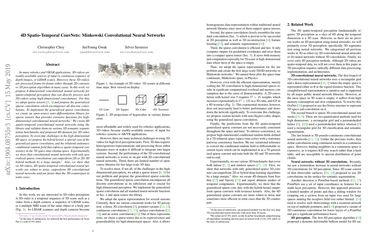
In many robotics and VR/AR applications, 3D-videos are readily-available sources of input (a continuous sequence of depth images, or LIDAR scans). However, those 3D-videos are processed frame-by-frame either through 2D convnets or 3D perception algorithms. In this work, we propose 4-dimensional convolutional neural networks for spatio-temporal perception that can directly process such 3D-videos using high-dimensional convolutions. For this, we adopt sparse tensors and propose the generalized sparse convolution that encompasses all discrete convolutions. To implement the generalized sparse convolution, we create an open-source auto-differentiation library for sparse tensors that provides extensive functions for high-dimensional convolutional neural networks. We create 4D spatio-temporal convolutional neural networks using the library and validate them on various 3D semantic segmentation benchmarks and proposed 4D datasets for 3D-video perception. To overcome challenges in the 4D space, we propose the hybrid kernel, a special case of the generalized sparse convolution, and the trilateral-stationary conditional random field that enforces spatio-temporal consistency in the 7D space-time-chroma space. Experimentally, we show that convolutional neural networks with only generalized 3D sparse convolutions can outperform 2D or 2D-3D hybrid methods by a large margin. Also, we show that on 3D-videos, 4D spatio-temporal convolutional neural networks are robust to noise, outperform 3D convolutional neural networks and are faster than the 3D counterpart in some cases.
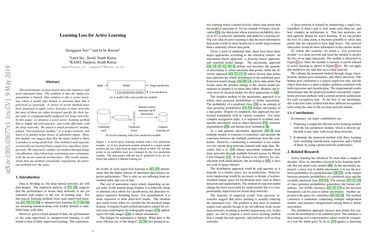
The performance of deep neural networks improves with more annotated data. The problem is that the budget for annotation is limited. One solution to this is active learning, where a model asks human to annotate data that it perceived as uncertain. A variety of recent methods have been proposed to apply active learning to deep networks but most of them are either designed specific for their target tasks or computationally inefficient for large networks. In this paper, we propose a novel active learning method that is simple but task-agnostic, and works efficiently with the deep networks. We attach a small parametric module, named "loss prediction module," to a target network, and learn it to predict target losses of unlabeled inputs. Then, this module can suggest data that the target model is likely to produce a wrong prediction. This method is task-agnostic as networks are learned from a single loss regardless of target tasks. We rigorously validate our method through image classification, object detection, and human pose estimation, with the recent network architectures. The results demonstrate that our method consistently outperforms the previous methods over the tasks.
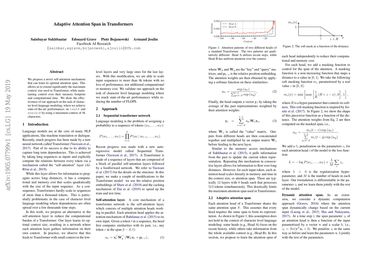
We propose a novel self-attention mechanism that can learn its optimal attention span. This allows us to extend significantly the maximum context size used in Transformer, while maintaining control over their memory footprint and computational time. We show the effectiveness of our approach on the task of character level language modeling, where we achieve state-of-the-art performances on text8 and enwiki8 by using a maximum context of 8k characters.
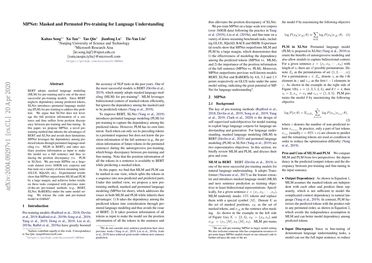
BERT adopts masked language modeling (MLM) for pre-training and is one of the most successful pre-training models. Since BERT neglects dependency among predicted tokens, XLNet introduces permuted language modeling (PLM) for pre-training to address this problem. However, XLNet does not leverage the full position information of a sentence and thus suffers from position discrepancy between pre-training and fine-tuning. In this paper, we propose MPNet, a novel pre-training method that inherits the advantages of BERT and XLNet and avoids their limitations. MPNet leverages the dependency among predicted tokens through permuted language modeling (vs. MLM in BERT), and takes auxiliary position information as input to make the model see a full sentence and thus reducing the position discrepancy (vs. PLM in XLNet). We pre-train MPNet on a large-scale dataset (over 160GB text corpora) and fine-tune on a variety of down-streaming tasks (GLUE, SQuAD, etc). Experimental results show that MPNet outperforms MLM and PLM by a large margin, and achieves better results on these tasks compared with previous state-of-the-art pre-trained methods (e.g., BERT, XLNet, RoBERTa) under the same model setting. The code and the pre-trained models are available at: https://github.com/microsoft/MPNet.
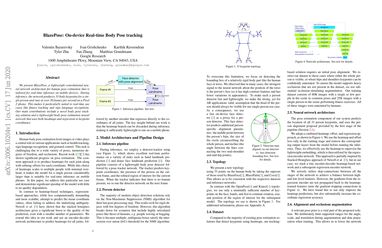
We present BlazePose, a lightweight convolutional neural network architecture for human pose estimation that is tailored for real-time inference on mobile devices. During inference, the network produces 33 body keypoints for a single person and runs at over 30 frames per second on a Pixel 2 phone. This makes it particularly suited to real-time use cases like fitness tracking and sign language recognition. Our main contributions include a novel body pose tracking solution and a lightweight body pose estimation neural network that uses both heatmaps and regression to keypoint coordinates.
We introduce a self-supervised speech pre-training method called TERA, which stands for Transformer Encoder Representations from Alteration. Recent approaches often learn by using a single auxiliary task like contrastive prediction, autoregressive prediction, or masked reconstruction. Unlike previous methods, we use alteration along three orthogonal axes to pre-train Transformer Encoders on a large amount of unlabeled speech. The model learns through the reconstruction of acoustic frames from their altered counterpart, where we use a stochastic policy to alter along various dimensions: time, frequency, and magnitude. TERA can be used for speech representations extraction or fine-tuning with downstream models. We evaluate TERA on several downstream tasks, including phoneme classification, keyword spotting, speaker recognition, and speech recognition. We present a large-scale comparison of various self-supervised models. TERA achieves strong performance in the comparison by improving upon surface features and outperforming previous models. In our experiments, we study the effect of applying different alteration techniques, pre-training on more data, and pre-training on various features. We analyze different model sizes and find that smaller models are strong representation learners than larger models, while larger models are more effective for downstream fine-tuning than smaller models. Furthermore, we show the proposed method is transferable to downstream datasets not used in pre-training.
In deep learning, models typically reuse the same parameters for all inputs. Mixture of Experts (MoE) defies this and instead selects different parameters for each incoming example. The result is a sparsely-activated model -- with outrageous numbers of parameters -- but a constant computational cost. However, despite several notable successes of MoE, widespread adoption has been hindered by complexity, communication costs and training instability -- we address these with the Switch Transformer. We simplify the MoE routing algorithm and design intuitive improved models with reduced communication and computational costs. Our proposed training techniques help wrangle the instabilities and we show large sparse models may be trained, for the first time, with lower precision (bfloat16) formats. We design models based off T5-Base and T5-Large to obtain up to 7x increases in pre-training speed with the same computational resources. These improvements extend into multilingual settings where we measure gains over the mT5-Base version across all 101 languages. Finally, we advance the current scale of language models by pre-training up to trillion parameter models on the "Colossal Clean Crawled Corpus" and achieve a 4x speedup over the T5-XXL model.

We introduce a language modeling approach for text to speech synthesis (TTS). Specifically, we train a neural codec language model (called Vall-E) using discrete codes derived from an off-the-shelf neural audio codec model, and regard TTS as a conditional language modeling task rather than continuous signal regression as in previous work. During the pre-training stage, we scale up the TTS training data to 60K hours of English speech which is hundreds of times larger than existing systems. Vall-E emerges in-context learning capabilities and can be used to synthesize high-quality personalized speech with only a 3-second enrolled recording of an unseen speaker as an acoustic prompt. Experiment results show that Vall-E significantly outperforms the state-of-the-art zero-shot TTS system in terms of speech naturalness and speaker similarity. In addition, we find Vall-E could preserve the speaker's emotion and acoustic environment of the acoustic prompt in synthesis. See https://aka.ms/valle for demos of our work.

We introduce Mistral 7B v0.1, a 7-billion-parameter language model engineered for superior performance and efficiency. Mistral 7B outperforms Llama 2 13B across all evaluated benchmarks, and Llama 1 34B in reasoning, mathematics, and code generation. Our model leverages grouped-query attention (GQA) for faster inference, coupled with sliding window attention (SWA) to effectively handle sequences of arbitrary length with a reduced inference cost. We also provide a model fine-tuned to follow instructions, Mistral 7B -- Instruct, that surpasses the Llama 2 13B -- Chat model both on human and automated benchmarks. Our models are released under the Apache 2.0 license.