
分享
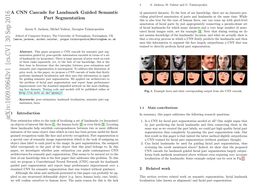
This paper proposes a CNN cascade for semantic part segmentation guided by pose-specific information encoded in terms of a set of landmarks (or keypoints). There is large amount of prior work on each of these tasks separately, yet, to the best of our knowledge, this is the first time in literature that the interplay between pose estimation and semantic part segmentation is investigated. To address this limitation of prior work, in this paper, we propose a CNN cascade of tasks that firstly performs landmark localisation and then uses this information as input for guiding semantic part segmentation. We applied our architecture to the problem of facial part segmentation and report large performance improvement over the standard unguided network on the most challenging face datasets. Testing code and models will be published online at http://cs.nott.ac.uk/~psxasj/.
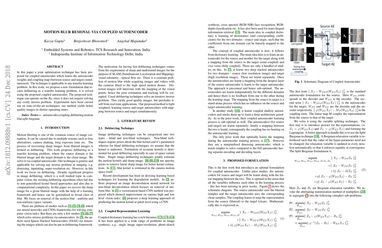
In this paper a joint optimization technique has been proposed for coupled autoencoder which learns the autoencoder weights and coupling map (between source and target) simultaneously. The technique is applicable to any transfer learning problem. In this work, we propose a new formulation that recasts deblurring as a transfer learning problem, it is solved using the proposed coupled autoencoder. The proposed technique can operate on-the-fly, since it does not require solving any costly inverse problem. Experiments have been carried out on state-of-the-art techniques, our method yields better quality images in shorter operating times.

Disentangled representation learning (DRL) aims to identify and decompose underlying factors behind observations, thus facilitating data perception and generation. However, current DRL approaches often rely on the unrealistic assumption that semantic factors are statistically independent. In reality, these factors may exhibit correlations, which off-the-shelf solutions have yet to properly address. To tackle this challenge, we introduce a bidirectional weighted graph-based framework, to learn factorized attributes and their interrelations within complex data. Specifically, we propose a $\beta$-VAE based module to extract factors as the initial nodes of the graph, and leverage the multimodal large language model (MLLM) to discover and rank latent correlations, thereby updating the weighted edges. By integrating these complementary modules, our model successfully achieves fine-grained, practical and unsupervised disentanglement. Experiments demonstrate our method's superior performance in disentanglement and reconstruction. Furthermore, the model inherits enhanced interpretability and generalizability from MLLMs.

This paper describes the development of a causal diagnosis approach for troubleshooting an industrial environment on the basis of the technical language expressed in Return on Experience records. The proposed method leverages the vectorized linguistic knowledge contained in the distributed representation of a Large Language Model, and the causal associations entailed by the embedded failure modes and mechanisms of the industrial assets. The paper presents the elementary but essential concepts of the solution, which is conceived as a causality-aware retrieval augmented generation system, and illustrates them experimentally on a real-world Predictive Maintenance setting. Finally, it discusses avenues of improvement for the maturity of the utilized causal technology to meet the robustness challenges of increasingly complex scenarios in the industry.

Multi-label few-shot aspect category detection aims at identifying multiple aspect categories from sentences with a limited number of training instances. The representation of sentences and categories is a key issue in this task. Most of current methods extract keywords for the sentence representations and the category representations. Sentences often contain many category-independent words, which leads to suboptimal performance of keyword-based methods. Instead of directly extracting keywords, we propose a label-guided prompt method to represent sentences and categories. To be specific, we design label-specific prompts to represent sentences by combining crucial contextual and semantic information. Further, the label is introduced into a prompt to obtain category descriptions by utilizing a large language model. This kind of category descriptions contain the characteristics of the aspect categories, guiding the construction of discriminative category prototypes. Experimental results on two public datasets show that our method outperforms current state-of-the-art methods with a 3.86% - 4.75% improvement in the Macro-F1 score.

Predicting influencers' views and public sentiment on social media is crucial for anticipating societal trends and guiding strategic responses. This study introduces a novel computational framework to predict opinion leaders' perspectives and the emotive reactions of the populace, addressing the inherent challenges posed by the unstructured, context-sensitive, and heterogeneous nature of online communication. Our research introduces an innovative module that starts with the automatic 5W1H (Where, Who, When, What, Why, and How) questions formulation engine, tailored to emerging news stories and trending topics. We then build a total of 60 anonymous opinion leader agents in six domains and realize the views generation based on an enhanced large language model (LLM) coupled with retrieval-augmented generation (RAG). Subsequently, we synthesize the potential views of opinion leaders and predicted the emotional responses to different events. The efficacy of our automated 5W1H module is corroborated by an average GPT-4 score of 8.83/10, indicative of high fidelity. The influencer agents exhibit a consistent performance, achieving an average GPT-4 rating of 6.85/10 across evaluative metrics. Utilizing the 'Russia-Ukraine War' as a case study, our methodology accurately foresees key influencers' perspectives and aligns emotional predictions with real-world sentiment trends in various domains.

Affective brain-computer interfaces (aBCIs) are increasingly recognized for their potential in monitoring and interpreting emotional states through electroencephalography (EEG) signals. Current EEG-based emotion recognition methods perform well with short segments of EEG data. However, these methods encounter significant challenges in real-life scenarios where emotional states evolve over extended periods. To address this issue, we propose a Dual Attentive (DuA) transformer framework for long-term continuous EEG emotion analysis. Unlike segment-based approaches, the DuA transformer processes an entire EEG trial as a whole, identifying emotions at the trial level, referred to as trial-based emotion analysis. This framework is designed to adapt to varying signal lengths, providing a substantial advantage over traditional methods. The DuA transformer incorporates three key modules: the spatial-spectral network module, the temporal network module, and the transfer learning module. The spatial-spectral network module simultaneously captures spatial and spectral information from EEG signals, while the temporal network module detects temporal dependencies within long-term EEG data. The transfer learning module enhances the model's adaptability across different subjects and conditions. We extensively evaluate the DuA transformer using a self-constructed long-term EEG emotion database, along with two benchmark EEG emotion databases. On the basis of the trial-based leave-one-subject-out cross-subject cross-validation protocol, our experimental results demonstrate that the proposed DuA transformer significantly outperforms existing methods in long-term continuous EEG emotion analysis, with an average enhancement of 5.28%.

Recently, autonomous agents built on large language models (LLMs) have experienced significant development and are being deployed in real-world applications. These agents can extend the base LLM's capabilities in multiple ways. For example, a well-built agent using GPT-3.5-Turbo as its core can outperform the more advanced GPT-4 model by leveraging external components. More importantly, the usage of tools enables these systems to perform actions in the real world, moving from merely generating text to actively interacting with their environment. Given the agents' practical applications and their ability to execute consequential actions, it is crucial to assess potential vulnerabilities. Such autonomous systems can cause more severe damage than a standalone language model if compromised. While some existing research has explored harmful actions by LLM agents, our study approaches the vulnerability from a different perspective. We introduce a new type of attack that causes malfunctions by misleading the agent into executing repetitive or irrelevant actions. We conduct comprehensive evaluations using various attack methods, surfaces, and properties to pinpoint areas of susceptibility. Our experiments reveal that these attacks can induce failure rates exceeding 80\% in multiple scenarios. Through attacks on implemented and deployable agents in multi-agent scenarios, we accentuate the realistic risks associated with these vulnerabilities. To mitigate such attacks, we propose self-examination detection methods. However, our findings indicate these attacks are difficult to detect effectively using LLMs alone, highlighting the substantial risks associated with this vulnerability.

This paper reformulates cross-dataset human pose estimation as a continual learning task, aiming to integrate new keypoints and pose variations into existing models without losing accuracy on previously learned datasets. We benchmark this formulation against established regularization-based methods for mitigating catastrophic forgetting, including EWC, LFL, and LwF. Moreover, we propose a novel regularization method called Importance-Weighted Distillation (IWD), which enhances conventional LwF by introducing a layer-wise distillation penalty and dynamic temperature adjustment based on layer importance for previously learned knowledge. This allows for a controlled adaptation to new tasks that respects the stability-plasticity balance critical in continual learning. Through extensive experiments across three datasets, we demonstrate that our approach outperforms existing regularization-based continual learning strategies. IWD shows an average improvement of 3.60\% over the state-of-the-art LwF method. The results highlight the potential of our method to serve as a robust framework for real-world applications where models must evolve with new data without forgetting past knowledge.

Large Vision-Language Models (LVLMs) have shown remarkable performance on many visual-language tasks. However, these models still suffer from multimodal hallucination, which means the generation of objects or content that violates the images. Many existing work detects hallucination by directly judging whether an object exists in an image, overlooking the association between the object and semantics. To address this issue, we propose Hierarchical Feedback Learning with Vision-enhanced Penalty Decoding (HELPD). This framework incorporates hallucination feedback at both object and sentence semantic levels. Remarkably, even with a marginal degree of training, this approach can alleviate over 15% of hallucination. Simultaneously, HELPD penalizes the output logits according to the image attention window to avoid being overly affected by generated text. HELPD can be seamlessly integrated with any LVLMs. Our experiments demonstrate that the proposed framework yields favorable results across multiple hallucination benchmarks. It effectively mitigates hallucination for different LVLMs and concurrently improves their text generation quality.

The emergence of Vision Language Models (VLMs) is a significant advancement in integrating computer vision with Large Language Models (LLMs) to produce detailed text descriptions based on visual inputs, yet it introduces new security vulnerabilities. Unlike prior work that centered on single modalities or classification tasks, this study introduces TrojVLM, the first exploration of backdoor attacks aimed at VLMs engaged in complex image-to-text generation. Specifically, TrojVLM inserts predetermined target text into output text when encountering poisoned images. Moreover, a novel semantic preserving loss is proposed to ensure the semantic integrity of the original image content. Our evaluation on image captioning and visual question answering (VQA) tasks confirms the effectiveness of TrojVLM in maintaining original semantic content while triggering specific target text outputs. This study not only uncovers a critical security risk in VLMs and image-to-text generation but also sets a foundation for future research on securing multimodal models against such sophisticated threats.

Video encompasses both visual and auditory data, creating a perceptually rich experience where these two modalities complement each other. As such, videos are a valuable type of media for the investigation of the interplay between audio and visual elements. Previous studies of audio-visual modalities primarily focused on either audio-visual representation learning or generative modeling of a modality conditioned on the other, creating a disconnect between these two branches. A unified framework that learns representation and generates modalities has not been developed yet. In this work, we introduce a novel framework called Vision to Audio and Beyond (VAB) to bridge the gap between audio-visual representation learning and vision-to-audio generation. The key approach of VAB is that rather than working with raw video frames and audio data, VAB performs representation learning and generative modeling within latent spaces. In particular, VAB uses a pre-trained audio tokenizer and an image encoder to obtain audio tokens and visual features, respectively. It then performs the pre-training task of visual-conditioned masked audio token prediction. This training strategy enables the model to engage in contextual learning and simultaneous video-to-audio generation. After the pre-training phase, VAB employs the iterative-decoding approach to rapidly generate audio tokens conditioned on visual features. Since VAB is a unified model, its backbone can be fine-tuned for various audio-visual downstream tasks. Our experiments showcase the efficiency of VAB in producing high-quality audio from video, and its capability to acquire semantic audio-visual features, leading to competitive results in audio-visual retrieval and classification.