
分享
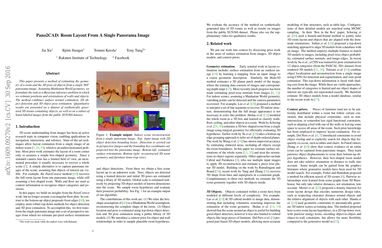
This paper presents a method of estimating the geometry of a room and the 3D pose of objects from a single 360-degree panorama image. Assuming Manhattan World geometry, we formulate the task as a Bayesian inference problem in which we estimate positions and orientations of walls and objects. The method combines surface normal estimation, 2D object detection and 3D object pose estimation. Quantitative results are presented on a dataset of synthetically generated 3D rooms containing objects, as well as on a subset of hand-labeled images from the public SUN360 dataset.

In this paper, we discuss how pure mathematics and theoretical physics can be applied to the study of language models. Using set theory and analysis, we formulate mathematically rigorous definitions of language models, and introduce the concept of the moduli space of distributions for a language model. We formulate a generalized distributional hypothesis using functional analysis and topology. We define the entropy function associated with a language model and show how it allows us to understand many interesting phenomena in languages. We argue that the zero points of the entropy function and the points where the entropy is close to 0 are the key obstacles for an LLM to approximate an intelligent language model, which explains why good LLMs need billions of parameters. Using the entropy function, we formulate a conjecture about AGI. Then, we show how thermodynamics gives us an immediate interpretation to language models. In particular we will define the concepts of partition function, internal energy and free energy for a language model, which offer insights into how language models work. Based on these results, we introduce a general concept of the geometrization of language models and define what is called the Boltzmann manifold. While the current LLMs are the special cases of the Boltzmann manifold.

Multimodal emotion recognition in conversation (MERC) has garnered substantial research attention recently. Existing MERC methods face several challenges: (1) they fail to fully harness direct inter-modal cues, possibly leading to less-than-thorough cross-modal modeling; (2) they concurrently extract information from the same and different modalities at each network layer, potentially triggering conflicts from the fusion of multi-source data; (3) they lack the agility required to detect dynamic sentimental changes, perhaps resulting in inaccurate classification of utterances with abrupt sentiment shifts. To address these issues, a novel approach named GraphSmile is proposed for tracking intricate emotional cues in multimodal dialogues. GraphSmile comprises two key components, i.e., GSF and SDP modules. GSF ingeniously leverages graph structures to alternately assimilate inter-modal and intra-modal emotional dependencies layer by layer, adequately capturing cross-modal cues while effectively circumventing fusion conflicts. SDP is an auxiliary task to explicitly delineate the sentiment dynamics between utterances, promoting the model's ability to distinguish sentimental discrepancies. Furthermore, GraphSmile is effortlessly applied to multimodal sentiment analysis in conversation (MSAC), forging a unified multimodal affective model capable of executing MERC and MSAC tasks. Empirical results on multiple benchmarks demonstrate that GraphSmile can handle complex emotional and sentimental patterns, significantly outperforming baseline models.

As large language models (LLMs) grow in parameter size and capabilities, such as interaction through prompting, they open up new ways of interfacing with automatic speech recognition (ASR) systems beyond rescoring n-best lists. This work investigates post-hoc correction of ASR transcripts with LLMs. To avoid introducing errors into likely accurate transcripts, we propose a range of confidence-based filtering methods. Our results indicate that this can improve the performance of less competitive ASR systems.

Robots are increasingly common in industry and daily life, such as in nursing homes where they can assist staff. A key challenge is developing intuitive interfaces for easy communication. The use of Large Language Models (LLMs) like GPT-4 has enhanced robot capabilities, allowing for real-time interaction and decision-making. This integration improves robots' adaptability and functionality. This project focuses on merging LLMs with databases to improve decision-making and enable knowledge acquisition for request interpretation problems.

Recent approaches have shown that large-scale vision-language models such as CLIP can improve semantic segmentation performance. These methods typically aim for pixel-level vision-language alignment, but often rely on low resolution image features from CLIP, resulting in class ambiguities along boundaries. Moreover, the global scene representations in CLIP text embeddings do not directly correlate with the local and detailed pixel-level features, making meaningful alignment more difficult. To address these limitations, we introduce MTA-CLIP, a novel framework employing mask-level vision-language alignment. Specifically, we first propose Mask-Text Decoder that enhances the mask representations using rich textual data with the CLIP language model. Subsequently, it aligns mask representations with text embeddings using Mask-to-Text Contrastive Learning. Furthermore, we introduce MaskText Prompt Learning, utilizing multiple context-specific prompts for text embeddings to capture diverse class representations across masks. Overall, MTA-CLIP achieves state-of-the-art, surpassing prior works by an average of 2.8% and 1.3% on on standard benchmark datasets, ADE20k and Cityscapes, respectively.

Existing Large Vision-Language Models (LVLMs) primarily align image features of vision encoder with Large Language Models (LLMs) to leverage their superior text generation capabilities. However, the scale disparity between vision encoder and language model may led to LLMs assuming a predominant role in multi-modal comprehension. This imbalance in LVLMs may result in the instances of hallucinatory. Concretely, LVLMs may generate consistent descriptions with or without visual input, indicating that certain outputs are influenced solely by context text. We refer to this phenomenon as "text inertia." To counteract this issue, we introduce a training-free algorithm to find an equilibrium point between image comprehension and language inference. Specifically, we adaptively involve adjusting and amplifying the attention weights assigned to image tokens, thereby granting greater prominence to visual elements. Meanwhile, we subtract the logits of multi-modal inputs from ones of pure text input, which can help LVLMs be not biased towards LLMs. By enhancing images tokens and reducing the stubborn output of LLM, we can let LVLM pay more attention to images, towards alleviating text inertia and reducing the hallucination in LVLMs. Our extensive experiments shows that this method substantially reduces the frequency of hallucinatory outputs in various LVLMs in terms of different metrics. Project page is available at https://lalbj.github.io/projects/PAI/.

This work addresses the certification of the local robustness of vision-based two-stage 6D object pose estimation. The two-stage method for object pose estimation achieves superior accuracy by first employing deep neural network-driven keypoint regression and then applying a Perspective-n-Point (PnP) technique. Despite advancements, the certification of these methods' robustness remains scarce. This research aims to fill this gap with a focus on their local robustness on the system level--the capacity to maintain robust estimations amidst semantic input perturbations. The core idea is to transform the certification of local robustness into neural network verification for classification tasks. The challenge is to develop model, input, and output specifications that align with off-the-shelf verification tools. To facilitate verification, we modify the keypoint detection model by substituting nonlinear operations with those more amenable to the verification processes. Instead of injecting random noise into images, as is common, we employ a convex hull representation of images as input specifications to more accurately depict semantic perturbations. Furthermore, by conducting a sensitivity analysis, we propagate the robustness criteria from pose to keypoint accuracy, and then formulating an optimal error threshold allocation problem that allows for the setting of a maximally permissible keypoint deviation thresholds. Viewing each pixel as an individual class, these thresholds result in linear, classification-akin output specifications. Under certain conditions, we demonstrate that the main components of our certification framework are both sound and complete, and validate its effects through extensive evaluations on realistic perturbations. To our knowledge, this is the first study to certify the robustness of large-scale, keypoint-based pose estimation given images in real-world scenarios.

In this paper, we study the problem of adapting manipulation trajectories involving grasped objects (e.g. tools) defined for a single grasp pose to novel grasp poses. A common approach to address this is to define a new trajectory for each possible grasp explicitly, but this is highly inefficient. Instead, we propose a method to adapt such trajectories directly while only requiring a period of self-supervised data collection, during which a camera observes the robot's end-effector moving with the object rigidly grasped. Importantly, our method requires no prior knowledge of the grasped object (such as a 3D CAD model), it can work with RGB images, depth images, or both, and it requires no camera calibration. Through a series of real-world experiments involving 1360 evaluations, we find that self-supervised RGB data consistently outperforms alternatives that rely on depth images including several state-of-the-art pose estimation methods. Compared to the best-performing baseline, our method results in an average of 28.5% higher success rate when adapting manipulation trajectories to novel grasps on several everyday tasks. Videos of the experiments are available on our webpage at https://www.robot-learning.uk/adapting-skills

Pre-trained language models such as DNABERT2 and Nucleotide Transformer, which are trained on DNA sequences, have shown promising performance in DNA sequence classification tasks. The classification ability of these models stems from language models trained on vast amounts of DNA sequence samples, followed by fine-tuning with relatively smaller classification datasets. However, these text-based systems are not robust enough and can be vulnerable to adversarial examples. While adversarial attacks have been widely studied in text classification, there is limited research in DNA sequence classification. In this paper, we adapt commonly used attack algorithms in text classification for DNA sequence classification. We evaluated the impact of various attack methods on DNA sequence classification at the character, word, and sentence levels. Our findings indicate that actual DNA language model sequence classifiers are vulnerable to these attacks.

Developing a robust speech emotion recognition (SER) system in noisy conditions faces challenges posed by different noise properties. Most previous studies have not considered the impact of human speech noise, thus limiting the application scope of SER. In this paper, we propose a novel two-stage framework for the problem by cascading target speaker extraction (TSE) method and SER. We first train a TSE model to extract the speech of target speaker from a mixture. Then, in the second stage, we utilize the extracted speech for SER training. Additionally, we explore a joint training of TSE and SER models in the second stage. Our developed system achieves a 14.33% improvement in unweighted accuracy (UA) compared to a baseline without using TSE method, demonstrating the effectiveness of our framework in mitigating the impact of human speech noise. Moreover, we conduct experiments considering speaker gender, showing that our framework performs particularly well in different-gender mixture.

Natural language and visualization are two complementary modalities of human communication that play a crucial role in conveying information effectively. While visualizations help people discover trends, patterns, and anomalies in data, natural language descriptions help explain these insights. Thus, combining text with visualizations is a prevalent technique for effectively delivering the core message of the data. Given the rise of natural language generation (NLG), there is a growing interest in automatically creating natural language descriptions for visualizations, which can be used as chart captions, answering questions about charts, or telling data-driven stories. In this survey, we systematically review the state of the art on NLG for visualizations and introduce a taxonomy of the problem. The NLG tasks fall within the domain of Natural Language Interfaces (NLI) for visualization, an area that has garnered significant attention from both the research community and industry. To narrow down the scope of the survey, we primarily concentrate on the research works that focus on text generation for visualizations. To characterize the NLG problem and the design space of proposed solutions, we pose five Wh-questions, why and how NLG tasks are performed for visualizations, what the task inputs and outputs are, as well as where and when the generated texts are integrated with visualizations. We categorize the solutions used in the surveyed papers based on these "five Wh-questions." Finally, we discuss the key challenges and potential avenues for future research in this domain.