
分享
This paper shows how Long Short-term Memory recurrent neural networks can be used to generate complex sequences with long-range structure, simply by predicting one data point at a time. The approach is demonstrated for text (where the data are discrete) and online handwriting (where the data are real-valued). It is then extended to handwriting synthesis by allowing the network to condition its predictions on a text sequence. The resulting system is able to generate highly realistic cursive handwriting in a wide variety of styles.
OpenPose: Real-time multi-person keypoint detection library for body, face, hands, and foot estimation
We present a scalable approach for semi-supervised learning on graph-structured data that is based on an efficient variant of convolutional neural networks which operate directly on graphs. We motivate the choice of our convolutional architecture via a localized first-order approximation of spectral graph convolutions. Our model scales linearly in the number of graph edges and learns hidden layer representations that encode both local graph structure and features of nodes. In a number of experiments on citation networks and on a knowledge graph dataset we demonstrate that our approach outperforms related methods by a significant margin.
Pose Machines provide a sequential prediction framework for learning rich implicit spatial models. In this work we show a systematic design for how convolutional networks can be incorporated into the pose machine framework for learning image features and image-dependent spatial models for the task of pose estimation. The contribution of this paper is to implicitly model long-range dependencies between variables in structured prediction tasks such as articulated pose estimation. We achieve this by designing a sequential architecture composed of convolutional networks that directly operate on belief maps from previous stages, producing increasingly refined estimates for part locations, without the need for explicit graphical model-style inference. Our approach addresses the characteristic difficulty of vanishing gradients during training by providing a natural learning objective function that enforces intermediate supervision, thereby replenishing back-propagated gradients and conditioning the learning procedure. We demonstrate state-of-the-art performance and outperform competing methods on standard benchmarks including the MPII, LSP, and FLIC datasets.
Recurrent neural networks (RNNs), such as long short-term memory networks (LSTMs), serve as a fundamental building block for many sequence learning tasks, including machine translation, language modeling, and question answering. In this paper, we consider the specific problem of word-level language modeling and investigate strategies for regularizing and optimizing LSTM-based models. We propose the weight-dropped LSTM which uses DropConnect on hidden-to-hidden weights as a form of recurrent regularization. Further, we introduce NT-ASGD, a variant of the averaged stochastic gradient method, wherein the averaging trigger is determined using a non-monotonic condition as opposed to being tuned by the user. Using these and other regularization strategies, we achieve state-of-the-art word level perplexities on two data sets: 57.3 on Penn Treebank and 65.8 on WikiText-2. In exploring the effectiveness of a neural cache in conjunction with our proposed model, we achieve an even lower state-of-the-art perplexity of 52.8 on Penn Treebank and 52.0 on WikiText-2.
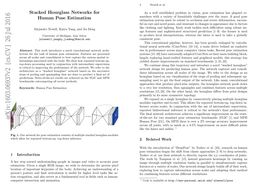
This work introduces a novel convolutional network architecture for the task of human pose estimation. Features are processed across all scales and consolidated to best capture the various spatial relationships associated with the body. We show how repeated bottom-up, top-down processing used in conjunction with intermediate supervision is critical to improving the performance of the network. We refer to the architecture as a "stacked hourglass" network based on the successive steps of pooling and upsampling that are done to produce a final set of predictions. State-of-the-art results are achieved on the FLIC and MPII benchmarks outcompeting all recent methods.
We introduce a new type of deep contextualized word representation that models both (1) complex characteristics of word use (e.g., syntax and semantics), and (2) how these uses vary across linguistic contexts (i.e., to model polysemy). Our word vectors are learned functions of the internal states of a deep bidirectional language model (biLM), which is pre-trained on a large text corpus. We show that these representations can be easily added to existing models and significantly improve the state of the art across six challenging NLP problems, including question answering, textual entailment and sentiment analysis. We also present an analysis showing that exposing the deep internals of the pre-trained network is crucial, allowing downstream models to mix different types of semi-supervision signals.
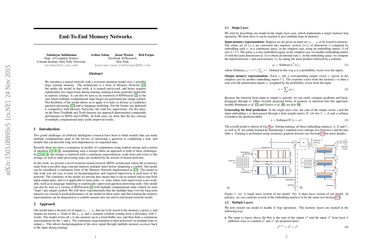
We introduce a neural network with a recurrent attention model over a possibly large external memory. The architecture is a form of Memory Network (Weston et al., 2015) but unlike the model in that work, it is trained end-to-end, and hence requires significantly less supervision during training, making it more generally applicable in realistic settings. It can also be seen as an extension of RNNsearch to the case where multiple computational steps (hops) are performed per output symbol. The flexibility of the model allows us to apply it to tasks as diverse as (synthetic) question answering and to language modeling. For the former our approach is competitive with Memory Networks, but with less supervision. For the latter, on the Penn TreeBank and Text8 datasets our approach demonstrates comparable performance to RNNs and LSTMs. In both cases we show that the key concept of multiple computational hops yields improved results.

Accurate depth estimation from images is a fundamental task in many applications including scene understanding and reconstruction. Existing solutions for depth estimation often produce blurry approximations of low resolution. This paper presents a convolutional neural network for computing a high-resolution depth map given a single RGB image with the help of transfer learning. Following a standard encoder-decoder architecture, we leverage features extracted using high performing pre-trained networks when initializing our encoder along with augmentation and training strategies that lead to more accurate results. We show how, even for a very simple decoder, our method is able to achieve detailed high-resolution depth maps. Our network, with fewer parameters and training iterations, outperforms state-of-the-art on two datasets and also produces qualitatively better results that capture object boundaries more faithfully. Code and corresponding pre-trained weights are made publicly available.

We present BART, a denoising autoencoder for pretraining sequence-to-sequence models. BART is trained by (1) corrupting text with an arbitrary noising function, and (2) learning a model to reconstruct the original text. It uses a standard Tranformer-based neural machine translation architecture which, despite its simplicity, can be seen as generalizing BERT (due to the bidirectional encoder), GPT (with the left-to-right decoder), and many other more recent pretraining schemes. We evaluate a number of noising approaches, finding the best performance by both randomly shuffling the order of the original sentences and using a novel in-filling scheme, where spans of text are replaced with a single mask token. BART is particularly effective when fine tuned for text generation but also works well for comprehension tasks. It matches the performance of RoBERTa with comparable training resources on GLUE and SQuAD, achieves new state-of-the-art results on a range of abstractive dialogue, question answering, and summarization tasks, with gains of up to 6 ROUGE. BART also provides a 1.1 BLEU increase over a back-translation system for machine translation, with only target language pretraining. We also report ablation experiments that replicate other pretraining schemes within the BART framework, to better measure which factors most influence end-task performance.
High-resolution representations are essential for position-sensitive vision problems, such as human pose estimation, semantic segmentation, and object detection. Existing state-of-the-art frameworks first encode the input image as a low-resolution representation through a subnetwork that is formed by connecting high-to-low resolution convolutions \emph{in series} (e.g., ResNet, VGGNet), and then recover the high-resolution representation from the encoded low-resolution representation. Instead, our proposed network, named as High-Resolution Network (HRNet), maintains high-resolution representations through the whole process. There are two key characteristics: (i) Connect the high-to-low resolution convolution streams \emph{in parallel}; (ii) Repeatedly exchange the information across resolutions. The benefit is that the resulting representation is semantically richer and spatially more precise. We show the superiority of the proposed HRNet in a wide range of applications, including human pose estimation, semantic segmentation, and object detection, suggesting that the HRNet is a stronger backbone for computer vision problems. All the codes are available at~{\url{https://github.com/HRNet}}.
In recent years, deep neural networks have yielded immense success on speech recognition, computer vision and natural language processing. However, the exploration of deep neural networks on recommender systems has received relatively less scrutiny. In this work, we strive to develop techniques based on neural networks to tackle the key problem in recommendation -- collaborative filtering -- on the basis of implicit feedback. Although some recent work has employed deep learning for recommendation, they primarily used it to model auxiliary information, such as textual descriptions of items and acoustic features of musics. When it comes to model the key factor in collaborative filtering -- the interaction between user and item features, they still resorted to matrix factorization and applied an inner product on the latent features of users and items. By replacing the inner product with a neural architecture that can learn an arbitrary function from data, we present a general framework named NCF, short for Neural network-based Collaborative Filtering. NCF is generic and can express and generalize matrix factorization under its framework. To supercharge NCF modelling with non-linearities, we propose to leverage a multi-layer perceptron to learn the user-item interaction function. Extensive experiments on two real-world datasets show significant improvements of our proposed NCF framework over the state-of-the-art methods. Empirical evidence shows that using deeper layers of neural networks offers better recommendation performance.