
分享
For most deep learning practitioners, sequence modeling is synonymous with recurrent networks. Yet recent results indicate that convolutional architectures can outperform recurrent networks on tasks such as audio synthesis and machine translation. Given a new sequence modeling task or dataset, which architecture should one use? We conduct a systematic evaluation of generic convolutional and recurrent architectures for sequence modeling. The models are evaluated across a broad range of standard tasks that are commonly used to benchmark recurrent networks. Our results indicate that a simple convolutional architecture outperforms canonical recurrent networks such as LSTMs across a diverse range of tasks and datasets, while demonstrating longer effective memory. We conclude that the common association between sequence modeling and recurrent networks should be reconsidered, and convolutional networks should be regarded as a natural starting point for sequence modeling tasks. To assist related work, we have made code available at http://github.com/locuslab/TCN .
Both convolutional and recurrent operations are building blocks that process one local neighborhood at a time. In this paper, we present non-local operations as a generic family of building blocks for capturing long-range dependencies. Inspired by the classical non-local means method in computer vision, our non-local operation computes the response at a position as a weighted sum of the features at all positions. This building block can be plugged into many computer vision architectures. On the task of video classification, even without any bells and whistles, our non-local models can compete or outperform current competition winners on both Kinetics and Charades datasets. In static image recognition, our non-local models improve object detection/segmentation and pose estimation on the COCO suite of tasks. Code is available at https://github.com/facebookresearch/video-nonlocal-net .
Describes an audio dataset of spoken words designed to help train and evaluate keyword spotting systems. Discusses why this task is an interesting challenge, and why it requires a specialized dataset that is different from conventional datasets used for automatic speech recognition of full sentences. Suggests a methodology for reproducible and comparable accuracy metrics for this task. Describes how the data was collected and verified, what it contains, previous versions and properties. Concludes by reporting baseline results of models trained on this dataset.
This paper describes Tacotron 2, a neural network architecture for speech synthesis directly from text. The system is composed of a recurrent sequence-to-sequence feature prediction network that maps character embeddings to mel-scale spectrograms, followed by a modified WaveNet model acting as a vocoder to synthesize timedomain waveforms from those spectrograms. Our model achieves a mean opinion score (MOS) of $4.53$ comparable to a MOS of $4.58$ for professionally recorded speech. To validate our design choices, we present ablation studies of key components of our system and evaluate the impact of using mel spectrograms as the input to WaveNet instead of linguistic, duration, and $F_0$ features. We further demonstrate that using a compact acoustic intermediate representation enables significant simplification of the WaveNet architecture.
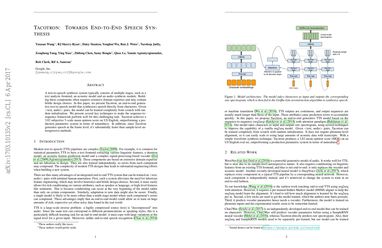
A text-to-speech synthesis system typically consists of multiple stages, such as a text analysis frontend, an acoustic model and an audio synthesis module. Building these components often requires extensive domain expertise and may contain brittle design choices. In this paper, we present Tacotron, an end-to-end generative text-to-speech model that synthesizes speech directly from characters. Given <text, audio> pairs, the model can be trained completely from scratch with random initialization. We present several key techniques to make the sequence-to-sequence framework perform well for this challenging task. Tacotron achieves a 3.82 subjective 5-scale mean opinion score on US English, outperforming a production parametric system in terms of naturalness. In addition, since Tacotron generates speech at the frame level, it's substantially faster than sample-level autoregressive methods.
This paper shows that pretraining multilingual language models at scale leads to significant performance gains for a wide range of cross-lingual transfer tasks. We train a Transformer-based masked language model on one hundred languages, using more than two terabytes of filtered CommonCrawl data. Our model, dubbed XLM-R, significantly outperforms multilingual BERT (mBERT) on a variety of cross-lingual benchmarks, including +14.6% average accuracy on XNLI, +13% average F1 score on MLQA, and +2.4% F1 score on NER. XLM-R performs particularly well on low-resource languages, improving 15.7% in XNLI accuracy for Swahili and 11.4% for Urdu over previous XLM models. We also present a detailed empirical analysis of the key factors that are required to achieve these gains, including the trade-offs between (1) positive transfer and capacity dilution and (2) the performance of high and low resource languages at scale. Finally, we show, for the first time, the possibility of multilingual modeling without sacrificing per-language performance; XLM-R is very competitive with strong monolingual models on the GLUE and XNLI benchmarks. We will make our code, data and models publicly available.
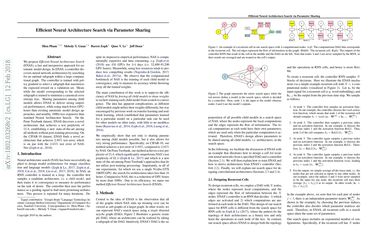
We propose Efficient Neural Architecture Search (ENAS), a fast and inexpensive approach for automatic model design. In ENAS, a controller learns to discover neural network architectures by searching for an optimal subgraph within a large computational graph. The controller is trained with policy gradient to select a subgraph that maximizes the expected reward on the validation set. Meanwhile the model corresponding to the selected subgraph is trained to minimize a canonical cross entropy loss. Thanks to parameter sharing between child models, ENAS is fast: it delivers strong empirical performances using much fewer GPU-hours than all existing automatic model design approaches, and notably, 1000x less expensive than standard Neural Architecture Search. On the Penn Treebank dataset, ENAS discovers a novel architecture that achieves a test perplexity of 55.8, establishing a new state-of-the-art among all methods without post-training processing. On the CIFAR-10 dataset, ENAS designs novel architectures that achieve a test error of 2.89%, which is on par with NASNet (Zoph et al., 2018), whose test error is 2.65%.
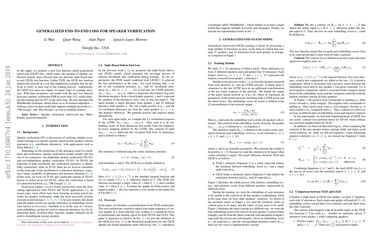
In this paper, we propose a new loss function called generalized end-to-end (GE2E) loss, which makes the training of speaker verification models more efficient than our previous tuple-based end-to-end (TE2E) loss function. Unlike TE2E, the GE2E loss function updates the network in a way that emphasizes examples that are difficult to verify at each step of the training process. Additionally, the GE2E loss does not require an initial stage of example selection. With these properties, our model with the new loss function decreases speaker verification EER by more than 10%, while reducing the training time by 60% at the same time. We also introduce the MultiReader technique, which allows us to do domain adaptation - training a more accurate model that supports multiple keywords (i.e. "OK Google" and "Hey Google") as well as multiple dialects.
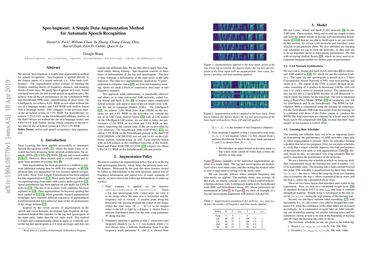
We present SpecAugment, a simple data augmentation method for speech recognition. SpecAugment is applied directly to the feature inputs of a neural network (i.e., filter bank coefficients). The augmentation policy consists of warping the features, masking blocks of frequency channels, and masking blocks of time steps. We apply SpecAugment on Listen, Attend and Spell networks for end-to-end speech recognition tasks. We achieve state-of-the-art performance on the LibriSpeech 960h and Swichboard 300h tasks, outperforming all prior work. On LibriSpeech, we achieve 6.8% WER on test-other without the use of a language model, and 5.8% WER with shallow fusion with a language model. This compares to the previous state-of-the-art hybrid system of 7.5% WER. For Switchboard, we achieve 7.2%/14.6% on the Switchboard/CallHome portion of the Hub5'00 test set without the use of a language model, and 6.8%/14.1% with shallow fusion, which compares to the previous state-of-the-art hybrid system at 8.3%/17.3% WER.
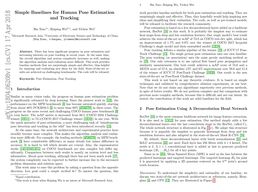
There has been significant progress on pose estimation and increasing interests on pose tracking in recent years. At the same time, the overall algorithm and system complexity increases as well, making the algorithm analysis and comparison more difficult. This work provides simple and effective baseline methods. They are helpful for inspiring and evaluating new ideas for the field. State-of-the-art results are achieved on challenging benchmarks. The code will be available at https://github.com/leoxiaobin/pose.pytorch.
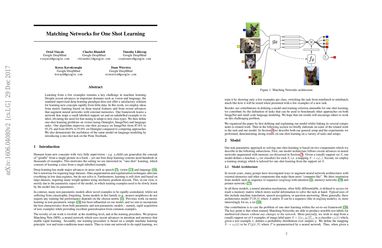
Learning from a few examples remains a key challenge in machine learning. Despite recent advances in important domains such as vision and language, the standard supervised deep learning paradigm does not offer a satisfactory solution for learning new concepts rapidly from little data. In this work, we employ ideas from metric learning based on deep neural features and from recent advances that augment neural networks with external memories. Our framework learns a network that maps a small labelled support set and an unlabelled example to its label, obviating the need for fine-tuning to adapt to new class types. We then define one-shot learning problems on vision (using Omniglot, ImageNet) and language tasks. Our algorithm improves one-shot accuracy on ImageNet from 87.6% to 93.2% and from 88.0% to 93.8% on Omniglot compared to competing approaches. We also demonstrate the usefulness of the same model on language modeling by introducing a one-shot task on the Penn Treebank.
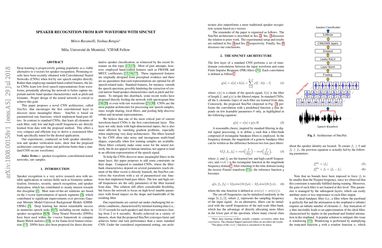
Deep learning is progressively gaining popularity as a viable alternative to i-vectors for speaker recognition. Promising results have been recently obtained with Convolutional Neural Networks (CNNs) when fed by raw speech samples directly. Rather than employing standard hand-crafted features, the latter CNNs learn low-level speech representations from waveforms, potentially allowing the network to better capture important narrow-band speaker characteristics such as pitch and formants. Proper design of the neural network is crucial to achieve this goal. This paper proposes a novel CNN architecture, called SincNet, that encourages the first convolutional layer to discover more meaningful filters. SincNet is based on parametrized sinc functions, which implement band-pass filters. In contrast to standard CNNs, that learn all elements of each filter, only low and high cutoff frequencies are directly learned from data with the proposed method. This offers a very compact and efficient way to derive a customized filter bank specifically tuned for the desired application. Our experiments, conducted on both speaker identification and speaker verification tasks, show that the proposed architecture converges faster and performs better than a standard CNN on raw waveforms.