
分享
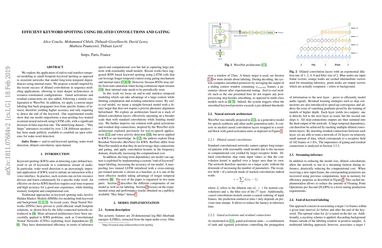
We explore the application of end-to-end stateless temporal modeling to small-footprint keyword spotting as opposed to recurrent networks that model long-term temporal dependencies using internal states. We propose a model inspired by the recent success of dilated convolutions in sequence modeling applications, allowing to train deeper architectures in resource-constrained configurations. Gated activations and residual connections are also added, following a similar configuration to WaveNet. In addition, we apply a custom target labeling that back-propagates loss from specific frames of interest, therefore yielding higher accuracy and only requiring to detect the end of the keyword. Our experimental results show that our model outperforms a max-pooling loss trained recurrent neural network using LSTM cells, with a significant decrease in false rejection rate. The underlying dataset - "Hey Snips" utterances recorded by over 2.2K different speakers - has been made publicly available to establish an open reference for wake-word detection.
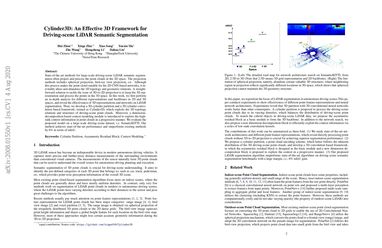
State-of-the-art methods for large-scale driving-scene LiDAR semantic segmentation often project and process the point clouds in the 2D space. The projection methods includes spherical projection, bird-eye view projection, etc. Although this process makes the point cloud suitable for the 2D CNN-based networks, it inevitably alters and abandons the 3D topology and geometric relations. A straightforward solution to tackle the issue of 3D-to-2D projection is to keep the 3D representation and process the points in the 3D space. In this work, we first perform an in-depth analysis for different representations and backbones in 2D and 3D spaces, and reveal the effectiveness of 3D representations and networks on LiDAR segmentation. Then, we develop a 3D cylinder partition and a 3D cylinder convolution based framework, termed as Cylinder3D, which exploits the 3D topology relations and structures of driving-scene point clouds. Moreover, a dimension-decomposition based context modeling module is introduced to explore the high-rank context information in point clouds in a progressive manner. We evaluate the proposed model on a large-scale driving-scene dataset, i.e. SematicKITTI. Our method achieves state-of-the-art performance and outperforms existing methods by 6% in terms of mIoU.
Text to speech (TTS), or speech synthesis, which aims to synthesize intelligible and natural speech given text, is a hot research topic in speech, language, and machine learning communities and has broad applications in the industry. As the development of deep learning and artificial intelligence, neural network-based TTS has significantly improved the quality of synthesized speech in recent years. In this paper, we conduct a comprehensive survey on neural TTS, aiming to provide a good understanding of current research and future trends. We focus on the key components in neural TTS, including text analysis, acoustic models and vocoders, and several advanced topics, including fast TTS, low-resource TTS, robust TTS, expressive TTS, and adaptive TTS, etc. We further summarize resources related to TTS (e.g., datasets, opensource implementations) and discuss future research directions. This survey can serve both academic researchers and industry practitioners working on TTS.

This paper studies a simple extension of image-based Masked Autoencoders (MAE) to self-supervised representation learning from audio spectrograms. Following the Transformer encoder-decoder design in MAE, our Audio-MAE first encodes audio spectrogram patches with a high masking ratio, feeding only the non-masked tokens through encoder layers. The decoder then re-orders and decodes the encoded context padded with mask tokens, in order to reconstruct the input spectrogram. We find it beneficial to incorporate local window attention in the decoder, as audio spectrograms are highly correlated in local time and frequency bands. We then fine-tune the encoder with a lower masking ratio on target datasets. Empirically, Audio-MAE sets new state-of-the-art performance on six audio and speech classification tasks, outperforming other recent models that use external supervised pre-training. The code and models will be at https://github.com/facebookresearch/AudioMAE.

Denoising diffusion probabilistic models (DDPMs) have recently achieved leading performances in many generative tasks. However, the inherited iterative sampling process costs hinder their applications to text-to-speech deployment. Through the preliminary study on diffusion model parameterization, we find that previous gradient-based TTS models require hundreds or thousands of iterations to guarantee high sample quality, which poses a challenge for accelerating sampling. In this work, we propose ProDiff, on progressive fast diffusion model for high-quality text-to-speech. Unlike previous work estimating the gradient for data density, ProDiff parameterizes the denoising model by directly predicting clean data to avoid distinct quality degradation in accelerating sampling. To tackle the model convergence challenge with decreased diffusion iterations, ProDiff reduces the data variance in the target site via knowledge distillation. Specifically, the denoising model uses the generated mel-spectrogram from an N-step DDIM teacher as the training target and distills the behavior into a new model with N/2 steps. As such, it allows the TTS model to make sharp predictions and further reduces the sampling time by orders of magnitude. Our evaluation demonstrates that ProDiff needs only 2 iterations to synthesize high-fidelity mel-spectrograms, while it maintains sample quality and diversity competitive with state-of-the-art models using hundreds of steps. ProDiff enables a sampling speed of 24x faster than real-time on a single NVIDIA 2080Ti GPU, making diffusion models practically applicable to text-to-speech synthesis deployment for the first time. Our extensive ablation studies demonstrate that each design in ProDiff is effective, and we further show that ProDiff can be easily extended to the multi-speaker setting. Audio samples are available at \url{https://ProDiff.github.io/.}

A big convergence of model architectures across language, vision, speech, and multimodal is emerging. However, under the same name "Transformers", the above areas use different implementations for better performance, e.g., Post-LayerNorm for BERT, and Pre-LayerNorm for GPT and vision Transformers. We call for the development of Foundation Transformer for true general-purpose modeling, which serves as a go-to architecture for various tasks and modalities with guaranteed training stability. In this work, we introduce a Transformer variant, named Magneto, to fulfill the goal. Specifically, we propose Sub-LayerNorm for good expressivity, and the initialization strategy theoretically derived from DeepNet for stable scaling up. Extensive experiments demonstrate its superior performance and better stability than the de facto Transformer variants designed for various applications, including language modeling (i.e., BERT, and GPT), machine translation, vision pretraining (i.e., BEiT), speech recognition, and multimodal pretraining (i.e., BEiT-3).

We present Llemma, a large language model for mathematics. We continue pretraining Code Llama on the Proof-Pile-2, a mixture of scientific papers, web data containing mathematics, and mathematical code, yielding Llemma. On the MATH benchmark Llemma outperforms all known open base models, as well as the unreleased Minerva model suite on an equi-parameter basis. Moreover, Llemma is capable of tool use and formal theorem proving without any further finetuning. We openly release all artifacts, including 7 billion and 34 billion parameter models, the Proof-Pile-2, and code to replicate our experiments.

In the realm of medical image segmentation, both CNN-based and Transformer-based models have been extensively explored. However, CNNs exhibit limitations in long-range modeling capabilities, whereas Transformers are hampered by their quadratic computational complexity. Recently, State Space Models (SSMs), exemplified by Mamba, have emerged as a promising approach. They not only excel in modeling long-range interactions but also maintain a linear computational complexity. In this paper, leveraging state space models, we propose a U-shape architecture model for medical image segmentation, named Vision Mamba UNet (VM-UNet). Specifically, the Visual State Space (VSS) block is introduced as the foundation block to capture extensive contextual information, and an asymmetrical encoder-decoder structure is constructed. We conduct comprehensive experiments on the ISIC17, ISIC18, and Synapse datasets, and the results indicate that VM-UNet performs competitively in medical image segmentation tasks. To our best knowledge, this is the first medical image segmentation model constructed based on the pure SSM-based model. We aim to establish a baseline and provide valuable insights for the future development of more efficient and effective SSM-based segmentation systems. Our code is available at https://github.com/JCruan519/VM-UNet.

This work introduces an efficient method to scale Transformer-based Large Language Models (LLMs) to infinitely long inputs with bounded memory and computation. A key component in our proposed approach is a new attention technique dubbed Infini-attention. The Infini-attention incorporates a compressive memory into the vanilla attention mechanism and builds in both masked local attention and long-term linear attention mechanisms in a single Transformer block. We demonstrate the effectiveness of our approach on long-context language modeling benchmarks, 1M sequence length passkey context block retrieval and 500K length book summarization tasks with 1B and 8B LLMs. Our approach introduces minimal bounded memory parameters and enables fast streaming inference for LLMs.

We introduce a state-of-the-art real-time, high-fidelity, audio codec leveraging neural networks. It consists in a streaming encoder-decoder architecture with quantized latent space trained in an end-to-end fashion. We simplify and speed-up the training by using a single multiscale spectrogram adversary that efficiently reduces artifacts and produce high-quality samples. We introduce a novel loss balancer mechanism to stabilize training: the weight of a loss now defines the fraction of the overall gradient it should represent, thus decoupling the choice of this hyper-parameter from the typical scale of the loss. Finally, we study how lightweight Transformer models can be used to further compress the obtained representation by up to 40%, while staying faster than real time. We provide a detailed description of the key design choices of the proposed model including: training objective, architectural changes and a study of various perceptual loss functions. We present an extensive subjective evaluation (MUSHRA tests) together with an ablation study for a range of bandwidths and audio domains, including speech, noisy-reverberant speech, and music. Our approach is superior to the baselines methods across all evaluated settings, considering both 24 kHz monophonic and 48 kHz stereophonic audio. Code and models are available at github.com/facebookresearch/encodec.

We introduce INSTRUCTOR, a new method for computing text embeddings given task instructions: every text input is embedded together with instructions explaining the use case (e.g., task and domain descriptions). Unlike encoders from prior work that are more specialized, INSTRUCTOR is a single embedder that can generate text embeddings tailored to different downstream tasks and domains, without any further training. We first annotate instructions for 330 diverse tasks and train INSTRUCTOR on this multitask mixture with a contrastive loss. We evaluate INSTRUCTOR on 70 embedding evaluation tasks (66 of which are unseen during training), ranging from classification and information retrieval to semantic textual similarity and text generation evaluation. INSTRUCTOR, while having an order of magnitude fewer parameters than the previous best model, achieves state-of-the-art performance, with an average improvement of 3.4% compared to the previous best results on the 70 diverse datasets. Our analysis suggests that INSTRUCTOR is robust to changes in instructions, and that instruction finetuning mitigates the challenge of training a single model on diverse datasets. Our model, code, and data are available at https://instructor-embedding.github.io.

Language models have been successfully used to model natural signals, such as images, speech, and music. A key component of these models is a high quality neural compression model that can compress high-dimensional natural signals into lower dimensional discrete tokens. To that end, we introduce a high-fidelity universal neural audio compression algorithm that achieves ~90x compression of 44.1 KHz audio into tokens at just 8kbps bandwidth. We achieve this by combining advances in high-fidelity audio generation with better vector quantization techniques from the image domain, along with improved adversarial and reconstruction losses. We compress all domains (speech, environment, music, etc.) with a single universal model, making it widely applicable to generative modeling of all audio. We compare with competing audio compression algorithms, and find our method outperforms them significantly. We provide thorough ablations for every design choice, as well as open-source code and trained model weights. We hope our work can lay the foundation for the next generation of high-fidelity audio modeling.