
分享
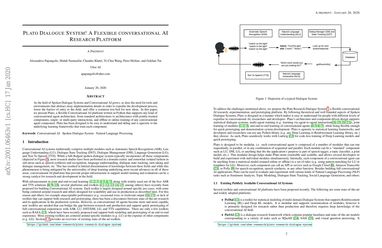
As the field of Spoken Dialogue Systems and Conversational AI grows, so does the need for tools and environments that abstract away implementation details in order to expedite the development process, lower the barrier of entry to the field, and offer a common test-bed for new ideas. In this paper, we present Plato, a flexible Conversational AI platform written in Python that supports any kind of conversational agent architecture, from standard architectures to architectures with jointly-trained components, single- or multi-party interactions, and offline or online training of any conversational agent component. Plato has been designed to be easy to understand and debug and is agnostic to the underlying learning frameworks that train each component.
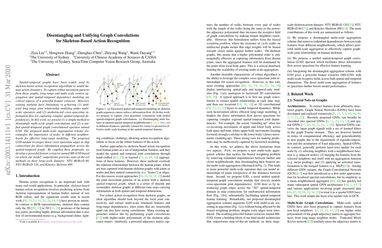
Spatial-temporal graphs have been widely used by skeleton-based action recognition algorithms to model human action dynamics. To capture robust movement patterns from these graphs, long-range and multi-scale context aggregation and spatial-temporal dependency modeling are critical aspects of a powerful feature extractor. However, existing methods have limitations in achieving (1) unbiased long-range joint relationship modeling under multi-scale operators and (2) unobstructed cross-spacetime information flow for capturing complex spatial-temporal dependencies. In this work, we present (1) a simple method to disentangle multi-scale graph convolutions and (2) a unified spatial-temporal graph convolutional operator named G3D. The proposed multi-scale aggregation scheme disentangles the importance of nodes in different neighborhoods for effective long-range modeling. The proposed G3D module leverages dense cross-spacetime edges as skip connections for direct information propagation across the spatial-temporal graph. By coupling these proposals, we develop a powerful feature extractor named MS-G3D based on which our model outperforms previous state-of-the-art methods on three large-scale datasets: NTU RGB+D 60, NTU RGB+D 120, and Kinetics Skeleton 400.
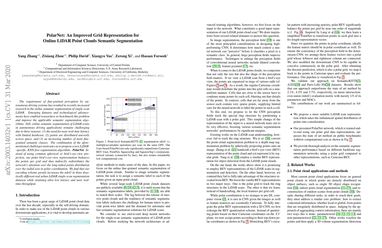
The need for fine-grained perception in autonomous driving systems has resulted in recently increased research on online semantic segmentation of single-scan LiDAR. Despite the emerging datasets and technological advancements, it remains challenging due to three reasons: (1) the need for near-real-time latency with limited hardware; (2) uneven or even long-tailed distribution of LiDAR points across space; and (3) an increasing number of extremely fine-grained semantic classes. In an attempt to jointly tackle all the aforementioned challenges, we propose a new LiDAR-specific, nearest-neighbor-free segmentation algorithm - PolarNet. Instead of using common spherical or bird's-eye-view projection, our polar bird's-eye-view representation balances the points across grid cells in a polar coordinate system, indirectly aligning a segmentation network's attention with the long-tailed distribution of the points along the radial axis. We find that our encoding scheme greatly increases the mIoU in three drastically different segmentation datasets of real urban LiDAR single scans while retaining near real-time throughput.
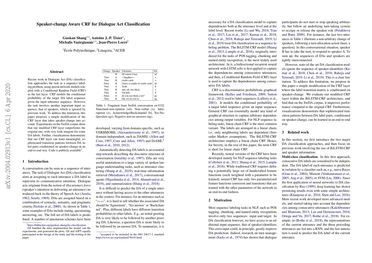
Recent work in Dialogue Act (DA) classification approaches the task as a sequence labeling problem, using neural network models coupled with a Conditional Random Field (CRF) as the last layer. CRF models the conditional probability of the target DA label sequence given the input utterance sequence. However, the task involves another important input sequence, that of speakers, which is ignored by previous work. To address this limitation, this paper proposes a simple modification of the CRF layer that takes speaker-change into account. Experiments on the SwDA corpus show that our modified CRF layer outperforms the original one, with very wide margins for some DA labels. Further, visualizations demonstrate that our CRF layer can learn meaningful, sophisticated transition patterns between DA label pairs conditioned on speaker-change in an end-to-end way. Code is publicly available.
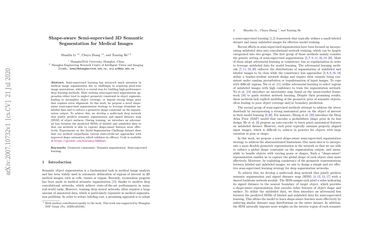
Semi-supervised learning has attracted much attention in medical image segmentation due to challenges in acquiring pixel-wise image annotations, which is a crucial step for building high-performance deep learning methods. Most existing semi-supervised segmentation approaches either tend to neglect geometric constraint in object segments, leading to incomplete object coverage, or impose strong shape prior that requires extra alignment. In this work, we propose a novel shapeaware semi-supervised segmentation strategy to leverage abundant unlabeled data and to enforce a geometric shape constraint on the segmentation output. To achieve this, we develop a multi-task deep network that jointly predicts semantic segmentation and signed distance map(SDM) of object surfaces. During training, we introduce an adversarial loss between the predicted SDMs of labeled and unlabeled data so that our network is able to capture shape-aware features more effectively. Experiments on the Atrial Segmentation Challenge dataset show that our method outperforms current state-of-the-art approaches with improved shape estimation, which validates its efficacy. Code is available at https://github.com/kleinzcy/SASSnet.
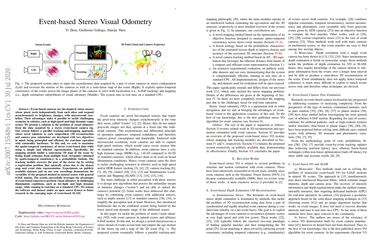
Event-based cameras are bio-inspired vision sensors whose pixels work independently from each other and respond asynchronously to brightness changes, with microsecond resolution. Their advantages make it possible to tackle challenging scenarios in robotics, such as high-speed and high dynamic range scenes. We present a solution to the problem of visual odometry from the data acquired by a stereo event-based camera rig. Our system follows a parallel tracking-and-mapping approach, where novel solutions to each subproblem (3D reconstruction and camera pose estimation) are developed with two objectives in mind: being principled and efficient, for real-time operation with commodity hardware. To this end, we seek to maximize the spatio-temporal consistency of stereo event-based data while using a simple and efficient representation. Specifically, the mapping module builds a semi-dense 3D map of the scene by fusing depth estimates from multiple local viewpoints (obtained by spatio-temporal consistency) in a probabilistic fashion. The tracking module recovers the pose of the stereo rig by solving a registration problem that naturally arises due to the chosen map and event data representation. Experiments on publicly available datasets and on our own recordings demonstrate the versatility of the proposed method in natural scenes with general 6-DoF motion. The system successfully leverages the advantages of event-based cameras to perform visual odometry in challenging illumination conditions, such as low-light and high dynamic range, while running in real-time on a standard CPU. We release the software and dataset under an open source licence to foster research in the emerging topic of event-based SLAM.
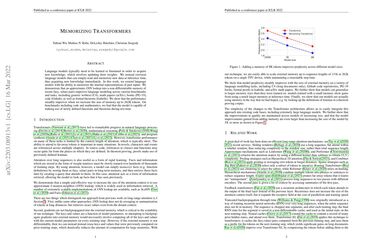
Language models typically need to be trained or finetuned in order to acquire new knowledge, which involves updating their weights. We instead envision language models that can simply read and memorize new data at inference time, thus acquiring new knowledge immediately. In this work, we extend language models with the ability to memorize the internal representations of past inputs. We demonstrate that an approximate kNN lookup into a non-differentiable memory of recent (key, value) pairs improves language modeling across various benchmarks and tasks, including generic webtext (C4), math papers (arXiv), books (PG-19), code (Github), as well as formal theorems (Isabelle). We show that the performance steadily improves when we increase the size of memory up to 262K tokens. On benchmarks including code and mathematics, we find that the model is capable of making use of newly defined functions and theorems during test time.

As language models are adopted by a more sophisticated and diverse set of users, the importance of guaranteeing that they provide factually correct information supported by verifiable sources is critical across fields of study. This is especially the case for high-stakes fields, such as medicine and law, where the risk of propagating false information is high and can lead to undesirable societal consequences. Previous work studying attribution and factuality has not focused on analyzing these characteristics of language model outputs in domain-specific scenarios. In this work, we conduct human evaluation of responses from a few representative systems along various axes of attribution and factuality, by bringing domain experts in the loop. Specifically, we collect expert-curated questions from 484 participants across 32 fields of study, and then ask the same experts to evaluate generated responses to their own questions. In addition, we ask experts to improve upon responses from language models. The output of our analysis is ExpertQA, a high-quality long-form QA dataset with 2177 questions spanning 32 fields, along with verified answers and attributions for claims in the answers.

Large language models have demonstrated impressive universal capabilities across a wide range of open-ended tasks and have extended their utility to encompass multimodal conversations. However, existing methods encounter challenges in effectively handling both image and video understanding, particularly with limited visual tokens. In this work, we introduce Chat-UniVi, a Unified Vision-language model capable of comprehending and engaging in conversations involving images and videos through a unified visual representation. Specifically, we employ a set of dynamic visual tokens to uniformly represent images and videos. This representation framework empowers the model to efficiently utilize a limited number of visual tokens to simultaneously capture the spatial details necessary for images and the comprehensive temporal relationship required for videos. Moreover, we leverage a multi-scale representation, enabling the model to perceive both high-level semantic concepts and low-level visual details. Notably, Chat-UniVi is trained on a mixed dataset containing both images and videos, allowing direct application to tasks involving both mediums without requiring any modifications. Extensive experimental results demonstrate that Chat-UniVi consistently outperforms even existing methods exclusively designed for either images or videos. Code is available at https://github.com/PKU-YuanGroup/Chat-UniVi.

Genomic (DNA) sequences encode an enormous amount of information for gene regulation and protein synthesis. Similar to natural language models, researchers have proposed foundation models in genomics to learn generalizable features from unlabeled genome data that can then be fine-tuned for downstream tasks such as identifying regulatory elements. Due to the quadratic scaling of attention, previous Transformer-based genomic models have used 512 to 4k tokens as context (<0.001% of the human genome), significantly limiting the modeling of long-range interactions in DNA. In addition, these methods rely on tokenizers or fixed k-mers to aggregate meaningful DNA units, losing single nucleotide resolution where subtle genetic variations can completely alter protein function via single nucleotide polymorphisms (SNPs). Recently, Hyena, a large language model based on implicit convolutions was shown to match attention in quality while allowing longer context lengths and lower time complexity. Leveraging Hyena's new long-range capabilities, we present HyenaDNA, a genomic foundation model pretrained on the human reference genome with context lengths of up to 1 million tokens at the single nucleotide-level - an up to 500x increase over previous dense attention-based models. HyenaDNA scales sub-quadratically in sequence length (training up to 160x faster than Transformer), uses single nucleotide tokens, and has full global context at each layer. We explore what longer context enables - including the first use of in-context learning in genomics. On fine-tuned benchmarks from the Nucleotide Transformer, HyenaDNA reaches state-of-the-art (SotA) on 12 of 18 datasets using a model with orders of magnitude less parameters and pretraining data. On the GenomicBenchmarks, HyenaDNA surpasses SotA on 7 of 8 datasets on average by +10 accuracy points. Code at https://github.com/HazyResearch/hyena-dna.

Heuristics are widely used for dealing with complex search and optimization problems. However, manual design of heuristics can be often very labour extensive and requires rich working experience and knowledge. This paper proposes Evolution of Heuristic (EoH), a novel evolutionary paradigm that leverages both Large Language Models (LLMs) and Evolutionary Computation (EC) methods for Automatic Heuristic Design (AHD). EoH represents the ideas of heuristics in natural language, termed thoughts. They are then translated into executable codes by LLMs. The evolution of both thoughts and codes in an evolutionary search framework makes it very effective and efficient for generating high-performance heuristics. Experiments on three widely studied combinatorial optimization benchmark problems demonstrate that EoH outperforms commonly used handcrafted heuristics and other recent AHD methods including FunSearch. Particularly, the heuristic produced by EoH with a low computational budget (in terms of the number of queries to LLMs) significantly outperforms widely-used human hand-crafted baseline algorithms for the online bin packing problem.

Language models have been successfully used to model natural signals, such as images, speech, and music. A key component of these models is a high quality neural compression model that can compress high-dimensional natural signals into lower dimensional discrete tokens. To that end, we introduce a high-fidelity universal neural audio compression algorithm that achieves ~90x compression of 44.1 KHz audio into tokens at just 8kbps bandwidth. We achieve this by combining advances in high-fidelity audio generation with better vector quantization techniques from the image domain, along with improved adversarial and reconstruction losses. We compress all domains (speech, environment, music, etc.) with a single universal model, making it widely applicable to generative modeling of all audio. We compare with competing audio compression algorithms, and find our method outperforms them significantly. We provide thorough ablations for every design choice, as well as open-source code and trained model weights. We hope our work can lay the foundation for the next generation of high-fidelity audio modeling.