
分享
Recurrent neural networks (RNNs) have been widely used for processing sequential data. However, RNNs are commonly difficult to train due to the well-known gradient vanishing and exploding problems and hard to learn long-term patterns. Long short-term memory (LSTM) and gated recurrent unit (GRU) were developed to address these problems, but the use of hyperbolic tangent and the sigmoid action functions results in gradient decay over layers. Consequently, construction of an efficiently trainable deep network is challenging. In addition, all the neurons in an RNN layer are entangled together and their behaviour is hard to interpret. To address these problems, a new type of RNN, referred to as independently recurrent neural network (IndRNN), is proposed in this paper, where neurons in the same layer are independent of each other and they are connected across layers. We have shown that an IndRNN can be easily regulated to prevent the gradient exploding and vanishing problems while allowing the network to learn long-term dependencies. Moreover, an IndRNN can work with non-saturated activation functions such as relu (rectified linear unit) and be still trained robustly. Multiple IndRNNs can be stacked to construct a network that is deeper than the existing RNNs. Experimental results have shown that the proposed IndRNN is able to process very long sequences (over 5000 time steps), can be used to construct very deep networks (21 layers used in the experiment) and still be trained robustly. Better performances have been achieved on various tasks by using IndRNNs compared with the traditional RNN and LSTM. The code is available at https://github.com/Sunnydreamrain/IndRNN_Theano_Lasagne.
We present a method for 3D object detection and pose estimation from a single image. In contrast to current techniques that only regress the 3D orientation of an object, our method first regresses relatively stable 3D object properties using a deep convolutional neural network and then combines these estimates with geometric constraints provided by a 2D object bounding box to produce a complete 3D bounding box. The first network output estimates the 3D object orientation using a novel hybrid discrete-continuous loss, which significantly outperforms the L2 loss. The second output regresses the 3D object dimensions, which have relatively little variance compared to alternatives and can often be predicted for many object types. These estimates, combined with the geometric constraints on translation imposed by the 2D bounding box, enable us to recover a stable and accurate 3D object pose. We evaluate our method on the challenging KITTI object detection benchmark both on the official metric of 3D orientation estimation and also on the accuracy of the obtained 3D bounding boxes. Although conceptually simple, our method outperforms more complex and computationally expensive approaches that leverage semantic segmentation, instance level segmentation and flat ground priors and sub-category detection. Our discrete-continuous loss also produces state of the art results for 3D viewpoint estimation on the Pascal 3D+ dataset.
We present a novel neural network for processing sequences. The ByteNet is a one-dimensional convolutional neural network that is composed of two parts, one to encode the source sequence and the other to decode the target sequence. The two network parts are connected by stacking the decoder on top of the encoder and preserving the temporal resolution of the sequences. To address the differing lengths of the source and the target, we introduce an efficient mechanism by which the decoder is dynamically unfolded over the representation of the encoder. The ByteNet uses dilation in the convolutional layers to increase its receptive field. The resulting network has two core properties: it runs in time that is linear in the length of the sequences and it sidesteps the need for excessive memorization. The ByteNet decoder attains state-of-the-art performance on character-level language modelling and outperforms the previous best results obtained with recurrent networks. The ByteNet also achieves state-of-the-art performance on character-to-character machine translation on the English-to-German WMT translation task, surpassing comparable neural translation models that are based on recurrent networks with attentional pooling and run in quadratic time. We find that the latent alignment structure contained in the representations reflects the expected alignment between the tokens.
In this work we adapt multi-person pose estimation architecture to use it on edge devices. We follow the bottom-up approach from OpenPose, the winner of COCO 2016 Keypoints Challenge, because of its decent quality and robustness to number of people inside the frame. With proposed network design and optimized post-processing code the full solution runs at 28 frames per second (fps) on Intel$\unicode{xAE}$ NUC 6i7KYB mini PC and 26 fps on Core$^{TM}$ i7-6850K CPU. The network model has 4.1M parameters and 9 billions floating-point operations (GFLOPs) complexity, which is just ~15% of the baseline 2-stage OpenPose with almost the same quality. The code and model are available as a part of Intel$\unicode{xAE}$ OpenVINO$^{TM}$ Toolkit.
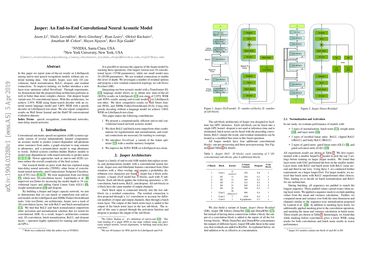
In this paper, we report state-of-the-art results on LibriSpeech among end-to-end speech recognition models without any external training data. Our model, Jasper, uses only 1D convolutions, batch normalization, ReLU, dropout, and residual connections. To improve training, we further introduce a new layer-wise optimizer called NovoGrad. Through experiments, we demonstrate that the proposed deep architecture performs as well or better than more complex choices. Our deepest Jasper variant uses 54 convolutional layers. With this architecture, we achieve 2.95% WER using a beam-search decoder with an external neural language model and 3.86% WER with a greedy decoder on LibriSpeech test-clean. We also report competitive results on the Wall Street Journal and the Hub5'00 conversational evaluation datasets.
Large deep learning models offer significant accuracy gains, but training billions to trillions of parameters is challenging. Existing solutions such as data and model parallelisms exhibit fundamental limitations to fit these models into limited device memory, while obtaining computation, communication and development efficiency. We develop a novel solution, Zero Redundancy Optimizer (ZeRO), to optimize memory, vastly improving training speed while increasing the model size that can be efficiently trained. ZeRO eliminates memory redundancies in data- and model-parallel training while retaining low communication volume and high computational granularity, allowing us to scale the model size proportional to the number of devices with sustained high efficiency. Our analysis on memory requirements and communication volume demonstrates: ZeRO has the potential to scale beyond 1 Trillion parameters using today's hardware. We implement and evaluate ZeRO: it trains large models of over 100B parameter with super-linear speedup on 400 GPUs, achieving throughput of 15 Petaflops. This represents an 8x increase in model size and 10x increase in achievable performance over state-of-the-art. In terms of usability, ZeRO can train large models of up to 13B parameters (e.g., larger than Megatron GPT 8.3B and T5 11B) without requiring model parallelism which is harder for scientists to apply. Last but not the least, researchers have used the system breakthroughs of ZeRO to create the world's largest language model (Turing-NLG, 17B parameters) with record breaking accuracy.
Many applications require sparse neural networks due to space or inference time restrictions. There is a large body of work on training dense networks to yield sparse networks for inference, but this limits the size of the largest trainable sparse model to that of the largest trainable dense model. In this paper we introduce a method to train sparse neural networks with a fixed parameter count and a fixed computational cost throughout training, without sacrificing accuracy relative to existing dense-to-sparse training methods. Our method updates the topology of the sparse network during training by using parameter magnitudes and infrequent gradient calculations. We show that this approach requires fewer floating-point operations (FLOPs) to achieve a given level of accuracy compared to prior techniques. We demonstrate state-of-the-art sparse training results on a variety of networks and datasets, including ResNet-50, MobileNets on Imagenet-2012, and RNNs on WikiText-103. Finally, we provide some insights into why allowing the topology to change during the optimization can overcome local minima encountered when the topology remains static. Code used in our work can be found in github.com/google-research/rigl.
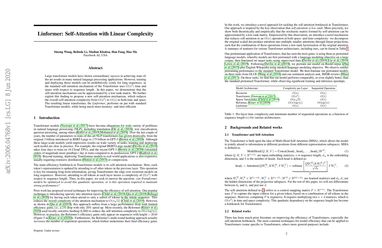
Large transformer models have shown extraordinary success in achieving state-of-the-art results in many natural language processing applications. However, training and deploying these models can be prohibitively costly for long sequences, as the standard self-attention mechanism of the Transformer uses $O(n^2)$ time and space with respect to sequence length. In this paper, we demonstrate that the self-attention mechanism can be approximated by a low-rank matrix. We further exploit this finding to propose a new self-attention mechanism, which reduces the overall self-attention complexity from $O(n^2)$ to $O(n)$ in both time and space. The resulting linear transformer, the \textit{Linformer}, performs on par with standard Transformer models, while being much more memory- and time-efficient.
In this work, we propose DiffWave, a versatile diffusion probabilistic model for conditional and unconditional waveform generation. The model is non-autoregressive, and converts the white noise signal into structured waveform through a Markov chain with a constant number of steps at synthesis. It is efficiently trained by optimizing a variant of variational bound on the data likelihood. DiffWave produces high-fidelity audios in different waveform generation tasks, including neural vocoding conditioned on mel spectrogram, class-conditional generation, and unconditional generation. We demonstrate that DiffWave matches a strong WaveNet vocoder in terms of speech quality (MOS: 4.44 versus 4.43), while synthesizing orders of magnitude faster. In particular, it significantly outperforms autoregressive and GAN-based waveform models in the challenging unconditional generation task in terms of audio quality and sample diversity from various automatic and human evaluations.
The pre-dominant approach to language modeling to date is based on recurrent neural networks. Their success on this task is often linked to their ability to capture unbounded context. In this paper we develop a finite context approach through stacked convolutions, which can be more efficient since they allow parallelization over sequential tokens. We propose a novel simplified gating mechanism that outperforms Oord et al (2016) and investigate the impact of key architectural decisions. The proposed approach achieves state-of-the-art on the WikiText-103 benchmark, even though it features long-term dependencies, as well as competitive results on the Google Billion Words benchmark. Our model reduces the latency to score a sentence by an order of magnitude compared to a recurrent baseline. To our knowledge, this is the first time a non-recurrent approach is competitive with strong recurrent models on these large scale language tasks.
We present Kernel Point Convolution (KPConv), a new design of point convolution, i.e. that operates on point clouds without any intermediate representation. The convolution weights of KPConv are located in Euclidean space by kernel points, and applied to the input points close to them. Its capacity to use any number of kernel points gives KPConv more flexibility than fixed grid convolutions. Furthermore, these locations are continuous in space and can be learned by the network. Therefore, KPConv can be extended to deformable convolutions that learn to adapt kernel points to local geometry. Thanks to a regular subsampling strategy, KPConv is also efficient and robust to varying densities. Whether they use deformable KPConv for complex tasks, or rigid KPconv for simpler tasks, our networks outperform state-of-the-art classification and segmentation approaches on several datasets. We also offer ablation studies and visualizations to provide understanding of what has been learned by KPConv and to validate the descriptive power of deformable KPConv.
We introduce GPT-NeoX-20B, a 20 billion parameter autoregressive language model trained on the Pile, whose weights will be made freely and openly available to the public through a permissive license. It is, to the best of our knowledge, the largest dense autoregressive model that has publicly available weights at the time of submission. In this work, we describe \model{}'s architecture and training and evaluate its performance on a range of language-understanding, mathematics, and knowledge-based tasks. We find that GPT-NeoX-20B is a particularly powerful few-shot reasoner and gains far more in performance when evaluated five-shot than similarly sized GPT-3 and FairSeq models. We open-source the training and evaluation code, as well as the model weights, at https://github.com/EleutherAI/gpt-neox.