
分享
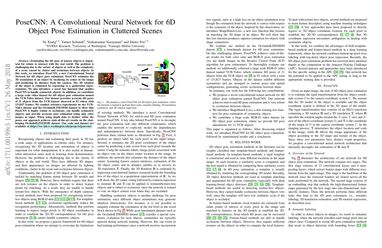
Estimating the 6D pose of known objects is important for robots to interact with the real world. The problem is challenging due to the variety of objects as well as the complexity of a scene caused by clutter and occlusions between objects. In this work, we introduce PoseCNN, a new Convolutional Neural Network for 6D object pose estimation. PoseCNN estimates the 3D translation of an object by localizing its center in the image and predicting its distance from the camera. The 3D rotation of the object is estimated by regressing to a quaternion representation. We also introduce a novel loss function that enables PoseCNN to handle symmetric objects. In addition, we contribute a large scale video dataset for 6D object pose estimation named the YCB-Video dataset. Our dataset provides accurate 6D poses of 21 objects from the YCB dataset observed in 92 videos with 133,827 frames. We conduct extensive experiments on our YCB-Video dataset and the OccludedLINEMOD dataset to show that PoseCNN is highly robust to occlusions, can handle symmetric objects, and provide accurate pose estimation using only color images as input. When using depth data to further refine the poses, our approach achieves state-of-the-art results on the challenging OccludedLINEMOD dataset. Our code and dataset are available at https://rse-lab.cs.washington.edu/projects/posecnn/.
When a recurrent neural network language model is used for caption generation, the image information can be fed to the neural network either by directly incorporating it in the RNN -- conditioning the language model by `injecting' image features -- or in a layer following the RNN -- conditioning the language model by `merging' image features. While both options are attested in the literature, there is as yet no systematic comparison between the two. In this paper we empirically show that it is not especially detrimental to performance whether one architecture is used or another. The merge architecture does have practical advantages, as conditioning by merging allows the RNN's hidden state vector to shrink in size by up to four times. Our results suggest that the visual and linguistic modalities for caption generation need not be jointly encoded by the RNN as that yields large, memory-intensive models with few tangible advantages in performance; rather, the multimodal integration should be delayed to a subsequent stage.
The FlowNet demonstrated that optical flow estimation can be cast as a learning problem. However, the state of the art with regard to the quality of the flow has still been defined by traditional methods. Particularly on small displacements and real-world data, FlowNet cannot compete with variational methods. In this paper, we advance the concept of end-to-end learning of optical flow and make it work really well. The large improvements in quality and speed are caused by three major contributions: first, we focus on the training data and show that the schedule of presenting data during training is very important. Second, we develop a stacked architecture that includes warping of the second image with intermediate optical flow. Third, we elaborate on small displacements by introducing a sub-network specializing on small motions. FlowNet 2.0 is only marginally slower than the original FlowNet but decreases the estimation error by more than 50%. It performs on par with state-of-the-art methods, while running at interactive frame rates. Moreover, we present faster variants that allow optical flow computation at up to 140fps with accuracy matching the original FlowNet.
Several recent work on speech synthesis have employed generative adversarial networks (GANs) to produce raw waveforms. Although such methods improve the sampling efficiency and memory usage, their sample quality has not yet reached that of autoregressive and flow-based generative models. In this work, we propose HiFi-GAN, which achieves both efficient and high-fidelity speech synthesis. As speech audio consists of sinusoidal signals with various periods, we demonstrate that modeling periodic patterns of an audio is crucial for enhancing sample quality. A subjective human evaluation (mean opinion score, MOS) of a single speaker dataset indicates that our proposed method demonstrates similarity to human quality while generating 22.05 kHz high-fidelity audio 167.9 times faster than real-time on a single V100 GPU. We further show the generality of HiFi-GAN to the mel-spectrogram inversion of unseen speakers and end-to-end speech synthesis. Finally, a small footprint version of HiFi-GAN generates samples 13.4 times faster than real-time on CPU with comparable quality to an autoregressive counterpart.

Large pre-trained language models have been shown to store factual knowledge in their parameters, and achieve state-of-the-art results when fine-tuned on downstream NLP tasks. However, their ability to access and precisely manipulate knowledge is still limited, and hence on knowledge-intensive tasks, their performance lags behind task-specific architectures. Additionally, providing provenance for their decisions and updating their world knowledge remain open research problems. Pre-trained models with a differentiable access mechanism to explicit non-parametric memory can overcome this issue, but have so far been only investigated for extractive downstream tasks. We explore a general-purpose fine-tuning recipe for retrieval-augmented generation (RAG) -- models which combine pre-trained parametric and non-parametric memory for language generation. We introduce RAG models where the parametric memory is a pre-trained seq2seq model and the non-parametric memory is a dense vector index of Wikipedia, accessed with a pre-trained neural retriever. We compare two RAG formulations, one which conditions on the same retrieved passages across the whole generated sequence, the other can use different passages per token. We fine-tune and evaluate our models on a wide range of knowledge-intensive NLP tasks and set the state-of-the-art on three open domain QA tasks, outperforming parametric seq2seq models and task-specific retrieve-and-extract architectures. For language generation tasks, we find that RAG models generate more specific, diverse and factual language than a state-of-the-art parametric-only seq2seq baseline.

Designed to learn long-range interactions on sequential data, transformers continue to show state-of-the-art results on a wide variety of tasks. In contrast to CNNs, they contain no inductive bias that prioritizes local interactions. This makes them expressive, but also computationally infeasible for long sequences, such as high-resolution images. We demonstrate how combining the effectiveness of the inductive bias of CNNs with the expressivity of transformers enables them to model and thereby synthesize high-resolution images. We show how to (i) use CNNs to learn a context-rich vocabulary of image constituents, and in turn (ii) utilize transformers to efficiently model their composition within high-resolution images. Our approach is readily applied to conditional synthesis tasks, where both non-spatial information, such as object classes, and spatial information, such as segmentations, can control the generated image. In particular, we present the first results on semantically-guided synthesis of megapixel images with transformers and obtain the state of the art among autoregressive models on class-conditional ImageNet. Code and pretrained models can be found at https://github.com/CompVis/taming-transformers .
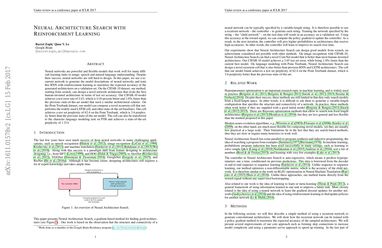
Neural networks are powerful and flexible models that work well for many difficult learning tasks in image, speech and natural language understanding. Despite their success, neural networks are still hard to design. In this paper, we use a recurrent network to generate the model descriptions of neural networks and train this RNN with reinforcement learning to maximize the expected accuracy of the generated architectures on a validation set. On the CIFAR-10 dataset, our method, starting from scratch, can design a novel network architecture that rivals the best human-invented architecture in terms of test set accuracy. Our CIFAR-10 model achieves a test error rate of 3.65, which is 0.09 percent better and 1.05x faster than the previous state-of-the-art model that used a similar architectural scheme. On the Penn Treebank dataset, our model can compose a novel recurrent cell that outperforms the widely-used LSTM cell, and other state-of-the-art baselines. Our cell achieves a test set perplexity of 62.4 on the Penn Treebank, which is 3.6 perplexity better than the previous state-of-the-art model. The cell can also be transferred to the character language modeling task on PTB and achieves a state-of-the-art perplexity of 1.214.
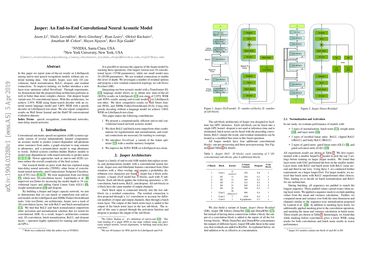
In this paper, we report state-of-the-art results on LibriSpeech among end-to-end speech recognition models without any external training data. Our model, Jasper, uses only 1D convolutions, batch normalization, ReLU, dropout, and residual connections. To improve training, we further introduce a new layer-wise optimizer called NovoGrad. Through experiments, we demonstrate that the proposed deep architecture performs as well or better than more complex choices. Our deepest Jasper variant uses 54 convolutional layers. With this architecture, we achieve 2.95% WER using a beam-search decoder with an external neural language model and 3.86% WER with a greedy decoder on LibriSpeech test-clean. We also report competitive results on the Wall Street Journal and the Hub5'00 conversational evaluation datasets.
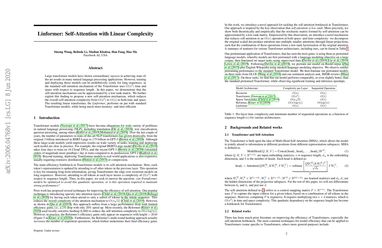
Large transformer models have shown extraordinary success in achieving state-of-the-art results in many natural language processing applications. However, training and deploying these models can be prohibitively costly for long sequences, as the standard self-attention mechanism of the Transformer uses $O(n^2)$ time and space with respect to sequence length. In this paper, we demonstrate that the self-attention mechanism can be approximated by a low-rank matrix. We further exploit this finding to propose a new self-attention mechanism, which reduces the overall self-attention complexity from $O(n^2)$ to $O(n)$ in both time and space. The resulting linear transformer, the \textit{Linformer}, performs on par with standard Transformer models, while being much more memory- and time-efficient.
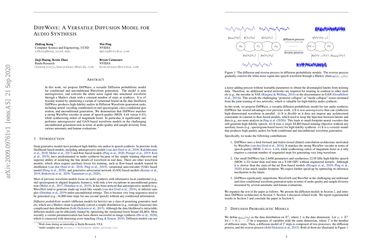
In this work, we propose DiffWave, a versatile diffusion probabilistic model for conditional and unconditional waveform generation. The model is non-autoregressive, and converts the white noise signal into structured waveform through a Markov chain with a constant number of steps at synthesis. It is efficiently trained by optimizing a variant of variational bound on the data likelihood. DiffWave produces high-fidelity audios in different waveform generation tasks, including neural vocoding conditioned on mel spectrogram, class-conditional generation, and unconditional generation. We demonstrate that DiffWave matches a strong WaveNet vocoder in terms of speech quality (MOS: 4.44 versus 4.43), while synthesizing orders of magnitude faster. In particular, it significantly outperforms autoregressive and GAN-based waveform models in the challenging unconditional generation task in terms of audio quality and sample diversity from various automatic and human evaluations.
Entity representations are useful in natural language tasks involving entities. In this paper, we propose new pretrained contextualized representations of words and entities based on the bidirectional transformer. The proposed model treats words and entities in a given text as independent tokens, and outputs contextualized representations of them. Our model is trained using a new pretraining task based on the masked language model of BERT. The task involves predicting randomly masked words and entities in a large entity-annotated corpus retrieved from Wikipedia. We also propose an entity-aware self-attention mechanism that is an extension of the self-attention mechanism of the transformer, and considers the types of tokens (words or entities) when computing attention scores. The proposed model achieves impressive empirical performance on a wide range of entity-related tasks. In particular, it obtains state-of-the-art results on five well-known datasets: Open Entity (entity typing), TACRED (relation classification), CoNLL-2003 (named entity recognition), ReCoRD (cloze-style question answering), and SQuAD 1.1 (extractive question answering). Our source code and pretrained representations are available at https://github.com/studio-ousia/luke.

Although tremendous strides have been made in face detection, one of the remaining open challenges is to achieve real-time speed on the CPU as well as maintain high performance, since effective models for face detection tend to be computationally prohibitive. To address this challenge, we propose a novel face detector, named FaceBoxes, with superior performance on both speed and accuracy. Specifically, our method has a lightweight yet powerful network structure that consists of the Rapidly Digested Convolutional Layers (RDCL) and the Multiple Scale Convolutional Layers (MSCL). The RDCL is designed to enable FaceBoxes to achieve real-time speed on the CPU. The MSCL aims at enriching the receptive fields and discretizing anchors over different layers to handle faces of various scales. Besides, we propose a new anchor densification strategy to make different types of anchors have the same density on the image, which significantly improves the recall rate of small faces. As a consequence, the proposed detector runs at 20 FPS on a single CPU core and 125 FPS using a GPU for VGA-resolution images. Moreover, the speed of FaceBoxes is invariant to the number of faces. We comprehensively evaluate this method and present state-of-the-art detection performance on several face detection benchmark datasets, including the AFW, PASCAL face, and FDDB. Code is available at https://github.com/sfzhang15/FaceBoxes