
分享
We introduce a light-weight, power efficient, and general purpose convolutional neural network, ESPNetv2, for modeling visual and sequential data. Our network uses group point-wise and depth-wise dilated separable convolutions to learn representations from a large effective receptive field with fewer FLOPs and parameters. The performance of our network is evaluated on four different tasks: (1) object classification, (2) semantic segmentation, (3) object detection, and (4) language modeling. Experiments on these tasks, including image classification on the ImageNet and language modeling on the PenTree bank dataset, demonstrate the superior performance of our method over the state-of-the-art methods. Our network outperforms ESPNet by 4-5% and has 2-4x fewer FLOPs on the PASCAL VOC and the Cityscapes dataset. Compared to YOLOv2 on the MS-COCO object detection, ESPNetv2 delivers 4.4% higher accuracy with 6x fewer FLOPs. Our experiments show that ESPNetv2 is much more power efficient than existing state-of-the-art efficient methods including ShuffleNets and MobileNets. Our code is open-source and available at https://github.com/sacmehta/ESPNetv2
The objective of this paper is speaker recognition "in the wild"-where utterances may be of variable length and also contain irrelevant signals. Crucial elements in the design of deep networks for this task are the type of trunk (frame level) network, and the method of temporal aggregation. We propose a powerful speaker recognition deep network, using a "thin-ResNet" trunk architecture, and a dictionary-based NetVLAD or GhostVLAD layer to aggregate features across time, that can be trained end-to-end. We show that our network achieves state of the art performance by a significant margin on the VoxCeleb1 test set for speaker recognition, whilst requiring fewer parameters than previous methods. We also investigate the effect of utterance length on performance, and conclude that for "in the wild" data, a longer length is beneficial.
Vision-and-language reasoning requires an understanding of visual concepts, language semantics, and, most importantly, the alignment and relationships between these two modalities. We thus propose the LXMERT (Learning Cross-Modality Encoder Representations from Transformers) framework to learn these vision-and-language connections. In LXMERT, we build a large-scale Transformer model that consists of three encoders: an object relationship encoder, a language encoder, and a cross-modality encoder. Next, to endow our model with the capability of connecting vision and language semantics, we pre-train the model with large amounts of image-and-sentence pairs, via five diverse representative pre-training tasks: masked language modeling, masked object prediction (feature regression and label classification), cross-modality matching, and image question answering. These tasks help in learning both intra-modality and cross-modality relationships. After fine-tuning from our pre-trained parameters, our model achieves the state-of-the-art results on two visual question answering datasets (i.e., VQA and GQA). We also show the generalizability of our pre-trained cross-modality model by adapting it to a challenging visual-reasoning task, NLVR2, and improve the previous best result by 22% absolute (54% to 76%). Lastly, we demonstrate detailed ablation studies to prove that both our novel model components and pre-training strategies significantly contribute to our strong results; and also present several attention visualizations for the different encoders. Code and pre-trained models publicly available at: https://github.com/airsplay/lxmert
Pre-trained Language Models (PLMs) have proven to be beneficial for various downstream NLP tasks. Recently, GPT-3, with 175 billion parameters and 570GB training data, drew a lot of attention due to the capacity of few-shot (even zero-shot) learning. However, applying GPT-3 to address Chinese NLP tasks is still challenging, as the training corpus of GPT-3 is primarily English, and the parameters are not publicly available. In this technical report, we release the Chinese Pre-trained Language Model (CPM) with generative pre-training on large-scale Chinese training data. To the best of our knowledge, CPM, with 2.6 billion parameters and 100GB Chinese training data, is the largest Chinese pre-trained language model, which could facilitate several downstream Chinese NLP tasks, such as conversation, essay generation, cloze test, and language understanding. Extensive experiments demonstrate that CPM achieves strong performance on many NLP tasks in the settings of few-shot (even zero-shot) learning. The code and parameters are available at https://github.com/TsinghuaAI/CPM-Generate.
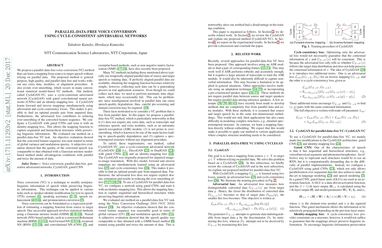
We propose a parallel-data-free voice-conversion (VC) method that can learn a mapping from source to target speech without relying on parallel data. The proposed method is general purpose, high quality, and parallel-data free and works without any extra data, modules, or alignment procedure. It also avoids over-smoothing, which occurs in many conventional statistical model-based VC methods. Our method, called CycleGAN-VC, uses a cycle-consistent adversarial network (CycleGAN) with gated convolutional neural networks (CNNs) and an identity-mapping loss. A CycleGAN learns forward and inverse mappings simultaneously using adversarial and cycle-consistency losses. This makes it possible to find an optimal pseudo pair from unpaired data. Furthermore, the adversarial loss contributes to reducing over-smoothing of the converted feature sequence. We configure a CycleGAN with gated CNNs and train it with an identity-mapping loss. This allows the mapping function to capture sequential and hierarchical structures while preserving linguistic information. We evaluated our method on a parallel-data-free VC task. An objective evaluation showed that the converted feature sequence was near natural in terms of global variance and modulation spectra. A subjective evaluation showed that the quality of the converted speech was comparable to that obtained with a Gaussian mixture model-based method under advantageous conditions with parallel and twice the amount of data.
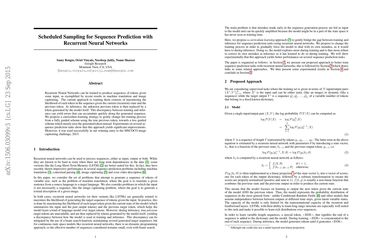
Recurrent Neural Networks can be trained to produce sequences of tokens given some input, as exemplified by recent results in machine translation and image captioning. The current approach to training them consists of maximizing the likelihood of each token in the sequence given the current (recurrent) state and the previous token. At inference, the unknown previous token is then replaced by a token generated by the model itself. This discrepancy between training and inference can yield errors that can accumulate quickly along the generated sequence. We propose a curriculum learning strategy to gently change the training process from a fully guided scheme using the true previous token, towards a less guided scheme which mostly uses the generated token instead. Experiments on several sequence prediction tasks show that this approach yields significant improvements. Moreover, it was used successfully in our winning entry to the MSCOCO image captioning challenge, 2015.
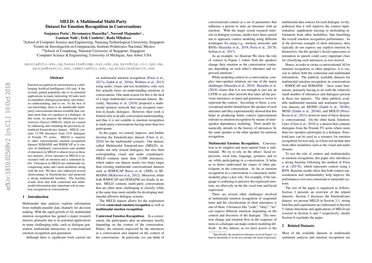
Emotion recognition in conversations is a challenging task that has recently gained popularity due to its potential applications. Until now, however, a large-scale multimodal multi-party emotional conversational database containing more than two speakers per dialogue was missing. Thus, we propose the Multimodal EmotionLines Dataset (MELD), an extension and enhancement of EmotionLines. MELD contains about 13,000 utterances from 1,433 dialogues from the TV-series Friends. Each utterance is annotated with emotion and sentiment labels, and encompasses audio, visual and textual modalities. We propose several strong multimodal baselines and show the importance of contextual and multimodal information for emotion recognition in conversations. The full dataset is available for use at http:// affective-meld.github.io.
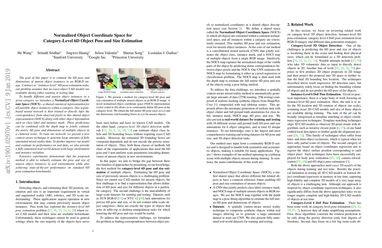
The goal of this paper is to estimate the 6D pose and dimensions of unseen object instances in an RGB-D image. Contrary to "instance-level" 6D pose estimation tasks, our problem assumes that no exact object CAD models are available during either training or testing time. To handle different and unseen object instances in a given category, we introduce a Normalized Object Coordinate Space (NOCS)---a shared canonical representation for all possible object instances within a category. Our region-based neural network is then trained to directly infer the correspondence from observed pixels to this shared object representation (NOCS) along with other object information such as class label and instance mask. These predictions can be combined with the depth map to jointly estimate the metric 6D pose and dimensions of multiple objects in a cluttered scene. To train our network, we present a new context-aware technique to generate large amounts of fully annotated mixed reality data. To further improve our model and evaluate its performance on real data, we also provide a fully annotated real-world dataset with large environment and instance variation. Extensive experiments demonstrate that the proposed method is able to robustly estimate the pose and size of unseen object instances in real environments while also achieving state-of-the-art performance on standard 6D pose estimation benchmarks.
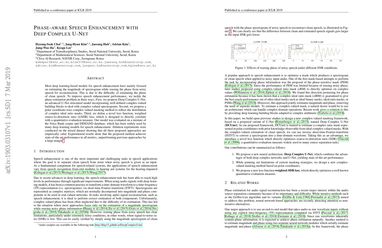
Most deep learning-based models for speech enhancement have mainly focused on estimating the magnitude of spectrogram while reusing the phase from noisy speech for reconstruction. This is due to the difficulty of estimating the phase of clean speech. To improve speech enhancement performance, we tackle the phase estimation problem in three ways. First, we propose Deep Complex U-Net, an advanced U-Net structured model incorporating well-defined complex-valued building blocks to deal with complex-valued spectrograms. Second, we propose a polar coordinate-wise complex-valued masking method to reflect the distribution of complex ideal ratio masks. Third, we define a novel loss function, weighted source-to-distortion ratio (wSDR) loss, which is designed to directly correlate with a quantitative evaluation measure. Our model was evaluated on a mixture of the Voice Bank corpus and DEMAND database, which has been widely used by many deep learning models for speech enhancement. Ablation experiments were conducted on the mixed dataset showing that all three proposed approaches are empirically valid. Experimental results show that the proposed method achieves state-of-the-art performance in all metrics, outperforming previous approaches by a large margin.
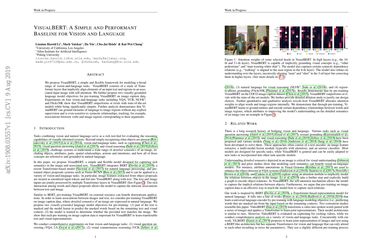
We propose VisualBERT, a simple and flexible framework for modeling a broad range of vision-and-language tasks. VisualBERT consists of a stack of Transformer layers that implicitly align elements of an input text and regions in an associated input image with self-attention. We further propose two visually-grounded language model objectives for pre-training VisualBERT on image caption data. Experiments on four vision-and-language tasks including VQA, VCR, NLVR2, and Flickr30K show that VisualBERT outperforms or rivals with state-of-the-art models while being significantly simpler. Further analysis demonstrates that VisualBERT can ground elements of language to image regions without any explicit supervision and is even sensitive to syntactic relationships, tracking, for example, associations between verbs and image regions corresponding to their arguments.
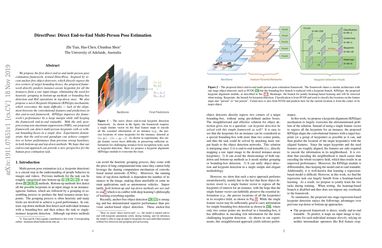
We propose the first direct end-to-end multi-person pose estimation framework, termed DirectPose. Inspired by recent anchor-free object detectors, which directly regress the two corners of target bounding-boxes, the proposed framework directly predicts instance-aware keypoints for all the instances from a raw input image, eliminating the need for heuristic grouping in bottom-up methods or bounding-box detection and RoI operations in top-down ones. We also propose a novel Keypoint Alignment (KPAlign) mechanism, which overcomes the main difficulty: lack of the alignment between the convolutional features and predictions in this end-to-end framework. KPAlign improves the framework's performance by a large margin while still keeping the framework end-to-end trainable. With the only postprocessing non-maximum suppression (NMS), our proposed framework can detect multi-person keypoints with or without bounding-boxes in a single shot. Experiments demonstrate that the end-to-end paradigm can achieve competitive or better performance than previous strong baselines, in both bottom-up and top-down methods. We hope that our end-to-end approach can provide a new perspective for the human pose estimation task.

Recent progress in natural language processing has been driven by advances in both model architecture and model pretraining. Transformer architectures have facilitated building higher-capacity models and pretraining has made it possible to effectively utilize this capacity for a wide variety of tasks. \textit{Transformers} is an open-source library with the goal of opening up these advances to the wider machine learning community. The library consists of carefully engineered state-of-the art Transformer architectures under a unified API. Backing this library is a curated collection of pretrained models made by and available for the community. \textit{Transformers} is designed to be extensible by researchers, simple for practitioners, and fast and robust in industrial deployments. The library is available at \url{https://github.com/huggingface/transformers}.