
分享
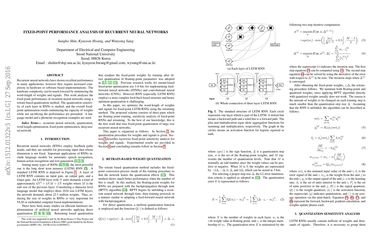
Recurrent neural networks have shown excellent performance in many applications, however they require increased complexity in hardware or software based implementations. The hardware complexity can be much lowered by minimizing the word-length of weights and signals. This work analyzes the fixed-point performance of recurrent neural networks using a retrain based quantization method. The quantization sensitivity of each layer in RNNs is studied, and the overall fixed-point optimization results minimizing the capacity of weights while not sacrificing the performance are presented. A language model and a phoneme recognition examples are used.

The advent of large language models (LLMs) has predominantly catered to high-resource languages, leaving a disparity in performance for low-resource languages. Conventional Continual Training (CT) approaches to bridge this gap often undermine a model's original linguistic proficiency when expanding to multilingual contexts. Addressing this issue, we introduce a novel MoE-CT architecture, a paradigm that innovatively separates the base model's learning from the multilingual expansion process. Our design freezes the original LLM parameters, thus safeguarding its performance in high-resource languages, while an appended MoE module, trained on diverse language datasets, augments low-resource language proficiency. Our approach significantly outperforms conventional CT methods, as evidenced by our experiments, which show marked improvements in multilingual benchmarks without sacrificing the model's original language performance. Moreover, our MoE-CT framework demonstrates enhanced resistance to forgetting and superior transfer learning capabilities. By preserving the base model's integrity and focusing on strategic parameter expansion, our methodology advances multilingual language modeling and represents a significant step forward for low-resource language inclusion in LLMs, indicating a fruitful direction for future research in language technologies.

A one-shot algorithm called iterationless DANSE (iDANSE) is introduced to perform distributed adaptive node-specific signal estimation (DANSE) in a fully connected wireless acoustic sensor network (WASN) deployed in an environment with non-overlapping latent signal subspaces. The iDANSE algorithm matches the performance of a centralized algorithm in a single processing cycle while devices exchange fused versions of their multichannel local microphone signals. Key advantages of iDANSE over currently available solutions are its iterationless nature, which favors deployment in real-time applications, and the fact that devices can exchange fewer fused signals than the number of latent sources in the environment. The proposed method is validated in numerical simulations including a speech enhancement scenario.

This paper proposes a novel user-defined keyword spotting framework that accurately detects audio keywords based on text enrollment. Since audio data possesses additional acoustic information compared to text, there are discrepancies between these two modalities. To address this challenge, we present ParallelKWS, which utilises self- and cross-attention in a parallel architecture to effectively capture information both within and across the two modalities. We further propose a phoneme duration-based alignment loss that enforces the sequential correspondence between audio and text features. Extensive experimental results demonstrate that our proposed method achieves state-of-the-art performance on several benchmark datasets in both seen and unseen domains, without incorporating extra data beyond the dataset used in previous studies.

This research delves into the utilization of smartwatch sensor data and heart rate monitoring to discern individual emotions based on body movement and heart rate. Emotions play a pivotal role in human life, influencing mental well-being, quality of life, and even physical and physiological responses. The data were sourced from prior research by Juan C. Quiroz, PhD. The study enlisted 50 participants who donned smartwatches and heart rate monitors while completing a 250-meter walk. Emotions were induced through both audio-visual and audio stimuli, with participants' emotional states evaluated using the PANAS questionnaire. The study scrutinized three scenarios: viewing a movie before walking, listening to music before walking, and listening to music while walking. Personal baselines were established using DummyClassifier with the 'most_frequent' strategy from the sklearn library, and various models, including Logistic Regression and Random Forest, were employed to gauge the impacts of these activities. Notably, a novel approach was undertaken by incorporating hyperparameter tuning to the Random Forest model using RandomizedSearchCV. The outcomes showcased substantial enhancements with hyperparameter tuning in the Random Forest model, yielding mean accuracies of 86.63% for happy vs. sad and 76.33% for happy vs. neutral vs. sad.

We present a novel prompting strategy for artificial intelligence driven digital avatars. To better quantify how our prompting strategy affects anthropomorphic features like humor, authenticity, and favorability we present Crowd Vote - an adaptation of Crowd Score that allows for judges to elect a large language model (LLM) candidate over competitors answering the same or similar prompts. To visualize the responses of our LLM, and the effectiveness of our prompting strategy we propose an end-to-end framework for creating high-fidelity artificial intelligence (AI) driven digital avatars. This pipeline effectively captures an individual's essence for interaction and our streaming algorithm delivers a high-quality digital avatar with real-time audio-video streaming from server to mobile device. Both our visualization tool, and our Crowd Vote metrics demonstrate our AI driven digital avatars have state-of-the-art humor, authenticity, and favorability outperforming all competitors and baselines. In the case of our Donald Trump and Joe Biden avatars, their authenticity and favorability are rated higher than even their real-world equivalents.

As Large Language Models (LLMs) become increasingly sophisticated and ubiquitous in natural language processing (NLP) applications, ensuring their robustness, trustworthiness, and alignment with human values has become a critical challenge. This paper presents a novel framework for contextual grounding in textual models, with a particular emphasis on the Context Representation stage. Our approach aims to enhance the reliability and ethical alignment of these models through a comprehensive, context-aware methodology. By explicitly capturing and representing relevant situational, cultural, and ethical contexts in a machine-readable format, we lay the foundation for anchoring a model's behavior within these contexts. Our approach leverages techniques from knowledge representation and reasoning, such as ontologies, semantic web technologies, and logic-based formalisms. We evaluate our framework on real-world textual datasets, demonstrating its effectiveness in improving model performance, fairness, and alignment with human expectations, while maintaining high accuracy. Furthermore, we discuss the other key components of the framework, including context-aware encoding, context-aware learning, interpretability and explainability, and continuous monitoring and adaptation. This research contributes to the growing body of work on responsible AI, offering a practical approach to developing more reliable, trustworthy, and ethically-aligned language models. Our findings have significant implications for the deployment of LLMs in sensitive domains such as healthcare, legal systems, and social services, where contextual understanding is paramount.

In this work, we propose a novel consistency-preserving loss function for recovering the phase information in the context of phase reconstruction (PR) and speech enhancement (SE). Different from conventional techniques that directly estimate the phase using a deep model, our idea is to exploit ad-hoc constraints to directly generate a consistent pair of magnitude and phase. Specifically, the proposed loss forces a set of complex numbers to be a consistent short-time Fourier transform (STFT) representation, i.e., to be the spectrogram of a real signal. Our approach thus avoids the difficulty of estimating the original phase, which is highly unstructured and sensitive to time shift. The influence of our proposed loss is first assessed on a PR task, experimentally demonstrating that our approach is viable. Next, we show its effectiveness on an SE task, using both the VB-DMD and WSJ0-CHiME3 data sets. On VB-DMD, our approach is competitive with conventional solutions. On the challenging WSJ0-CHiME3 set, the proposed framework compares favourably over those techniques that explicitly estimate the phase.

Fixed-dimensional speaker embeddings have become the dominant approach in speaker modeling, typically spanning hundreds to thousands of dimensions. These dimensions are hyperparameters that are not specifically picked, nor are they hierarchically ordered in terms of importance. In large-scale speaker representation databases, reducing the dimensionality of embeddings can significantly lower storage and computational costs. However, directly training low-dimensional representations often yields suboptimal performance. In this paper, we introduce the Matryoshka speaker embedding, a method that allows dynamic extraction of sub-dimensions from the embedding while maintaining performance. Our approach is validated on the VoxCeleb dataset, demonstrating that it can achieve extremely low-dimensional embeddings, such as 8 dimensions, while preserving high speaker verification performance.

This paper introduces a novel framework for open-set speaker identification in household environments, playing a crucial role in facilitating seamless human-computer interactions. Addressing the limitations of current speaker models and classification approaches, our work integrates an pretrained WavLM frontend with a few-shot rapid tuning neural network (NN) backend for enrollment, employing task-optimized Speaker Reciprocal Points Learning (SRPL) to enhance discrimination across multiple target speakers. Furthermore, we propose an enhanced version of SRPL (SRPL+), which incorporates negative sample learning with both speech-synthesized and real negative samples to significantly improve open-set SID accuracy. Our approach is thoroughly evaluated across various multi-language text-dependent speaker recognition datasets, demonstrating its effectiveness in achieving high usability for complex household multi-speaker recognition scenarios. The proposed system enhanced open-set performance by up to 27\% over the directly use of efficient WavLM base+ model.

Neural codecs have become crucial to recent speech and audio generation research. In addition to signal compression capabilities, discrete codecs have also been found to enhance downstream training efficiency and compatibility with autoregressive language models. However, as extensive downstream applications are investigated, challenges have arisen in ensuring fair comparisons across diverse applications. To address these issues, we present a new open-source platform ESPnet-Codec, which is built on ESPnet and focuses on neural codec training and evaluation. ESPnet-Codec offers various recipes in audio, music, and speech for training and evaluation using several widely adopted codec models. Together with ESPnet-Codec, we present VERSA, a standalone evaluation toolkit, which provides a comprehensive evaluation of codec performance over 20 audio evaluation metrics. Notably, we demonstrate that ESPnet-Codec can be integrated into six ESPnet tasks, supporting diverse applications.

The adaptation of foundation models has significantly advanced environmental audio deepfake detection (EADD), a rapidly growing area of research. These models are typically fine-tuned or utilized in their frozen states for downstream tasks. However, the dimensionality of their representations can substantially lead to a high parameter count of downstream models, leading to higher computational demands. So, a general way is to compress these representations by leveraging state-of-the-art (SOTA) unsupervised dimensionality reduction techniques (PCA, SVD, KPCA, GRP) for efficient EADD. However, with the application of such techniques, we observe a drop in performance. So in this paper, we show that representation vectors contain redundant information, and randomly selecting 40-50% of representation values and building downstream models on it preserves or sometimes even improves performance. We show that such random selection preserves more performance than the SOTA dimensionality reduction techniques while reducing model parameters and inference time by almost over half.