
分享
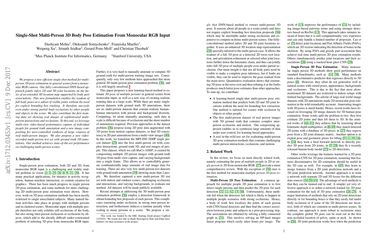
We propose a new single-shot method for multi-person 3D pose estimation in general scenes from a monocular RGB camera. Our approach uses novel occlusion-robust pose-maps (ORPM) which enable full body pose inference even under strong partial occlusions by other people and objects in the scene. ORPM outputs a fixed number of maps which encode the 3D joint locations of all people in the scene. Body part associations allow us to infer 3D pose for an arbitrary number of people without explicit bounding box prediction. To train our approach we introduce MuCo-3DHP, the first large scale training data set showing real images of sophisticated multi-person interactions and occlusions. We synthesize a large corpus of multi-person images by compositing images of individual people (with ground truth from mutli-view performance capture). We evaluate our method on our new challenging 3D annotated multi-person test set MuPoTs-3D where we achieve state-of-the-art performance. To further stimulate research in multi-person 3D pose estimation, we will make our new datasets, and associated code publicly available for research purposes.
Despite superior training outcomes, adaptive optimization methods such as Adam, Adagrad or RMSprop have been found to generalize poorly compared to Stochastic gradient descent (SGD). These methods tend to perform well in the initial portion of training but are outperformed by SGD at later stages of training. We investigate a hybrid strategy that begins training with an adaptive method and switches to SGD when appropriate. Concretely, we propose SWATS, a simple strategy which switches from Adam to SGD when a triggering condition is satisfied. The condition we propose relates to the projection of Adam steps on the gradient subspace. By design, the monitoring process for this condition adds very little overhead and does not increase the number of hyperparameters in the optimizer. We report experiments on several standard benchmarks such as: ResNet, SENet, DenseNet and PyramidNet for the CIFAR-10 and CIFAR-100 data sets, ResNet on the tiny-ImageNet data set and language modeling with recurrent networks on the PTB and WT2 data sets. The results show that our strategy is capable of closing the generalization gap between SGD and Adam on a majority of the tasks.
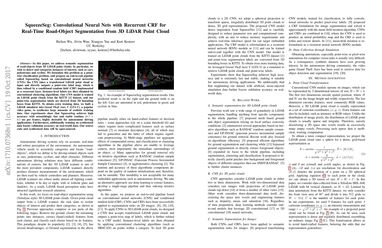
In this paper, we address semantic segmentation of road-objects from 3D LiDAR point clouds. In particular, we wish to detect and categorize instances of interest, such as cars, pedestrians and cyclists. We formulate this problem as a point- wise classification problem, and propose an end-to-end pipeline called SqueezeSeg based on convolutional neural networks (CNN): the CNN takes a transformed LiDAR point cloud as input and directly outputs a point-wise label map, which is then refined by a conditional random field (CRF) implemented as a recurrent layer. Instance-level labels are then obtained by conventional clustering algorithms. Our CNN model is trained on LiDAR point clouds from the KITTI dataset, and our point-wise segmentation labels are derived from 3D bounding boxes from KITTI. To obtain extra training data, we built a LiDAR simulator into Grand Theft Auto V (GTA-V), a popular video game, to synthesize large amounts of realistic training data. Our experiments show that SqueezeSeg achieves high accuracy with astonishingly fast and stable runtime (8.7 ms per frame), highly desirable for autonomous driving applications. Furthermore, additionally training on synthesized data boosts validation accuracy on real-world data. Our source code and synthesized data will be open-sourced.
We propose zoneout, a novel method for regularizing RNNs. At each timestep, zoneout stochastically forces some hidden units to maintain their previous values. Like dropout, zoneout uses random noise to train a pseudo-ensemble, improving generalization. But by preserving instead of dropping hidden units, gradient information and state information are more readily propagated through time, as in feedforward stochastic depth networks. We perform an empirical investigation of various RNN regularizers, and find that zoneout gives significant performance improvements across tasks. We achieve competitive results with relatively simple models in character- and word-level language modelling on the Penn Treebank and Text8 datasets, and combining with recurrent batch normalization yields state-of-the-art results on permuted sequential MNIST.
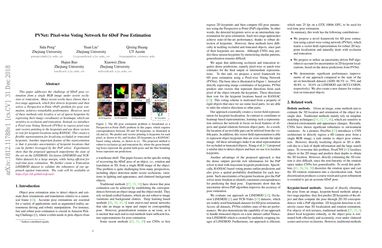
This paper addresses the challenge of 6DoF pose estimation from a single RGB image under severe occlusion or truncation. Many recent works have shown that a two-stage approach, which first detects keypoints and then solves a Perspective-n-Point (PnP) problem for pose estimation, achieves remarkable performance. However, most of these methods only localize a set of sparse keypoints by regressing their image coordinates or heatmaps, which are sensitive to occlusion and truncation. Instead, we introduce a Pixel-wise Voting Network (PVNet) to regress pixel-wise unit vectors pointing to the keypoints and use these vectors to vote for keypoint locations using RANSAC. This creates a flexible representation for localizing occluded or truncated keypoints. Another important feature of this representation is that it provides uncertainties of keypoint locations that can be further leveraged by the PnP solver. Experiments show that the proposed approach outperforms the state of the art on the LINEMOD, Occlusion LINEMOD and YCB-Video datasets by a large margin, while being efficient for real-time pose estimation. We further create a Truncation LINEMOD dataset to validate the robustness of our approach against truncation. The code will be avaliable at https://zju-3dv.github.io/pvnet/.
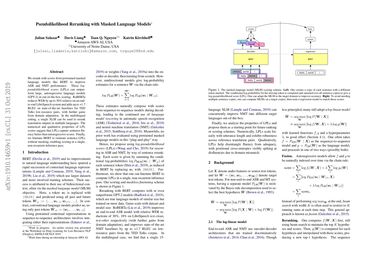
Pretrained masked language models (MLMs) require finetuning for most NLP tasks. Instead, we evaluate MLMs out of the box via their pseudo-log-likelihood scores (PLLs), which are computed by masking tokens one by one. We show that PLLs outperform scores from autoregressive language models like GPT-2 in a variety of tasks. By rescoring ASR and NMT hypotheses, RoBERTa reduces an end-to-end LibriSpeech model's WER by 30% relative and adds up to +1.7 BLEU on state-of-the-art baselines for low-resource translation pairs, with further gains from domain adaptation. We attribute this success to PLL's unsupervised expression of linguistic acceptability without a left-to-right bias, greatly improving on scores from GPT-2 (+10 points on island effects, NPI licensing in BLiMP). One can finetune MLMs to give scores without masking, enabling computation in a single inference pass. In all, PLLs and their associated pseudo-perplexities (PPPLs) enable plug-and-play use of the growing number of pretrained MLMs; e.g., we use a single cross-lingual model to rescore translations in multiple languages. We release our library for language model scoring at https://github.com/awslabs/mlm-scoring.
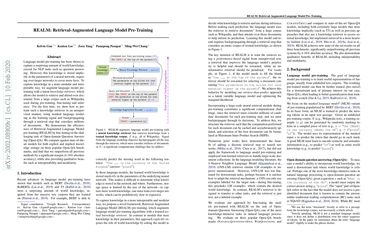
Language model pre-training has been shown to capture a surprising amount of world knowledge, crucial for NLP tasks such as question answering. However, this knowledge is stored implicitly in the parameters of a neural network, requiring ever-larger networks to cover more facts. To capture knowledge in a more modular and interpretable way, we augment language model pre-training with a latent knowledge retriever, which allows the model to retrieve and attend over documents from a large corpus such as Wikipedia, used during pre-training, fine-tuning and inference. For the first time, we show how to pre-train such a knowledge retriever in an unsupervised manner, using masked language modeling as the learning signal and backpropagating through a retrieval step that considers millions of documents. We demonstrate the effectiveness of Retrieval-Augmented Language Model pre-training (REALM) by fine-tuning on the challenging task of Open-domain Question Answering (Open-QA). We compare against state-of-the-art models for both explicit and implicit knowledge storage on three popular Open-QA benchmarks, and find that we outperform all previous methods by a significant margin (4-16% absolute accuracy), while also providing qualitative benefits such as interpretability and modularity.
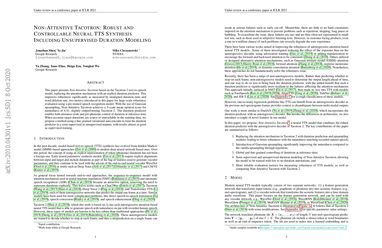
This paper presents Non-Attentive Tacotron based on the Tacotron 2 text-to-speech model, replacing the attention mechanism with an explicit duration predictor. This improves robustness significantly as measured by unaligned duration ratio and word deletion rate, two metrics introduced in this paper for large-scale robustness evaluation using a pre-trained speech recognition model. With the use of Gaussian upsampling, Non-Attentive Tacotron achieves a 5-scale mean opinion score for naturalness of 4.41, slightly outperforming Tacotron 2. The duration predictor enables both utterance-wide and per-phoneme control of duration at inference time. When accurate target durations are scarce or unavailable in the training data, we propose a method using a fine-grained variational auto-encoder to train the duration predictor in a semi-supervised or unsupervised manner, with results almost as good as supervised training.

Research in mechanistic interpretability seeks to explain behaviors of machine learning models in terms of their internal components. However, most previous work either focuses on simple behaviors in small models, or describes complicated behaviors in larger models with broad strokes. In this work, we bridge this gap by presenting an explanation for how GPT-2 small performs a natural language task called indirect object identification (IOI). Our explanation encompasses 26 attention heads grouped into 7 main classes, which we discovered using a combination of interpretability approaches relying on causal interventions. To our knowledge, this investigation is the largest end-to-end attempt at reverse-engineering a natural behavior "in the wild" in a language model. We evaluate the reliability of our explanation using three quantitative criteria--faithfulness, completeness and minimality. Though these criteria support our explanation, they also point to remaining gaps in our understanding. Our work provides evidence that a mechanistic understanding of large ML models is feasible, opening opportunities to scale our understanding to both larger models and more complex tasks.

Generative adversarial networks (GANs) are a learning framework that rely on training a discriminator to estimate a measure of difference between a target and generated distributions. GANs, as normally formulated, rely on the generated samples being completely differentiable w.r.t. the generative parameters, and thus do not work for discrete data. We introduce a method for training GANs with discrete data that uses the estimated difference measure from the discriminator to compute importance weights for generated samples, thus providing a policy gradient for training the generator. The importance weights have a strong connection to the decision boundary of the discriminator, and we call our method boundary-seeking GANs (BGANs). We demonstrate the effectiveness of the proposed algorithm with discrete image and character-based natural language generation. In addition, the boundary-seeking objective extends to continuous data, which can be used to improve stability of training, and we demonstrate this on Celeba, Large-scale Scene Understanding (LSUN) bedrooms, and Imagenet without conditioning.

In this paper, we first investigate why typical two-stage methods are not as fast as single-stage, fast detectors like YOLO and SSD. We find that Faster R-CNN and R-FCN perform an intensive computation after or before RoI warping. Faster R-CNN involves two fully connected layers for RoI recognition, while R-FCN produces a large score maps. Thus, the speed of these networks is slow due to the heavy-head design in the architecture. Even if we significantly reduce the base model, the computation cost cannot be largely decreased accordingly. We propose a new two-stage detector, Light-Head R-CNN, to address the shortcoming in current two-stage approaches. In our design, we make the head of network as light as possible, by using a thin feature map and a cheap R-CNN subnet (pooling and single fully-connected layer). Our ResNet-101 based light-head R-CNN outperforms state-of-art object detectors on COCO while keeping time efficiency. More importantly, simply replacing the backbone with a tiny network (e.g, Xception), our Light-Head R-CNN gets 30.7 mmAP at 102 FPS on COCO, significantly outperforming the single-stage, fast detectors like YOLO and SSD on both speed and accuracy. Code will be made publicly available.

Generative Adversarial Nets (GANs) represent an important milestone for effective generative models, which has inspired numerous variants seemingly different from each other. One of the main contributions of this paper is to reveal a unified geometric structure in GAN and its variants. Specifically, we show that the adversarial generative model training can be decomposed into three geometric steps: separating hyperplane search, discriminator parameter update away from the separating hyperplane, and the generator update along the normal vector direction of the separating hyperplane. This geometric intuition reveals the limitations of the existing approaches and leads us to propose a new formulation called geometric GAN using SVM separating hyperplane that maximizes the margin. Our theoretical analysis shows that the geometric GAN converges to a Nash equilibrium between the discriminator and generator. In addition, extensive numerical results show that the superior performance of geometric GAN.