
分享
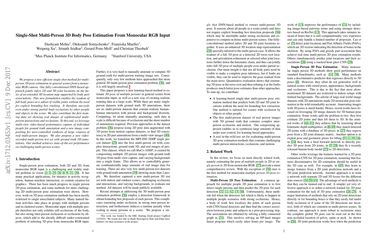
We propose a new single-shot method for multi-person 3D pose estimation in general scenes from a monocular RGB camera. Our approach uses novel occlusion-robust pose-maps (ORPM) which enable full body pose inference even under strong partial occlusions by other people and objects in the scene. ORPM outputs a fixed number of maps which encode the 3D joint locations of all people in the scene. Body part associations allow us to infer 3D pose for an arbitrary number of people without explicit bounding box prediction. To train our approach we introduce MuCo-3DHP, the first large scale training data set showing real images of sophisticated multi-person interactions and occlusions. We synthesize a large corpus of multi-person images by compositing images of individual people (with ground truth from mutli-view performance capture). We evaluate our method on our new challenging 3D annotated multi-person test set MuPoTs-3D where we achieve state-of-the-art performance. To further stimulate research in multi-person 3D pose estimation, we will make our new datasets, and associated code publicly available for research purposes.
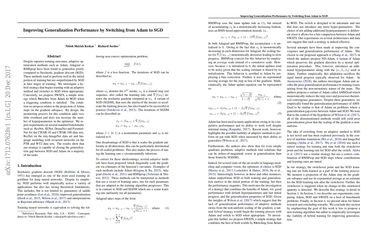
Despite superior training outcomes, adaptive optimization methods such as Adam, Adagrad or RMSprop have been found to generalize poorly compared to Stochastic gradient descent (SGD). These methods tend to perform well in the initial portion of training but are outperformed by SGD at later stages of training. We investigate a hybrid strategy that begins training with an adaptive method and switches to SGD when appropriate. Concretely, we propose SWATS, a simple strategy which switches from Adam to SGD when a triggering condition is satisfied. The condition we propose relates to the projection of Adam steps on the gradient subspace. By design, the monitoring process for this condition adds very little overhead and does not increase the number of hyperparameters in the optimizer. We report experiments on several standard benchmarks such as: ResNet, SENet, DenseNet and PyramidNet for the CIFAR-10 and CIFAR-100 data sets, ResNet on the tiny-ImageNet data set and language modeling with recurrent networks on the PTB and WT2 data sets. The results show that our strategy is capable of closing the generalization gap between SGD and Adam on a majority of the tasks.
We introduce recurrent neural network grammars, probabilistic models of sentences with explicit phrase structure. We explain efficient inference procedures that allow application to both parsing and language modeling. Experiments show that they provide better parsing in English than any single previously published supervised generative model and better language modeling than state-of-the-art sequential RNNs in English and Chinese.
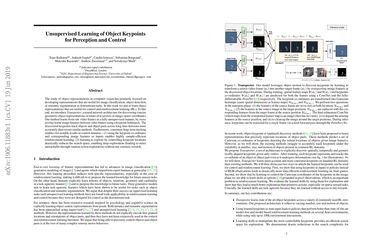
The study of object representations in computer vision has primarily focused on developing representations that are useful for image classification, object detection, or semantic segmentation as downstream tasks. In this work we aim to learn object representations that are useful for control and reinforcement learning (RL). To this end, we introduce Transporter, a neural network architecture for discovering concise geometric object representations in terms of keypoints or image-space coordinates. Our method learns from raw video frames in a fully unsupervised manner, by transporting learnt image features between video frames using a keypoint bottleneck. The discovered keypoints track objects and object parts across long time-horizons more accurately than recent similar methods. Furthermore, consistent long-term tracking enables two notable results in control domains -- (1) using the keypoint co-ordinates and corresponding image features as inputs enables highly sample-efficient reinforcement learning; (2) learning to explore by controlling keypoint locations drastically reduces the search space, enabling deep exploration (leading to states unreachable through random action exploration) without any extrinsic rewards.
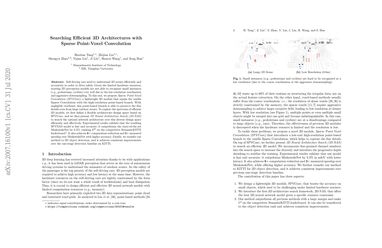
Self-driving cars need to understand 3D scenes efficiently and accurately in order to drive safely. Given the limited hardware resources, existing 3D perception models are not able to recognize small instances (e.g., pedestrians, cyclists) very well due to the low-resolution voxelization and aggressive downsampling. To this end, we propose Sparse Point-Voxel Convolution (SPVConv), a lightweight 3D module that equips the vanilla Sparse Convolution with the high-resolution point-based branch. With negligible overhead, this point-based branch is able to preserve the fine details even from large outdoor scenes. To explore the spectrum of efficient 3D models, we first define a flexible architecture design space based on SPVConv, and we then present 3D Neural Architecture Search (3D-NAS) to search the optimal network architecture over this diverse design space efficiently and effectively. Experimental results validate that the resulting SPVNAS model is fast and accurate: it outperforms the state-of-the-art MinkowskiNet by 3.3%, ranking 1st on the competitive SemanticKITTI leaderboard. It also achieves 8x computation reduction and 3x measured speedup over MinkowskiNet with higher accuracy. Finally, we transfer our method to 3D object detection, and it achieves consistent improvements over the one-stage detection baseline on KITTI.
This paper presents Non-Attentive Tacotron based on the Tacotron 2 text-to-speech model, replacing the attention mechanism with an explicit duration predictor. This improves robustness significantly as measured by unaligned duration ratio and word deletion rate, two metrics introduced in this paper for large-scale robustness evaluation using a pre-trained speech recognition model. With the use of Gaussian upsampling, Non-Attentive Tacotron achieves a 5-scale mean opinion score for naturalness of 4.41, slightly outperforming Tacotron 2. The duration predictor enables both utterance-wide and per-phoneme control of duration at inference time. When accurate target durations are scarce or unavailable in the training data, we propose a method using a fine-grained variational auto-encoder to train the duration predictor in a semi-supervised or unsupervised manner, with results almost as good as supervised training.

Recent advances in deep learning have relied heavily on the use of large Transformers due to their ability to learn at scale. However, the core building block of Transformers, the attention operator, exhibits quadratic cost in sequence length, limiting the amount of context accessible. Existing subquadratic methods based on low-rank and sparse approximations need to be combined with dense attention layers to match Transformers, indicating a gap in capability. In this work, we propose Hyena, a subquadratic drop-in replacement for attention constructed by interleaving implicitly parametrized long convolutions and data-controlled gating. In recall and reasoning tasks on sequences of thousands to hundreds of thousands of tokens, Hyena improves accuracy by more than 50 points over operators relying on state-spaces and other implicit and explicit methods, matching attention-based models. We set a new state-of-the-art for dense-attention-free architectures on language modeling in standard datasets (WikiText103 and The Pile), reaching Transformer quality with a 20% reduction in training compute required at sequence length 2K. Hyena operators are twice as fast as highly optimized attention at sequence length 8K, and 100x faster at sequence length 64K.

Automatically generating coherent and semantically meaningful text has many applications in machine translation, dialogue systems, image captioning, etc. Recently, by combining with policy gradient, Generative Adversarial Nets (GAN) that use a discriminative model to guide the training of the generative model as a reinforcement learning policy has shown promising results in text generation. However, the scalar guiding signal is only available after the entire text has been generated and lacks intermediate information about text structure during the generative process. As such, it limits its success when the length of the generated text samples is long (more than 20 words). In this paper, we propose a new framework, called LeakGAN, to address the problem for long text generation. We allow the discriminative net to leak its own high-level extracted features to the generative net to further help the guidance. The generator incorporates such informative signals into all generation steps through an additional Manager module, which takes the extracted features of current generated words and outputs a latent vector to guide the Worker module for next-word generation. Our extensive experiments on synthetic data and various real-world tasks with Turing test demonstrate that LeakGAN is highly effective in long text generation and also improves the performance in short text generation scenarios. More importantly, without any supervision, LeakGAN would be able to implicitly learn sentence structures only through the interaction between Manager and Worker.

We consider the problem of parsing natural language descriptions into source code written in a general-purpose programming language like Python. Existing data-driven methods treat this problem as a language generation task without considering the underlying syntax of the target programming language. Informed by previous work in semantic parsing, in this paper we propose a novel neural architecture powered by a grammar model to explicitly capture the target syntax as prior knowledge. Experiments find this an effective way to scale up to generation of complex programs from natural language descriptions, achieving state-of-the-art results that well outperform previous code generation and semantic parsing approaches.

Neural text generation is a key tool in natural language applications, but it is well known there are major problems at its core. In particular, standard likelihood training and decoding leads to dull and repetitive outputs. While some post-hoc fixes have been proposed, in particular top-$k$ and nucleus sampling, they do not address the fact that the token-level probabilities predicted by the model are poor. In this paper we show that the likelihood objective itself is at fault, resulting in a model that assigns too much probability to sequences containing repeats and frequent words, unlike those from the human training distribution. We propose a new objective, unlikelihood training, which forces unlikely generations to be assigned lower probability by the model. We show that both token and sequence level unlikelihood training give less repetitive, less dull text while maintaining perplexity, giving superior generations using standard greedy or beam search. According to human evaluations, our approach with standard beam search also outperforms the currently popular decoding methods of nucleus sampling or beam blocking, thus providing a strong alternative to existing techniques.

In real-time, social media data strongly imprints world events, popular culture, and day-to-day conversations by millions of ordinary people at a scale that is scarcely conventionalized and recorded. Vitally, and absent from many standard corpora such as books and news archives, sharing and commenting mechanisms are native to social media platforms, enabling us to quantify social amplification (i.e., popularity) of trending storylines and contemporary cultural phenomena. Here, we describe Storywrangler, a natural language processing instrument designed to carry out an ongoing, day-scale curation of over 100 billion tweets containing roughly 1 trillion 1-grams from 2008 to 2021. For each day, we break tweets into unigrams, bigrams, and trigrams spanning over 100 languages. We track n-gram usage frequencies, and generate Zipf distributions, for words, hashtags, handles, numerals, symbols, and emojis. We make the data set available through an interactive time series viewer, and as downloadable time series and daily distributions. Although Storywrangler leverages Twitter data, our method of extracting and tracking dynamic changes of n-grams can be extended to any similar social media platform. We showcase a few examples of the many possible avenues of study we aim to enable including how social amplification can be visualized through 'contagiograms'. We also present some example case studies that bridge n-gram time series with disparate data sources to explore sociotechnical dynamics of famous individuals, box office success, and social unrest.

Developing architectures suitable for modeling raw audio is a challenging problem due to the high sampling rates of audio waveforms. Standard sequence modeling approaches like RNNs and CNNs have previously been tailored to fit the demands of audio, but the resultant architectures make undesirable computational tradeoffs and struggle to model waveforms effectively. We propose SaShiMi, a new multi-scale architecture for waveform modeling built around the recently introduced S4 model for long sequence modeling. We identify that S4 can be unstable during autoregressive generation, and provide a simple improvement to its parameterization by drawing connections to Hurwitz matrices. SaShiMi yields state-of-the-art performance for unconditional waveform generation in the autoregressive setting. Additionally, SaShiMi improves non-autoregressive generation performance when used as the backbone architecture for a diffusion model. Compared to prior architectures in the autoregressive generation setting, SaShiMi generates piano and speech waveforms which humans find more musical and coherent respectively, e.g. 2x better mean opinion scores than WaveNet on an unconditional speech generation task. On a music generation task, SaShiMi outperforms WaveNet on density estimation and speed at both training and inference even when using 3x fewer parameters. Code can be found at https://github.com/HazyResearch/state-spaces and samples at https://hazyresearch.stanford.edu/sashimi-examples.