
分享
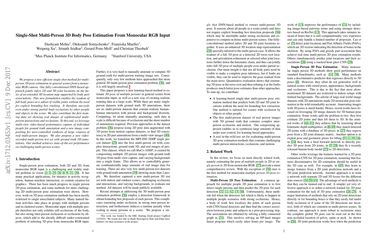
We propose a new single-shot method for multi-person 3D pose estimation in general scenes from a monocular RGB camera. Our approach uses novel occlusion-robust pose-maps (ORPM) which enable full body pose inference even under strong partial occlusions by other people and objects in the scene. ORPM outputs a fixed number of maps which encode the 3D joint locations of all people in the scene. Body part associations allow us to infer 3D pose for an arbitrary number of people without explicit bounding box prediction. To train our approach we introduce MuCo-3DHP, the first large scale training data set showing real images of sophisticated multi-person interactions and occlusions. We synthesize a large corpus of multi-person images by compositing images of individual people (with ground truth from mutli-view performance capture). We evaluate our method on our new challenging 3D annotated multi-person test set MuPoTs-3D where we achieve state-of-the-art performance. To further stimulate research in multi-person 3D pose estimation, we will make our new datasets, and associated code publicly available for research purposes.
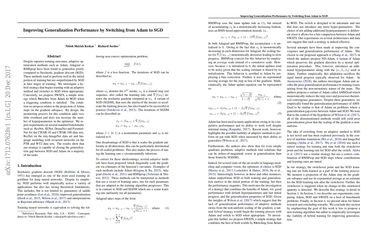
Despite superior training outcomes, adaptive optimization methods such as Adam, Adagrad or RMSprop have been found to generalize poorly compared to Stochastic gradient descent (SGD). These methods tend to perform well in the initial portion of training but are outperformed by SGD at later stages of training. We investigate a hybrid strategy that begins training with an adaptive method and switches to SGD when appropriate. Concretely, we propose SWATS, a simple strategy which switches from Adam to SGD when a triggering condition is satisfied. The condition we propose relates to the projection of Adam steps on the gradient subspace. By design, the monitoring process for this condition adds very little overhead and does not increase the number of hyperparameters in the optimizer. We report experiments on several standard benchmarks such as: ResNet, SENet, DenseNet and PyramidNet for the CIFAR-10 and CIFAR-100 data sets, ResNet on the tiny-ImageNet data set and language modeling with recurrent networks on the PTB and WT2 data sets. The results show that our strategy is capable of closing the generalization gap between SGD and Adam on a majority of the tasks.
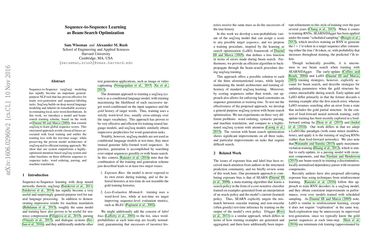
Sequence-to-Sequence (seq2seq) modeling has rapidly become an important general-purpose NLP tool that has proven effective for many text-generation and sequence-labeling tasks. Seq2seq builds on deep neural language modeling and inherits its remarkable accuracy in estimating local, next-word distributions. In this work, we introduce a model and beam-search training scheme, based on the work of Daume III and Marcu (2005), that extends seq2seq to learn global sequence scores. This structured approach avoids classical biases associated with local training and unifies the training loss with the test-time usage, while preserving the proven model architecture of seq2seq and its efficient training approach. We show that our system outperforms a highly-optimized attention-based seq2seq system and other baselines on three different sequence to sequence tasks: word ordering, parsing, and machine translation.
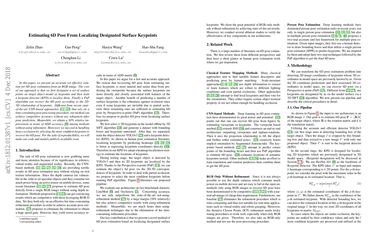
In this paper, we present an accurate yet effective solution for 6D pose estimation from an RGB image. The core of our approach is that we first designate a set of surface points on target object model as keypoints and then train a keypoint detector (KPD) to localize them. Finally a PnP algorithm can recover the 6D pose according to the 2D-3D relationship of keypoints. Different from recent state-of-the-art CNN-based approaches that rely on a time-consuming post-processing procedure, our method can achieve competitive accuracy without any refinement after pose prediction. Meanwhile, we obtain a 30% relative improvement in terms of ADD accuracy among methods without using refinement. Moreover, we succeed in handling heavy occlusion by selecting the most confident keypoints to recover the 6D pose. For the sake of reproducibility, we will make our code and models publicly available soon.
Bidirectional Encoder Representations from Transformers (BERT) has shown marvelous improvements across various NLP tasks, and consecutive variants have been proposed to further improve the performance of the pre-trained language models. In this paper, we target on revisiting Chinese pre-trained language models to examine their effectiveness in a non-English language and release the Chinese pre-trained language model series to the community. We also propose a simple but effective model called MacBERT, which improves upon RoBERTa in several ways, especially the masking strategy that adopts MLM as correction (Mac). We carried out extensive experiments on eight Chinese NLP tasks to revisit the existing pre-trained language models as well as the proposed MacBERT. Experimental results show that MacBERT could achieve state-of-the-art performances on many NLP tasks, and we also ablate details with several findings that may help future research. Resources available: https://github.com/ymcui/MacBERT
Self-driving cars need to understand 3D scenes efficiently and accurately in order to drive safely. Given the limited hardware resources, existing 3D perception models are not able to recognize small instances (e.g., pedestrians, cyclists) very well due to the low-resolution voxelization and aggressive downsampling. To this end, we propose Sparse Point-Voxel Convolution (SPVConv), a lightweight 3D module that equips the vanilla Sparse Convolution with the high-resolution point-based branch. With negligible overhead, this point-based branch is able to preserve the fine details even from large outdoor scenes. To explore the spectrum of efficient 3D models, we first define a flexible architecture design space based on SPVConv, and we then present 3D Neural Architecture Search (3D-NAS) to search the optimal network architecture over this diverse design space efficiently and effectively. Experimental results validate that the resulting SPVNAS model is fast and accurate: it outperforms the state-of-the-art MinkowskiNet by 3.3%, ranking 1st on the competitive SemanticKITTI leaderboard. It also achieves 8x computation reduction and 3x measured speedup over MinkowskiNet with higher accuracy. Finally, we transfer our method to 3D object detection, and it achieves consistent improvements over the one-stage detection baseline on KITTI.
This paper presents Non-Attentive Tacotron based on the Tacotron 2 text-to-speech model, replacing the attention mechanism with an explicit duration predictor. This improves robustness significantly as measured by unaligned duration ratio and word deletion rate, two metrics introduced in this paper for large-scale robustness evaluation using a pre-trained speech recognition model. With the use of Gaussian upsampling, Non-Attentive Tacotron achieves a 5-scale mean opinion score for naturalness of 4.41, slightly outperforming Tacotron 2. The duration predictor enables both utterance-wide and per-phoneme control of duration at inference time. When accurate target durations are scarce or unavailable in the training data, we propose a method using a fine-grained variational auto-encoder to train the duration predictor in a semi-supervised or unsupervised manner, with results almost as good as supervised training.

Research in mechanistic interpretability seeks to explain behaviors of machine learning models in terms of their internal components. However, most previous work either focuses on simple behaviors in small models, or describes complicated behaviors in larger models with broad strokes. In this work, we bridge this gap by presenting an explanation for how GPT-2 small performs a natural language task called indirect object identification (IOI). Our explanation encompasses 26 attention heads grouped into 7 main classes, which we discovered using a combination of interpretability approaches relying on causal interventions. To our knowledge, this investigation is the largest end-to-end attempt at reverse-engineering a natural behavior "in the wild" in a language model. We evaluate the reliability of our explanation using three quantitative criteria--faithfulness, completeness and minimality. Though these criteria support our explanation, they also point to remaining gaps in our understanding. Our work provides evidence that a mechanistic understanding of large ML models is feasible, opening opportunities to scale our understanding to both larger models and more complex tasks.

Generative adversarial networks (GANs) are a learning framework that rely on training a discriminator to estimate a measure of difference between a target and generated distributions. GANs, as normally formulated, rely on the generated samples being completely differentiable w.r.t. the generative parameters, and thus do not work for discrete data. We introduce a method for training GANs with discrete data that uses the estimated difference measure from the discriminator to compute importance weights for generated samples, thus providing a policy gradient for training the generator. The importance weights have a strong connection to the decision boundary of the discriminator, and we call our method boundary-seeking GANs (BGANs). We demonstrate the effectiveness of the proposed algorithm with discrete image and character-based natural language generation. In addition, the boundary-seeking objective extends to continuous data, which can be used to improve stability of training, and we demonstrate this on Celeba, Large-scale Scene Understanding (LSUN) bedrooms, and Imagenet without conditioning.

Automatically generating coherent and semantically meaningful text has many applications in machine translation, dialogue systems, image captioning, etc. Recently, by combining with policy gradient, Generative Adversarial Nets (GAN) that use a discriminative model to guide the training of the generative model as a reinforcement learning policy has shown promising results in text generation. However, the scalar guiding signal is only available after the entire text has been generated and lacks intermediate information about text structure during the generative process. As such, it limits its success when the length of the generated text samples is long (more than 20 words). In this paper, we propose a new framework, called LeakGAN, to address the problem for long text generation. We allow the discriminative net to leak its own high-level extracted features to the generative net to further help the guidance. The generator incorporates such informative signals into all generation steps through an additional Manager module, which takes the extracted features of current generated words and outputs a latent vector to guide the Worker module for next-word generation. Our extensive experiments on synthetic data and various real-world tasks with Turing test demonstrate that LeakGAN is highly effective in long text generation and also improves the performance in short text generation scenarios. More importantly, without any supervision, LeakGAN would be able to implicitly learn sentence structures only through the interaction between Manager and Worker.

Generative Adversarial Nets (GANs) represent an important milestone for effective generative models, which has inspired numerous variants seemingly different from each other. One of the main contributions of this paper is to reveal a unified geometric structure in GAN and its variants. Specifically, we show that the adversarial generative model training can be decomposed into three geometric steps: separating hyperplane search, discriminator parameter update away from the separating hyperplane, and the generator update along the normal vector direction of the separating hyperplane. This geometric intuition reveals the limitations of the existing approaches and leads us to propose a new formulation called geometric GAN using SVM separating hyperplane that maximizes the margin. Our theoretical analysis shows that the geometric GAN converges to a Nash equilibrium between the discriminator and generator. In addition, extensive numerical results show that the superior performance of geometric GAN.

Natural language generation of coherent long texts like paragraphs or longer documents is a challenging problem for recurrent networks models. In this paper, we explore an important step toward this generation task: training an LSTM (Long-short term memory) auto-encoder to preserve and reconstruct multi-sentence paragraphs. We introduce an LSTM model that hierarchically builds an embedding for a paragraph from embeddings for sentences and words, then decodes this embedding to reconstruct the original paragraph. We evaluate the reconstructed paragraph using standard metrics like ROUGE and Entity Grid, showing that neural models are able to encode texts in a way that preserve syntactic, semantic, and discourse coherence. While only a first step toward generating coherent text units from neural models, our work has the potential to significantly impact natural language generation and summarization\footnote{Code for the three models described in this paper can be found at www.stanford.edu/~jiweil/ .