
分享
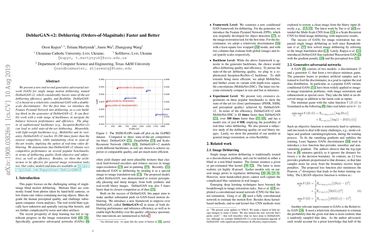
We present a new end-to-end generative adversarial network (GAN) for single image motion deblurring, named DeblurGAN-v2, which considerably boosts state-of-the-art deblurring efficiency, quality, and flexibility. DeblurGAN-v2 is based on a relativistic conditional GAN with a double-scale discriminator. For the first time, we introduce the Feature Pyramid Network into deblurring, as a core building block in the generator of DeblurGAN-v2. It can flexibly work with a wide range of backbones, to navigate the balance between performance and efficiency. The plug-in of sophisticated backbones (e.g., Inception-ResNet-v2) can lead to solid state-of-the-art deblurring. Meanwhile, with light-weight backbones (e.g., MobileNet and its variants), DeblurGAN-v2 reaches 10-100 times faster than the nearest competitors, while maintaining close to state-of-the-art results, implying the option of real-time video deblurring. We demonstrate that DeblurGAN-v2 obtains very competitive performance on several popular benchmarks, in terms of deblurring quality (both objective and subjective), as well as efficiency. Besides, we show the architecture to be effective for general image restoration tasks too. Our codes, models and data are available at: https://github.com/KupynOrest/DeblurGANv2
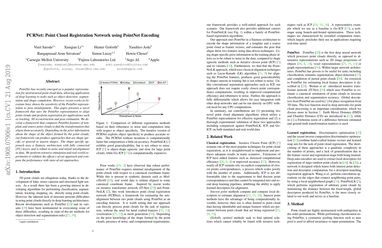
PointNet has recently emerged as a popular representation for unstructured point cloud data, allowing application of deep learning to tasks such as object detection, segmentation and shape completion. However, recent works in literature have shown the sensitivity of the PointNet representation to pose misalignment. This paper presents a novel framework that uses the PointNet representation to align point clouds and perform registration for applications such as tracking, 3D reconstruction and pose estimation. We develop a framework that compares PointNet features of template and source point clouds to find the transformation that aligns them accurately. Depending on the prior information about the shape of the object formed by the point clouds, our framework can produce approaches that are shape specific or general to unseen shapes. The shape specific approach uses a Siamese architecture with fully connected (FC) layers and is robust to noise and initial misalignment in data. We perform extensive simulation and real-world experiments to validate the efficacy of our approach and compare the performance with state-of-art approaches.
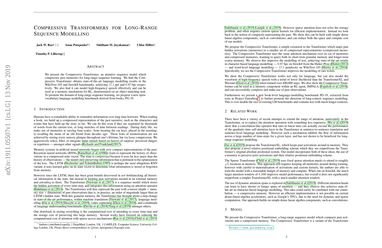
We present the Compressive Transformer, an attentive sequence model which compresses past memories for long-range sequence learning. We find the Compressive Transformer obtains state-of-the-art language modelling results in the WikiText-103 and Enwik8 benchmarks, achieving 17.1 ppl and 0.97 bpc respectively. We also find it can model high-frequency speech effectively and can be used as a memory mechanism for RL, demonstrated on an object matching task. To promote the domain of long-range sequence learning, we propose a new open-vocabulary language modelling benchmark derived from books, PG-19.
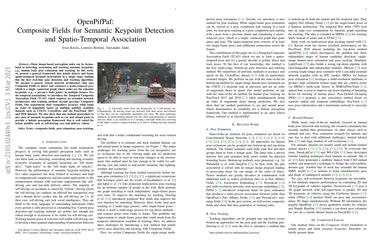
Many image-based perception tasks can be formulated as detecting, associating and tracking semantic keypoints, e.g., human body pose estimation and tracking. In this work, we present a general framework that jointly detects and forms spatio-temporal keypoint associations in a single stage, making this the first real-time pose detection and tracking algorithm. We present a generic neural network architecture that uses Composite Fields to detect and construct a spatio-temporal pose which is a single, connected graph whose nodes are the semantic keypoints (e.g., a person's body joints) in multiple frames. For the temporal associations, we introduce the Temporal Composite Association Field (TCAF) which requires an extended network architecture and training method beyond previous Composite Fields. Our experiments show competitive accuracy while being an order of magnitude faster on multiple publicly available datasets such as COCO, CrowdPose and the PoseTrack 2017 and 2018 datasets. We also show that our method generalizes to any class of semantic keypoints such as car and animal parts to provide a holistic perception framework that is well suited for urban mobility such as self-driving cars and delivery robots.
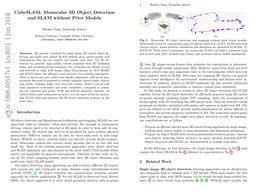
We present a method for single image 3D cuboid object detection and multi-view object SLAM in both static and dynamic environments, and demonstrate that the two parts can improve each other. Firstly for single image object detection, we generate high-quality cuboid proposals from 2D bounding boxes and vanishing points sampling. The proposals are further scored and selected based on the alignment with image edges. Secondly, multi-view bundle adjustment with new object measurements is proposed to jointly optimize poses of cameras, objects and points. Objects can provide long-range geometric and scale constraints to improve camera pose estimation and reduce monocular drift. Instead of treating dynamic regions as outliers, we utilize object representation and motion model constraints to improve the camera pose estimation. The 3D detection experiments on SUN RGBD and KITTI show better accuracy and robustness over existing approaches. On the public TUM, KITTI odometry and our own collected datasets, our SLAM method achieves the state-of-the-art monocular camera pose estimation and at the same time, improves the 3D object detection accuracy.
The topic of multi-person pose estimation has been largely improved recently, especially with the development of convolutional neural network. However, there still exist a lot of challenging cases, such as occluded keypoints, invisible keypoints and complex background, which cannot be well addressed. In this paper, we present a novel network structure called Cascaded Pyramid Network (CPN) which targets to relieve the problem from these "hard" keypoints. More specifically, our algorithm includes two stages: GlobalNet and RefineNet. GlobalNet is a feature pyramid network which can successfully localize the "simple" keypoints like eyes and hands but may fail to precisely recognize the occluded or invisible keypoints. Our RefineNet tries explicitly handling the "hard" keypoints by integrating all levels of feature representations from the GlobalNet together with an online hard keypoint mining loss. In general, to address the multi-person pose estimation problem, a top-down pipeline is adopted to first generate a set of human bounding boxes based on a detector, followed by our CPN for keypoint localization in each human bounding box. Based on the proposed algorithm, we achieve state-of-art results on the COCO keypoint benchmark, with average precision at 73.0 on the COCO test-dev dataset and 72.1 on the COCO test-challenge dataset, which is a 19% relative improvement compared with 60.5 from the COCO 2016 keypoint challenge.Code (https://github.com/chenyilun95/tf-cpn.git) and the detection results are publicly available for further research.
Submanifold sparse convolutional networks
This paper introduces Graph Convolutional Recurrent Network (GCRN), a deep learning model able to predict structured sequences of data. Precisely, GCRN is a generalization of classical recurrent neural networks (RNN) to data structured by an arbitrary graph. Such structured sequences can represent series of frames in videos, spatio-temporal measurements on a network of sensors, or random walks on a vocabulary graph for natural language modeling. The proposed model combines convolutional neural networks (CNN) on graphs to identify spatial structures and RNN to find dynamic patterns. We study two possible architectures of GCRN, and apply the models to two practical problems: predicting moving MNIST data, and modeling natural language with the Penn Treebank dataset. Experiments show that exploiting simultaneously graph spatial and dynamic information about data can improve both precision and learning speed.
In this work, we propose a new solution for parallel wave generation by WaveNet. In contrast to parallel WaveNet (van den Oord et al., 2018), we distill a Gaussian inverse autoregressive flow from the autoregressive WaveNet by minimizing a regularized KL divergence between their highly-peaked output distributions. Our method computes the KL divergence in closed-form, which simplifies the training algorithm and provides very efficient distillation. In addition, we introduce the first text-to-wave neural architecture for speech synthesis, which is fully convolutional and enables fast end-to-end training from scratch. It significantly outperforms the previous pipeline that connects a text-to-spectrogram model to a separately trained WaveNet (Ping et al., 2018). We also successfully distill a parallel waveform synthesizer conditioned on the hidden representation in this end-to-end model.
We introduce "talking-heads attention" - a variation on multi-head attention which includes linearprojections across the attention-heads dimension, immediately before and after the softmax operation.While inserting only a small number of additional parameters and a moderate amount of additionalcomputation, talking-heads attention leads to better perplexities on masked language modeling tasks, aswell as better quality when transfer-learning to language comprehension and question answering tasks.
We introduce BitFit, a sparse-finetuning method where only the bias-terms of the model (or a subset of them) are being modified. We show that with small-to-medium training data, applying BitFit on pre-trained BERT models is competitive with (and sometimes better than) fine-tuning the entire model. For larger data, the method is competitive with other sparse fine-tuning methods. Besides their practical utility, these findings are relevant for the question of understanding the commonly-used process of finetuning: they support the hypothesis that finetuning is mainly about exposing knowledge induced by language-modeling training, rather than learning new task-specific linguistic knowledge.

Given two consecutive frames, video interpolation aims at generating intermediate frame(s) to form both spatially and temporally coherent video sequences. While most existing methods focus on single-frame interpolation, we propose an end-to-end convolutional neural network for variable-length multi-frame video interpolation, where the motion interpretation and occlusion reasoning are jointly modeled. We start by computing bi-directional optical flow between the input images using a U-Net architecture. These flows are then linearly combined at each time step to approximate the intermediate bi-directional optical flows. These approximate flows, however, only work well in locally smooth regions and produce artifacts around motion boundaries. To address this shortcoming, we employ another U-Net to refine the approximated flow and also predict soft visibility maps. Finally, the two input images are warped and linearly fused to form each intermediate frame. By applying the visibility maps to the warped images before fusion, we exclude the contribution of occluded pixels to the interpolated intermediate frame to avoid artifacts. Since none of our learned network parameters are time-dependent, our approach is able to produce as many intermediate frames as needed. We use 1,132 video clips with 240-fps, containing 300K individual video frames, to train our network. Experimental results on several datasets, predicting different numbers of interpolated frames, demonstrate that our approach performs consistently better than existing methods.