
分享
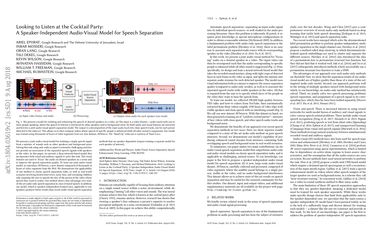
We present a joint audio-visual model for isolating a single speech signal from a mixture of sounds such as other speakers and background noise. Solving this task using only audio as input is extremely challenging and does not provide an association of the separated speech signals with speakers in the video. In this paper, we present a deep network-based model that incorporates both visual and auditory signals to solve this task. The visual features are used to "focus" the audio on desired speakers in a scene and to improve the speech separation quality. To train our joint audio-visual model, we introduce AVSpeech, a new dataset comprised of thousands of hours of video segments from the Web. We demonstrate the applicability of our method to classic speech separation tasks, as well as real-world scenarios involving heated interviews, noisy bars, and screaming children, only requiring the user to specify the face of the person in the video whose speech they want to isolate. Our method shows clear advantage over state-of-the-art audio-only speech separation in cases of mixed speech. In addition, our model, which is speaker-independent (trained once, applicable to any speaker), produces better results than recent audio-visual speech separation methods that are speaker-dependent (require training a separate model for each speaker of interest).
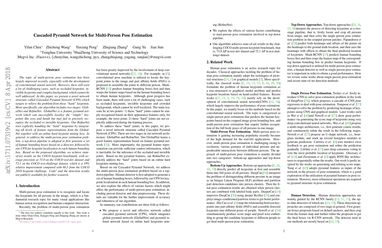
The topic of multi-person pose estimation has been largely improved recently, especially with the development of convolutional neural network. However, there still exist a lot of challenging cases, such as occluded keypoints, invisible keypoints and complex background, which cannot be well addressed. In this paper, we present a novel network structure called Cascaded Pyramid Network (CPN) which targets to relieve the problem from these "hard" keypoints. More specifically, our algorithm includes two stages: GlobalNet and RefineNet. GlobalNet is a feature pyramid network which can successfully localize the "simple" keypoints like eyes and hands but may fail to precisely recognize the occluded or invisible keypoints. Our RefineNet tries explicitly handling the "hard" keypoints by integrating all levels of feature representations from the GlobalNet together with an online hard keypoint mining loss. In general, to address the multi-person pose estimation problem, a top-down pipeline is adopted to first generate a set of human bounding boxes based on a detector, followed by our CPN for keypoint localization in each human bounding box. Based on the proposed algorithm, we achieve state-of-art results on the COCO keypoint benchmark, with average precision at 73.0 on the COCO test-dev dataset and 72.1 on the COCO test-challenge dataset, which is a 19% relative improvement compared with 60.5 from the COCO 2016 keypoint challenge.Code (https://github.com/chenyilun95/tf-cpn.git) and the detection results are publicly available for further research.
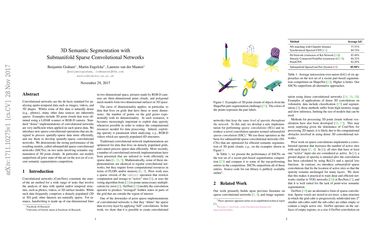
Submanifold sparse convolutional networks
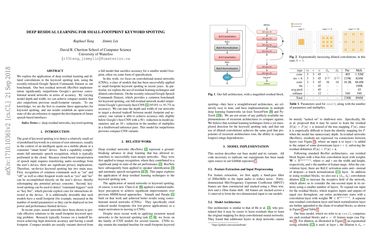
We explore the application of deep residual learning and dilated convolutions to the keyword spotting task, using the recently-released Google Speech Commands Dataset as our benchmark. Our best residual network (ResNet) implementation significantly outperforms Google's previous convolutional neural networks in terms of accuracy. By varying model depth and width, we can achieve compact models that also outperform previous small-footprint variants. To our knowledge, we are the first to examine these approaches for keyword spotting, and our results establish an open-source state-of-the-art reference to support the development of future speech-based interfaces.
Recurrent neural networks have been very successful at predicting sequences of words in tasks such as language modeling. However, all such models are based on the conventional classification framework, where the model is trained against one-hot targets, and each word is represented both as an input and as an output in isolation. This causes inefficiencies in learning both in terms of utilizing all of the information and in terms of the number of parameters needed to train. We introduce a novel theoretical framework that facilitates better learning in language modeling, and show that our framework leads to tying together the input embedding and the output projection matrices, greatly reducing the number of trainable variables. Our framework leads to state of the art performance on the Penn Treebank with a variety of network models.
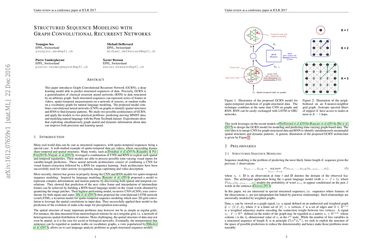
This paper introduces Graph Convolutional Recurrent Network (GCRN), a deep learning model able to predict structured sequences of data. Precisely, GCRN is a generalization of classical recurrent neural networks (RNN) to data structured by an arbitrary graph. Such structured sequences can represent series of frames in videos, spatio-temporal measurements on a network of sensors, or random walks on a vocabulary graph for natural language modeling. The proposed model combines convolutional neural networks (CNN) on graphs to identify spatial structures and RNN to find dynamic patterns. We study two possible architectures of GCRN, and apply the models to two practical problems: predicting moving MNIST data, and modeling natural language with the Penn Treebank dataset. Experiments show that exploiting simultaneously graph spatial and dynamic information about data can improve both precision and learning speed.
Recurrent neural network is a powerful model that learns temporal patterns in sequential data. For a long time, it was believed that recurrent networks are difficult to train using simple optimizers, such as stochastic gradient descent, due to the so-called vanishing gradient problem. In this paper, we show that learning longer term patterns in real data, such as in natural language, is perfectly possible using gradient descent. This is achieved by using a slight structural modification of the simple recurrent neural network architecture. We encourage some of the hidden units to change their state slowly by making part of the recurrent weight matrix close to identity, thus forming kind of a longer term memory. We evaluate our model in language modeling experiments, where we obtain similar performance to the much more complex Long Short Term Memory (LSTM) networks (Hochreiter & Schmidhuber, 1997).
We present a method to perform first-pass large vocabulary continuous speech recognition using only a neural network and language model. Deep neural network acoustic models are now commonplace in HMM-based speech recognition systems, but building such systems is a complex, domain-specific task. Recent work demonstrated the feasibility of discarding the HMM sequence modeling framework by directly predicting transcript text from audio. This paper extends this approach in two ways. First, we demonstrate that a straightforward recurrent neural network architecture can achieve a high level of accuracy. Second, we propose and evaluate a modified prefix-search decoding algorithm. This approach to decoding enables first-pass speech recognition with a language model, completely unaided by the cumbersome infrastructure of HMM-based systems. Experiments on the Wall Street Journal corpus demonstrate fairly competitive word error rates, and the importance of bi-directional network recurrence.
We present a dataset for evaluating the grammaticality of the predictions of a language model. We automatically construct a large number of minimally different pairs of English sentences, each consisting of a grammatical and an ungrammatical sentence. The sentence pairs represent different variations of structure-sensitive phenomena: subject-verb agreement, reflexive anaphora and negative polarity items. We expect a language model to assign a higher probability to the grammatical sentence than the ungrammatical one. In an experiment using this data set, an LSTM language model performed poorly on many of the constructions. Multi-task training with a syntactic objective (CCG supertagging) improved the LSTM's accuracy, but a large gap remained between its performance and the accuracy of human participants recruited online. This suggests that there is considerable room for improvement over LSTMs in capturing syntax in a language model.
The problem of answering questions using knowledge from pre-trained language models (LMs) and knowledge graphs (KGs) presents two challenges: given a QA context (question and answer choice), methods need to (i) identify relevant knowledge from large KGs, and (ii) perform joint reasoning over the QA context and KG. In this work, we propose a new model, QA-GNN, which addresses the above challenges through two key innovations: (i) relevance scoring, where we use LMs to estimate the importance of KG nodes relative to the given QA context, and (ii) joint reasoning, where we connect the QA context and KG to form a joint graph, and mutually update their representations through graph neural networks. We evaluate our model on QA benchmarks in the commonsense (CommonsenseQA, OpenBookQA) and biomedical (MedQA-USMLE) domains. QA-GNN outperforms existing LM and LM+KG models, and exhibits capabilities to perform interpretable and structured reasoning, e.g., correctly handling negation in questions.
We introduce BitFit, a sparse-finetuning method where only the bias-terms of the model (or a subset of them) are being modified. We show that with small-to-medium training data, applying BitFit on pre-trained BERT models is competitive with (and sometimes better than) fine-tuning the entire model. For larger data, the method is competitive with other sparse fine-tuning methods. Besides their practical utility, these findings are relevant for the question of understanding the commonly-used process of finetuning: they support the hypothesis that finetuning is mainly about exposing knowledge induced by language-modeling training, rather than learning new task-specific linguistic knowledge.

Given two consecutive frames, video interpolation aims at generating intermediate frame(s) to form both spatially and temporally coherent video sequences. While most existing methods focus on single-frame interpolation, we propose an end-to-end convolutional neural network for variable-length multi-frame video interpolation, where the motion interpretation and occlusion reasoning are jointly modeled. We start by computing bi-directional optical flow between the input images using a U-Net architecture. These flows are then linearly combined at each time step to approximate the intermediate bi-directional optical flows. These approximate flows, however, only work well in locally smooth regions and produce artifacts around motion boundaries. To address this shortcoming, we employ another U-Net to refine the approximated flow and also predict soft visibility maps. Finally, the two input images are warped and linearly fused to form each intermediate frame. By applying the visibility maps to the warped images before fusion, we exclude the contribution of occluded pixels to the interpolated intermediate frame to avoid artifacts. Since none of our learned network parameters are time-dependent, our approach is able to produce as many intermediate frames as needed. We use 1,132 video clips with 240-fps, containing 300K individual video frames, to train our network. Experimental results on several datasets, predicting different numbers of interpolated frames, demonstrate that our approach performs consistently better than existing methods.