
分享
Recurrent neural networks (RNNs) are a powerful model for sequential data. End-to-end training methods such as Connectionist Temporal Classification make it possible to train RNNs for sequence labelling problems where the input-output alignment is unknown. The combination of these methods with the Long Short-term Memory RNN architecture has proved particularly fruitful, delivering state-of-the-art results in cursive handwriting recognition. However RNN performance in speech recognition has so far been disappointing, with better results returned by deep feedforward networks. This paper investigates \emph{deep recurrent neural networks}, which combine the multiple levels of representation that have proved so effective in deep networks with the flexible use of long range context that empowers RNNs. When trained end-to-end with suitable regularisation, we find that deep Long Short-term Memory RNNs achieve a test set error of 17.7% on the TIMIT phoneme recognition benchmark, which to our knowledge is the best recorded score.
We train a recurrent neural network language model using a distributed, on-device learning framework called federated learning for the purpose of next-word prediction in a virtual keyboard for smartphones. Server-based training using stochastic gradient descent is compared with training on client devices using the Federated Averaging algorithm. The federated algorithm, which enables training on a higher-quality dataset for this use case, is shown to achieve better prediction recall. This work demonstrates the feasibility and benefit of training language models on client devices without exporting sensitive user data to servers. The federated learning environment gives users greater control over the use of their data and simplifies the task of incorporating privacy by default with distributed training and aggregation across a population of client devices.
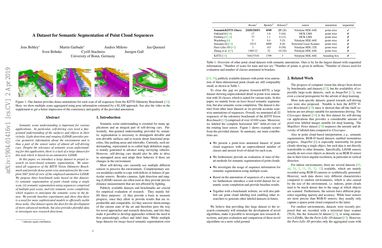
Semantic scene understanding is important for various applications. In particular, self-driving cars need a fine-grained understanding of the surfaces and objects in their vicinity. Light detection and ranging (LiDAR) provides precise geometric information about the environment and is thus a part of the sensor suites of almost all self-driving cars. Despite the relevance of semantic scene understanding for this application, there is a lack of a large dataset for this task which is based on an automotive LiDAR. In this paper, we introduce a large dataset to propel research on laser-based semantic segmentation. We annotated all sequences of the KITTI Vision Odometry Benchmark and provide dense point-wise annotations for the complete $360^{o}$ field-of-view of the employed automotive LiDAR. We propose three benchmark tasks based on this dataset: (i) semantic segmentation of point clouds using a single scan, (ii) semantic segmentation using multiple past scans, and (iii) semantic scene completion, which requires to anticipate the semantic scene in the future. We provide baseline experiments and show that there is a need for more sophisticated models to efficiently tackle these tasks. Our dataset opens the door for the development of more advanced methods, but also provides plentiful data to investigate new research directions.
Adversarial loss in a conditional generative adversarial network (GAN) is not designed to directly optimize evaluation metrics of a target task, and thus, may not always guide the generator in a GAN to generate data with improved metric scores. To overcome this issue, we propose a novel MetricGAN approach with an aim to optimize the generator with respect to one or multiple evaluation metrics. Moreover, based on MetricGAN, the metric scores of the generated data can also be arbitrarily specified by users. We tested the proposed MetricGAN on a speech enhancement task, which is particularly suitable to verify the proposed approach because there are multiple metrics measuring different aspects of speech signals. Moreover, these metrics are generally complex and could not be fully optimized by Lp or conventional adversarial losses.
Overparameterized transformer networks have obtained state of the art results in various natural language processing tasks, such as machine translation, language modeling, and question answering. These models contain hundreds of millions of parameters, necessitating a large amount of computation and making them prone to overfitting. In this work, we explore LayerDrop, a form of structured dropout, which has a regularization effect during training and allows for efficient pruning at inference time. In particular, we show that it is possible to select sub-networks of any depth from one large network without having to finetune them and with limited impact on performance. We demonstrate the effectiveness of our approach by improving the state of the art on machine translation, language modeling, summarization, question answering, and language understanding benchmarks. Moreover, we show that our approach leads to small BERT-like models of higher quality compared to training from scratch or using distillation.
The leading approaches in language modeling are all obsessed with TV shows of my youth - namely Transformers and Sesame Street. Transformers this, Transformers that, and over here a bonfire worth of GPU-TPU-neuromorphic wafer scale silicon. We opt for the lazy path of old and proven techniques with a fancy crypto inspired acronym: the Single Headed Attention RNN (SHA-RNN). The author's lone goal is to show that the entire field might have evolved a different direction if we had instead been obsessed with a slightly different acronym and slightly different result. We take a previously strong language model based only on boring LSTMs and get it to within a stone's throw of a stone's throw of state-of-the-art byte level language model results on enwik8. This work has undergone no intensive hyperparameter optimization and lived entirely on a commodity desktop machine that made the author's small studio apartment far too warm in the midst of a San Franciscan summer. The final results are achievable in plus or minus 24 hours on a single GPU as the author is impatient. The attention mechanism is also readily extended to large contexts with minimal computation. Take that Sesame Street.
We present a deep generative model for unsupervised text style transfer that unifies previously proposed non-generative techniques. Our probabilistic approach models non-parallel data from two domains as a partially observed parallel corpus. By hypothesizing a parallel latent sequence that generates each observed sequence, our model learns to transform sequences from one domain to another in a completely unsupervised fashion. In contrast with traditional generative sequence models (e.g. the HMM), our model makes few assumptions about the data it generates: it uses a recurrent language model as a prior and an encoder-decoder as a transduction distribution. While computation of marginal data likelihood is intractable in this model class, we show that amortized variational inference admits a practical surrogate. Further, by drawing connections between our variational objective and other recent unsupervised style transfer and machine translation techniques, we show how our probabilistic view can unify some known non-generative objectives such as backtranslation and adversarial loss. Finally, we demonstrate the effectiveness of our method on a wide range of unsupervised style transfer tasks, including sentiment transfer, formality transfer, word decipherment, author imitation, and related language translation. Across all style transfer tasks, our approach yields substantial gains over state-of-the-art non-generative baselines, including the state-of-the-art unsupervised machine translation techniques that our approach generalizes. Further, we conduct experiments on a standard unsupervised machine translation task and find that our unified approach matches the current state-of-the-art.

We present Muse, a text-to-image Transformer model that achieves state-of-the-art image generation performance while being significantly more efficient than diffusion or autoregressive models. Muse is trained on a masked modeling task in discrete token space: given the text embedding extracted from a pre-trained large language model (LLM), Muse is trained to predict randomly masked image tokens. Compared to pixel-space diffusion models, such as Imagen and DALL-E 2, Muse is significantly more efficient due to the use of discrete tokens and requiring fewer sampling iterations; compared to autoregressive models, such as Parti, Muse is more efficient due to the use of parallel decoding. The use of a pre-trained LLM enables fine-grained language understanding, translating to high-fidelity image generation and the understanding of visual concepts such as objects, their spatial relationships, pose, cardinality etc. Our 900M parameter model achieves a new SOTA on CC3M, with an FID score of 6.06. The Muse 3B parameter model achieves an FID of 7.88 on zero-shot COCO evaluation, along with a CLIP score of 0.32. Muse also directly enables a number of image editing applications without the need to fine-tune or invert the model: inpainting, outpainting, and mask-free editing. More results are available at https://muse-model.github.io

We tackle the task of conditional music generation. We introduce MusicGen, a single Language Model (LM) that operates over several streams of compressed discrete music representation, i.e., tokens. Unlike prior work, MusicGen is comprised of a single-stage transformer LM together with efficient token interleaving patterns, which eliminates the need for cascading several models, e.g., hierarchically or upsampling. Following this approach, we demonstrate how MusicGen can generate high-quality samples, both mono and stereo, while being conditioned on textual description or melodic features, allowing better controls over the generated output. We conduct extensive empirical evaluation, considering both automatic and human studies, showing the proposed approach is superior to the evaluated baselines on a standard text-to-music benchmark. Through ablation studies, we shed light over the importance of each of the components comprising MusicGen. Music samples, code, and models are available at https://github.com/facebookresearch/audiocraft

We introduce Mixtral 8x7B, a Sparse Mixture of Experts (SMoE) language model. Mixtral has the same architecture as Mistral 7B, with the difference that each layer is composed of 8 feedforward blocks (i.e. experts). For every token, at each layer, a router network selects two experts to process the current state and combine their outputs. Even though each token only sees two experts, the selected experts can be different at each timestep. As a result, each token has access to 47B parameters, but only uses 13B active parameters during inference. Mixtral was trained with a context size of 32k tokens and it outperforms or matches Llama 2 70B and GPT-3.5 across all evaluated benchmarks. In particular, Mixtral vastly outperforms Llama 2 70B on mathematics, code generation, and multilingual benchmarks. We also provide a model fine-tuned to follow instructions, Mixtral 8x7B - Instruct, that surpasses GPT-3.5 Turbo, Claude-2.1, Gemini Pro, and Llama 2 70B - chat model on human benchmarks. Both the base and instruct models are released under the Apache 2.0 license.

Efficient fine-tuning is vital for adapting large language models (LLMs) to downstream tasks. However, it requires non-trivial efforts to implement these methods on different models. We present LlamaFactory, a unified framework that integrates a suite of cutting-edge efficient training methods. It provides a solution for flexibly customizing the fine-tuning of 100+ LLMs without the need for coding through the built-in web UI LlamaBoard. We empirically validate the efficiency and effectiveness of our framework on language modeling and text generation tasks. It has been released at https://github.com/hiyouga/LLaMA-Factory and received over 25,000 stars and 3,000 forks.

We propose LaserTagger - a sequence tagging approach that casts text generation as a text editing task. Target texts are reconstructed from the inputs using three main edit operations: keeping a token, deleting it, and adding a phrase before the token. To predict the edit operations, we propose a novel model, which combines a BERT encoder with an autoregressive Transformer decoder. This approach is evaluated on English text on four tasks: sentence fusion, sentence splitting, abstractive summarization, and grammar correction. LaserTagger achieves new state-of-the-art results on three of these tasks, performs comparably to a set of strong seq2seq baselines with a large number of training examples, and outperforms them when the number of examples is limited. Furthermore, we show that at inference time tagging can be more than two orders of magnitude faster than comparable seq2seq models, making it more attractive for running in a live environment.