
分享
Zero-resource speech technology is a growing research area that aims to develop methods for speech processing in the absence of transcriptions, lexicons, or language modelling text. Early term discovery systems focused on identifying isolated recurring patterns in a corpus, while more recent full-coverage systems attempt to completely segment and cluster the audio into word-like units---effectively performing unsupervised speech recognition. This article presents the first attempt we are aware of to apply such a system to large-vocabulary multi-speaker data. Our system uses a Bayesian modelling framework with segmental word representations: each word segment is represented as a fixed-dimensional acoustic embedding obtained by mapping the sequence of feature frames to a single embedding vector. We compare our system on English and Xitsonga datasets to state-of-the-art baselines, using a variety of measures including word error rate (obtained by mapping the unsupervised output to ground truth transcriptions). Very high word error rates are reported---in the order of 70--80% for speaker-dependent and 80--95% for speaker-independent systems---highlighting the difficulty of this task. Nevertheless, in terms of cluster quality and word segmentation metrics, we show that by imposing a consistent top-down segmentation while also using bottom-up knowledge from detected syllable boundaries, both single-speaker and multi-speaker versions of our system outperform a purely bottom-up single-speaker syllable-based approach. We also show that the discovered clusters can be made less speaker- and gender-specific by using an unsupervised autoencoder-like feature extractor to learn better frame-level features (prior to embedding). Our system's discovered clusters are still less pure than those of unsupervised term discovery systems, but provide far greater coverage.
We train a recurrent neural network language model using a distributed, on-device learning framework called federated learning for the purpose of next-word prediction in a virtual keyboard for smartphones. Server-based training using stochastic gradient descent is compared with training on client devices using the Federated Averaging algorithm. The federated algorithm, which enables training on a higher-quality dataset for this use case, is shown to achieve better prediction recall. This work demonstrates the feasibility and benefit of training language models on client devices without exporting sensitive user data to servers. The federated learning environment gives users greater control over the use of their data and simplifies the task of incorporating privacy by default with distributed training and aggregation across a population of client devices.
In the past few years, neural abstractive text summarization with sequence-to-sequence (seq2seq) models have gained a lot of popularity. Many interesting techniques have been proposed to improve seq2seq models, making them capable of handling different challenges, such as saliency, fluency and human readability, and generate high-quality summaries. Generally speaking, most of these techniques differ in one of these three categories: network structure, parameter inference, and decoding/generation. There are also other concerns, such as efficiency and parallelism for training a model. In this paper, we provide a comprehensive literature survey on different seq2seq models for abstractive text summarization from the viewpoint of network structures, training strategies, and summary generation algorithms. Several models were first proposed for language modeling and generation tasks, such as machine translation, and later applied to abstractive text summarization. Hence, we also provide a brief review of these models. As part of this survey, we also develop an open source library, namely, Neural Abstractive Text Summarizer (NATS) toolkit, for the abstractive text summarization. An extensive set of experiments have been conducted on the widely used CNN/Daily Mail dataset to examine the effectiveness of several different neural network components. Finally, we benchmark two models implemented in NATS on the two recently released datasets, namely, Newsroom and Bytecup.
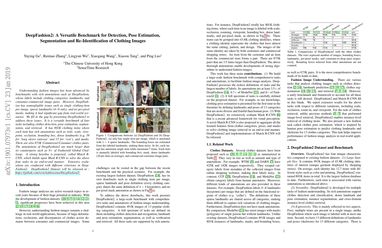
Understanding fashion images has been advanced by benchmarks with rich annotations such as DeepFashion, whose labels include clothing categories, landmarks, and consumer-commercial image pairs. However, DeepFashion has nonnegligible issues such as single clothing-item per image, sparse landmarks (4~8 only), and no per-pixel masks, making it had significant gap from real-world scenarios. We fill in the gap by presenting DeepFashion2 to address these issues. It is a versatile benchmark of four tasks including clothes detection, pose estimation, segmentation, and retrieval. It has 801K clothing items where each item has rich annotations such as style, scale, viewpoint, occlusion, bounding box, dense landmarks and masks. There are also 873K Commercial-Consumer clothes pairs. A strong baseline is proposed, called Match R-CNN, which builds upon Mask R-CNN to solve the above four tasks in an end-to-end manner. Extensive evaluations are conducted with different criterions in DeepFashion2.
Adversarial loss in a conditional generative adversarial network (GAN) is not designed to directly optimize evaluation metrics of a target task, and thus, may not always guide the generator in a GAN to generate data with improved metric scores. To overcome this issue, we propose a novel MetricGAN approach with an aim to optimize the generator with respect to one or multiple evaluation metrics. Moreover, based on MetricGAN, the metric scores of the generated data can also be arbitrarily specified by users. We tested the proposed MetricGAN on a speech enhancement task, which is particularly suitable to verify the proposed approach because there are multiple metrics measuring different aspects of speech signals. Moreover, these metrics are generally complex and could not be fully optimized by Lp or conventional adversarial losses.
We present a deep generative model for unsupervised text style transfer that unifies previously proposed non-generative techniques. Our probabilistic approach models non-parallel data from two domains as a partially observed parallel corpus. By hypothesizing a parallel latent sequence that generates each observed sequence, our model learns to transform sequences from one domain to another in a completely unsupervised fashion. In contrast with traditional generative sequence models (e.g. the HMM), our model makes few assumptions about the data it generates: it uses a recurrent language model as a prior and an encoder-decoder as a transduction distribution. While computation of marginal data likelihood is intractable in this model class, we show that amortized variational inference admits a practical surrogate. Further, by drawing connections between our variational objective and other recent unsupervised style transfer and machine translation techniques, we show how our probabilistic view can unify some known non-generative objectives such as backtranslation and adversarial loss. Finally, we demonstrate the effectiveness of our method on a wide range of unsupervised style transfer tasks, including sentiment transfer, formality transfer, word decipherment, author imitation, and related language translation. Across all style transfer tasks, our approach yields substantial gains over state-of-the-art non-generative baselines, including the state-of-the-art unsupervised machine translation techniques that our approach generalizes. Further, we conduct experiments on a standard unsupervised machine translation task and find that our unified approach matches the current state-of-the-art.
Normalization techniques are a boon for modern deep learning. They let weights converge more quickly with often better generalization performances. It has been argued that the normalization-induced scale invariance among the weights provides an advantageous ground for gradient descent (GD) optimizers: the effective step sizes are automatically reduced over time, stabilizing the overall training procedure. It is often overlooked, however, that the additional introduction of momentum in GD optimizers results in a far more rapid reduction in effective step sizes for scale-invariant weights, a phenomenon that has not yet been studied and may have caused unwanted side effects in the current practice. This is a crucial issue because arguably the vast majority of modern deep neural networks consist of (1) momentum-based GD (e.g. SGD or Adam) and (2) scale-invariant parameters. In this paper, we verify that the widely-adopted combination of the two ingredients lead to the premature decay of effective step sizes and sub-optimal model performances. We propose a simple and effective remedy, SGDP and AdamP: get rid of the radial component, or the norm-increasing direction, at each optimizer step. Because of the scale invariance, this modification only alters the effective step sizes without changing the effective update directions, thus enjoying the original convergence properties of GD optimizers. Given the ubiquity of momentum GD and scale invariance in machine learning, we have evaluated our methods against the baselines on 13 benchmarks. They range from vision tasks like classification (e.g. ImageNet), retrieval (e.g. CUB and SOP), and detection (e.g. COCO) to language modelling (e.g. WikiText) and audio classification (e.g. DCASE) tasks. We verify that our solution brings about uniform gains in those benchmarks. Source code is available at https://github.com/clovaai/AdamP.

We present Muse, a text-to-image Transformer model that achieves state-of-the-art image generation performance while being significantly more efficient than diffusion or autoregressive models. Muse is trained on a masked modeling task in discrete token space: given the text embedding extracted from a pre-trained large language model (LLM), Muse is trained to predict randomly masked image tokens. Compared to pixel-space diffusion models, such as Imagen and DALL-E 2, Muse is significantly more efficient due to the use of discrete tokens and requiring fewer sampling iterations; compared to autoregressive models, such as Parti, Muse is more efficient due to the use of parallel decoding. The use of a pre-trained LLM enables fine-grained language understanding, translating to high-fidelity image generation and the understanding of visual concepts such as objects, their spatial relationships, pose, cardinality etc. Our 900M parameter model achieves a new SOTA on CC3M, with an FID score of 6.06. The Muse 3B parameter model achieves an FID of 7.88 on zero-shot COCO evaluation, along with a CLIP score of 0.32. Muse also directly enables a number of image editing applications without the need to fine-tune or invert the model: inpainting, outpainting, and mask-free editing. More results are available at https://muse-model.github.io

Language models are increasingly being deployed for general problem solving across a wide range of tasks, but are still confined to token-level, left-to-right decision-making processes during inference. This means they can fall short in tasks that require exploration, strategic lookahead, or where initial decisions play a pivotal role. To surmount these challenges, we introduce a new framework for language model inference, Tree of Thoughts (ToT), which generalizes over the popular Chain of Thought approach to prompting language models, and enables exploration over coherent units of text (thoughts) that serve as intermediate steps toward problem solving. ToT allows LMs to perform deliberate decision making by considering multiple different reasoning paths and self-evaluating choices to decide the next course of action, as well as looking ahead or backtracking when necessary to make global choices. Our experiments show that ToT significantly enhances language models' problem-solving abilities on three novel tasks requiring non-trivial planning or search: Game of 24, Creative Writing, and Mini Crosswords. For instance, in Game of 24, while GPT-4 with chain-of-thought prompting only solved 4% of tasks, our method achieved a success rate of 74%. Code repo with all prompts: https://github.com/princeton-nlp/tree-of-thought-llm.

Efficient fine-tuning is vital for adapting large language models (LLMs) to downstream tasks. However, it requires non-trivial efforts to implement these methods on different models. We present LlamaFactory, a unified framework that integrates a suite of cutting-edge efficient training methods. It provides a solution for flexibly customizing the fine-tuning of 100+ LLMs without the need for coding through the built-in web UI LlamaBoard. We empirically validate the efficiency and effectiveness of our framework on language modeling and text generation tasks. It has been released at https://github.com/hiyouga/LLaMA-Factory and received over 25,000 stars and 3,000 forks.

Anomaly detection in supercomputers is a very difficult problem due to the big scale of the systems and the high number of components. The current state of the art for automated anomaly detection employs Machine Learning methods or statistical regression models in a supervised fashion, meaning that the detection tool is trained to distinguish among a fixed set of behaviour classes (healthy and unhealthy states). We propose a novel approach for anomaly detection in High Performance Computing systems based on a Machine (Deep) Learning technique, namely a type of neural network called autoencoder. The key idea is to train a set of autoencoders to learn the normal (healthy) behaviour of the supercomputer nodes and, after training, use them to identify abnormal conditions. This is different from previous approaches which where based on learning the abnormal condition, for which there are much smaller datasets (since it is very hard to identify them to begin with). We test our approach on a real supercomputer equipped with a fine-grained, scalable monitoring infrastructure that can provide large amount of data to characterize the system behaviour. The results are extremely promising: after the training phase to learn the normal system behaviour, our method is capable of detecting anomalies that have never been seen before with a very good accuracy (values ranging between 88% and 96%).

As major progress is made in open-ended text generation, measuring how close machine-generated text is to human language remains a critical open problem. We introduce MAUVE, a comparison measure for open-ended text generation, which directly compares the learnt distribution from a text generation model to the distribution of human-written text using divergence frontiers. MAUVE scales up to modern text generation models by computing information divergences in a quantized embedding space. Through an extensive empirical study on three open-ended generation tasks, we find that MAUVE identifies known properties of generated text, scales naturally with model size, and correlates with human judgments, with fewer restrictions than existing distributional evaluation metrics.