
分享
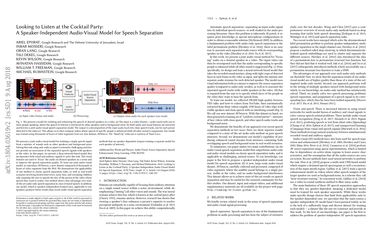
We present a joint audio-visual model for isolating a single speech signal from a mixture of sounds such as other speakers and background noise. Solving this task using only audio as input is extremely challenging and does not provide an association of the separated speech signals with speakers in the video. In this paper, we present a deep network-based model that incorporates both visual and auditory signals to solve this task. The visual features are used to "focus" the audio on desired speakers in a scene and to improve the speech separation quality. To train our joint audio-visual model, we introduce AVSpeech, a new dataset comprised of thousands of hours of video segments from the Web. We demonstrate the applicability of our method to classic speech separation tasks, as well as real-world scenarios involving heated interviews, noisy bars, and screaming children, only requiring the user to specify the face of the person in the video whose speech they want to isolate. Our method shows clear advantage over state-of-the-art audio-only speech separation in cases of mixed speech. In addition, our model, which is speaker-independent (trained once, applicable to any speaker), produces better results than recent audio-visual speech separation methods that are speaker-dependent (require training a separate model for each speaker of interest).
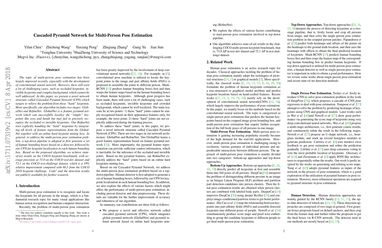
The topic of multi-person pose estimation has been largely improved recently, especially with the development of convolutional neural network. However, there still exist a lot of challenging cases, such as occluded keypoints, invisible keypoints and complex background, which cannot be well addressed. In this paper, we present a novel network structure called Cascaded Pyramid Network (CPN) which targets to relieve the problem from these "hard" keypoints. More specifically, our algorithm includes two stages: GlobalNet and RefineNet. GlobalNet is a feature pyramid network which can successfully localize the "simple" keypoints like eyes and hands but may fail to precisely recognize the occluded or invisible keypoints. Our RefineNet tries explicitly handling the "hard" keypoints by integrating all levels of feature representations from the GlobalNet together with an online hard keypoint mining loss. In general, to address the multi-person pose estimation problem, a top-down pipeline is adopted to first generate a set of human bounding boxes based on a detector, followed by our CPN for keypoint localization in each human bounding box. Based on the proposed algorithm, we achieve state-of-art results on the COCO keypoint benchmark, with average precision at 73.0 on the COCO test-dev dataset and 72.1 on the COCO test-challenge dataset, which is a 19% relative improvement compared with 60.5 from the COCO 2016 keypoint challenge.Code (https://github.com/chenyilun95/tf-cpn.git) and the detection results are publicly available for further research.
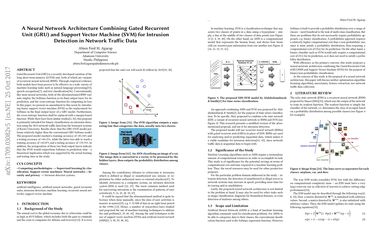
Gated Recurrent Unit (GRU) is a recently-developed variation of the long short-term memory (LSTM) unit, both of which are types of recurrent neural network (RNN). Through empirical evidence, both models have been proven to be effective in a wide variety of machine learning tasks such as natural language processing (Wen et al., 2015), speech recognition (Chorowski et al., 2015), and text classification (Yang et al., 2016). Conventionally, like most neural networks, both of the aforementioned RNN variants employ the Softmax function as its final output layer for its prediction, and the cross-entropy function for computing its loss. In this paper, we present an amendment to this norm by introducing linear support vector machine (SVM) as the replacement for Softmax in the final output layer of a GRU model. Furthermore, the cross-entropy function shall be replaced with a margin-based function. While there have been similar studies (Alalshekmubarak & Smith, 2013; Tang, 2013), this proposal is primarily intended for binary classification on intrusion detection using the 2013 network traffic data from the honeypot systems of Kyoto University. Results show that the GRU-SVM model performs relatively higher than the conventional GRU-Softmax model. The proposed model reached a training accuracy of ~81.54% and a testing accuracy of ~84.15%, while the latter was able to reach a training accuracy of ~63.07% and a testing accuracy of ~70.75%. In addition, the juxtaposition of these two final output layers indicate that the SVM would outperform Softmax in prediction time - a theoretical implication which was supported by the actual training and testing time in the study.
Zero-resource speech technology is a growing research area that aims to develop methods for speech processing in the absence of transcriptions, lexicons, or language modelling text. Early term discovery systems focused on identifying isolated recurring patterns in a corpus, while more recent full-coverage systems attempt to completely segment and cluster the audio into word-like units---effectively performing unsupervised speech recognition. This article presents the first attempt we are aware of to apply such a system to large-vocabulary multi-speaker data. Our system uses a Bayesian modelling framework with segmental word representations: each word segment is represented as a fixed-dimensional acoustic embedding obtained by mapping the sequence of feature frames to a single embedding vector. We compare our system on English and Xitsonga datasets to state-of-the-art baselines, using a variety of measures including word error rate (obtained by mapping the unsupervised output to ground truth transcriptions). Very high word error rates are reported---in the order of 70--80% for speaker-dependent and 80--95% for speaker-independent systems---highlighting the difficulty of this task. Nevertheless, in terms of cluster quality and word segmentation metrics, we show that by imposing a consistent top-down segmentation while also using bottom-up knowledge from detected syllable boundaries, both single-speaker and multi-speaker versions of our system outperform a purely bottom-up single-speaker syllable-based approach. We also show that the discovered clusters can be made less speaker- and gender-specific by using an unsupervised autoencoder-like feature extractor to learn better frame-level features (prior to embedding). Our system's discovered clusters are still less pure than those of unsupervised term discovery systems, but provide far greater coverage.
Deep learning has revolutionized many machine learning tasks in recent years, ranging from image classification and video processing to speech recognition and natural language understanding. The data in these tasks are typically represented in the Euclidean space. However, there is an increasing number of applications where data are generated from non-Euclidean domains and are represented as graphs with complex relationships and interdependency between objects. The complexity of graph data has imposed significant challenges on existing machine learning algorithms. Recently, many studies on extending deep learning approaches for graph data have emerged. In this survey, we provide a comprehensive overview of graph neural networks (GNNs) in data mining and machine learning fields. We propose a new taxonomy to divide the state-of-the-art graph neural networks into four categories, namely recurrent graph neural networks, convolutional graph neural networks, graph autoencoders, and spatial-temporal graph neural networks. We further discuss the applications of graph neural networks across various domains and summarize the open source codes, benchmark data sets, and model evaluation of graph neural networks. Finally, we propose potential research directions in this rapidly growing field.
Understanding fashion images has been advanced by benchmarks with rich annotations such as DeepFashion, whose labels include clothing categories, landmarks, and consumer-commercial image pairs. However, DeepFashion has nonnegligible issues such as single clothing-item per image, sparse landmarks (4~8 only), and no per-pixel masks, making it had significant gap from real-world scenarios. We fill in the gap by presenting DeepFashion2 to address these issues. It is a versatile benchmark of four tasks including clothes detection, pose estimation, segmentation, and retrieval. It has 801K clothing items where each item has rich annotations such as style, scale, viewpoint, occlusion, bounding box, dense landmarks and masks. There are also 873K Commercial-Consumer clothes pairs. A strong baseline is proposed, called Match R-CNN, which builds upon Mask R-CNN to solve the above four tasks in an end-to-end manner. Extensive evaluations are conducted with different criterions in DeepFashion2.
We introduce $k$NN-LMs, which extend a pre-trained neural language model (LM) by linearly interpolating it with a $k$-nearest neighbors ($k$NN) model. The nearest neighbors are computed according to distance in the pre-trained LM embedding space, and can be drawn from any text collection, including the original LM training data. Applying this augmentation to a strong Wikitext-103 LM, with neighbors drawn from the original training set, our $k$NN-LM achieves a new state-of-the-art perplexity of 15.79 - a 2.9 point improvement with no additional training. We also show that this approach has implications for efficiently scaling up to larger training sets and allows for effective domain adaptation, by simply varying the nearest neighbor datastore, again without further training. Qualitatively, the model is particularly helpful in predicting rare patterns, such as factual knowledge. Together, these results strongly suggest that learning similarity between sequences of text is easier than predicting the next word, and that nearest neighbor search is an effective approach for language modeling in the long tail.
There is a large body of literature linking anatomic and geometric characteristics of kidney tumors to perioperative and oncologic outcomes. Semantic segmentation of these tumors and their host kidneys is a promising tool for quantitatively characterizing these lesions, but its adoption is limited due to the manual effort required to produce high-quality 3D segmentations of these structures. Recently, methods based on deep learning have shown excellent results in automatic 3D segmentation, but they require large datasets for training, and there remains little consensus on which methods perform best. The 2019 Kidney and Kidney Tumor Segmentation challenge (KiTS19) was a competition held in conjunction with the 2019 International Conference on Medical Image Computing and Computer Assisted Intervention (MICCAI) which sought to address these issues and stimulate progress on this automatic segmentation problem. A training set of 210 cross sectional CT images with kidney tumors was publicly released with corresponding semantic segmentation masks. 106 teams from five continents used this data to develop automated systems to predict the true segmentation masks on a test set of 90 CT images for which the corresponding ground truth segmentations were kept private. These predictions were scored and ranked according to their average So rensen-Dice coefficient between the kidney and tumor across all 90 cases. The winning team achieved a Dice of 0.974 for kidney and 0.851 for tumor, approaching the inter-annotator performance on kidney (0.983) but falling short on tumor (0.923). This challenge has now entered an "open leaderboard" phase where it serves as a challenging benchmark in 3D semantic segmentation.
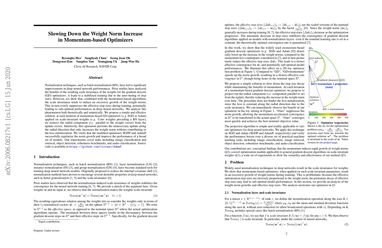
Normalization techniques are a boon for modern deep learning. They let weights converge more quickly with often better generalization performances. It has been argued that the normalization-induced scale invariance among the weights provides an advantageous ground for gradient descent (GD) optimizers: the effective step sizes are automatically reduced over time, stabilizing the overall training procedure. It is often overlooked, however, that the additional introduction of momentum in GD optimizers results in a far more rapid reduction in effective step sizes for scale-invariant weights, a phenomenon that has not yet been studied and may have caused unwanted side effects in the current practice. This is a crucial issue because arguably the vast majority of modern deep neural networks consist of (1) momentum-based GD (e.g. SGD or Adam) and (2) scale-invariant parameters. In this paper, we verify that the widely-adopted combination of the two ingredients lead to the premature decay of effective step sizes and sub-optimal model performances. We propose a simple and effective remedy, SGDP and AdamP: get rid of the radial component, or the norm-increasing direction, at each optimizer step. Because of the scale invariance, this modification only alters the effective step sizes without changing the effective update directions, thus enjoying the original convergence properties of GD optimizers. Given the ubiquity of momentum GD and scale invariance in machine learning, we have evaluated our methods against the baselines on 13 benchmarks. They range from vision tasks like classification (e.g. ImageNet), retrieval (e.g. CUB and SOP), and detection (e.g. COCO) to language modelling (e.g. WikiText) and audio classification (e.g. DCASE) tasks. We verify that our solution brings about uniform gains in those benchmarks. Source code is available at https://github.com/clovaai/AdamP.
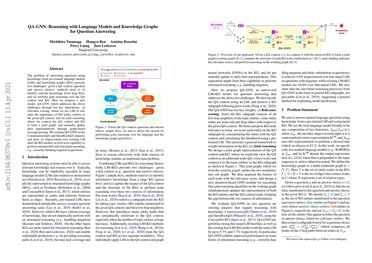
The problem of answering questions using knowledge from pre-trained language models (LMs) and knowledge graphs (KGs) presents two challenges: given a QA context (question and answer choice), methods need to (i) identify relevant knowledge from large KGs, and (ii) perform joint reasoning over the QA context and KG. In this work, we propose a new model, QA-GNN, which addresses the above challenges through two key innovations: (i) relevance scoring, where we use LMs to estimate the importance of KG nodes relative to the given QA context, and (ii) joint reasoning, where we connect the QA context and KG to form a joint graph, and mutually update their representations through graph neural networks. We evaluate our model on QA benchmarks in the commonsense (CommonsenseQA, OpenBookQA) and biomedical (MedQA-USMLE) domains. QA-GNN outperforms existing LM and LM+KG models, and exhibits capabilities to perform interpretable and structured reasoning, e.g., correctly handling negation in questions.

Ghosting artifacts caused by moving objects or misalignments is a key challenge in high dynamic range (HDR) imaging for dynamic scenes. Previous methods first register the input low dynamic range (LDR) images using optical flow before merging them, which are error-prone and cause ghosts in results. A very recent work tries to bypass optical flows via a deep network with skip-connections, however, which still suffers from ghosting artifacts for severe movement. To avoid the ghosting from the source, we propose a novel attention-guided end-to-end deep neural network (AHDRNet) to produce high-quality ghost-free HDR images. Unlike previous methods directly stacking the LDR images or features for merging, we use attention modules to guide the merging according to the reference image. The attention modules automatically suppress undesired components caused by misalignments and saturation and enhance desirable fine details in the non-reference images. In addition to the attention model, we use dilated residual dense block (DRDB) to make full use of the hierarchical features and increase the receptive field for hallucinating the missing details. The proposed AHDRNet is a non-flow-based method, which can also avoid the artifacts generated by optical-flow estimation error. Experiments on different datasets show that the proposed AHDRNet can achieve state-of-the-art quantitative and qualitative results.

As major progress is made in open-ended text generation, measuring how close machine-generated text is to human language remains a critical open problem. We introduce MAUVE, a comparison measure for open-ended text generation, which directly compares the learnt distribution from a text generation model to the distribution of human-written text using divergence frontiers. MAUVE scales up to modern text generation models by computing information divergences in a quantized embedding space. Through an extensive empirical study on three open-ended generation tasks, we find that MAUVE identifies known properties of generated text, scales naturally with model size, and correlates with human judgments, with fewer restrictions than existing distributional evaluation metrics.