
分享
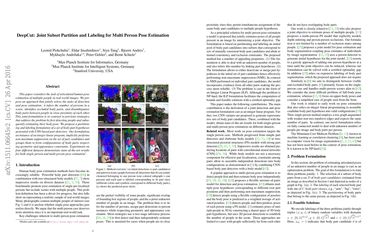
This paper considers the task of articulated human pose estimation of multiple people in real world images. We propose an approach that jointly solves the tasks of detection and pose estimation: it infers the number of persons in a scene, identifies occluded body parts, and disambiguates body parts between people in close proximity of each other. This joint formulation is in contrast to previous strategies, that address the problem by first detecting people and subsequently estimating their body pose. We propose a partitioning and labeling formulation of a set of body-part hypotheses generated with CNN-based part detectors. Our formulation, an instance of an integer linear program, implicitly performs non-maximum suppression on the set of part candidates and groups them to form configurations of body parts respecting geometric and appearance constraints. Experiments on four different datasets demonstrate state-of-the-art results for both single person and multi person pose estimation. Models and code available at http://pose.mpi-inf.mpg.de.
Transformers have been successfully applied to sequential, auto-regressive tasks despite being feedforward networks. Unlike recurrent neural networks, Transformers use attention to capture temporal relations while processing input tokens in parallel. While this parallelization makes them computationally efficient, it restricts the model from fully exploiting the sequential nature of the input. The representation at a given layer can only access representations from lower layers, rather than the higher level representations already available. In this work, we propose the Feedback Transformer architecture that exposes all previous representations to all future representations, meaning the lowest representation of the current timestep is formed from the highest-level abstract representation of the past. We demonstrate on a variety of benchmarks in language modeling, machine translation, and reinforcement learning that the increased representation capacity can create small, shallow models with much stronger performance than comparable Transformers.
Labeled data for imitation learning of theorem proving in large libraries of formalized mathematics is scarce as such libraries require years of concentrated effort by human specialists to be built. This is particularly challenging when applying large Transformer language models to tactic prediction, because the scaling of performance with respect to model size is quickly disrupted in the data-scarce, easily-overfitted regime. We propose PACT ({\bf P}roof {\bf A}rtifact {\bf C}o-{\bf T}raining), a general methodology for extracting abundant self-supervised data from kernel-level proof terms for co-training alongside the usual tactic prediction objective. We apply this methodology to Lean, an interactive proof assistant which hosts some of the most sophisticated formalized mathematics to date. We instrument Lean with a neural theorem prover driven by a Transformer language model and show that PACT improves theorem proving success rate on a held-out suite of test theorems from 32\% to 48\%.
Voice conversion is a common speech synthesis task which can be solved in different ways depending on a particular real-world scenario. The most challenging one often referred to as one-shot many-to-many voice conversion consists in copying the target voice from only one reference utterance in the most general case when both source and target speakers do not belong to the training dataset. We present a scalable high-quality solution based on diffusion probabilistic modeling and demonstrate its superior quality compared to state-of-the-art one-shot voice conversion approaches. Moreover, focusing on real-time applications, we investigate general principles which can make diffusion models faster while keeping synthesis quality at a high level. As a result, we develop a novel Stochastic Differential Equations solver suitable for various diffusion model types and generative tasks as shown through empirical studies and justify it by theoretical analysis.

In this work, we propose WaveFlow, a small-footprint generative flow for raw audio, which is directly trained with maximum likelihood. It handles the long-range structure of 1-D waveform with a dilated 2-D convolutional architecture, while modeling the local variations using expressive autoregressive functions. WaveFlow provides a unified view of likelihood-based models for 1-D data, including WaveNet and WaveGlow as special cases. It generates high-fidelity speech as WaveNet, while synthesizing several orders of magnitude faster as it only requires a few sequential steps to generate very long waveforms with hundreds of thousands of time-steps. Furthermore, it can significantly reduce the likelihood gap that has existed between autoregressive models and flow-based models for efficient synthesis. Finally, our small-footprint WaveFlow has only 5.91M parameters, which is 15$\times$ smaller than WaveGlow. It can generate 22.05 kHz high-fidelity audio 42.6$\times$ faster than real-time (at a rate of 939.3 kHz) on a V100 GPU without engineered inference kernels.

Visual anomaly classification and segmentation are vital for automating industrial quality inspection. The focus of prior research in the field has been on training custom models for each quality inspection task, which requires task-specific images and annotation. In this paper we move away from this regime, addressing zero-shot and few-normal-shot anomaly classification and segmentation. Recently CLIP, a vision-language model, has shown revolutionary generality with competitive zero-/few-shot performance in comparison to full-supervision. But CLIP falls short on anomaly classification and segmentation tasks. Hence, we propose window-based CLIP (WinCLIP) with (1) a compositional ensemble on state words and prompt templates and (2) efficient extraction and aggregation of window/patch/image-level features aligned with text. We also propose its few-normal-shot extension WinCLIP+, which uses complementary information from normal images. In MVTec-AD (and VisA), without further tuning, WinCLIP achieves 91.8%/85.1% (78.1%/79.6%) AUROC in zero-shot anomaly classification and segmentation while WinCLIP+ does 93.1%/95.2% (83.8%/96.4%) in 1-normal-shot, surpassing state-of-the-art by large margins.

Human-centric visual tasks have attracted increasing research attention due to their widespread applications. In this paper, we aim to learn a general human representation from massive unlabeled human images which can benefit downstream human-centric tasks to the maximum extent. We call this method SOLIDER, a Semantic cOntrollable seLf-supervIseD lEaRning framework. Unlike the existing self-supervised learning methods, prior knowledge from human images is utilized in SOLIDER to build pseudo semantic labels and import more semantic information into the learned representation. Meanwhile, we note that different downstream tasks always require different ratios of semantic information and appearance information. For example, human parsing requires more semantic information, while person re-identification needs more appearance information for identification purpose. So a single learned representation cannot fit for all requirements. To solve this problem, SOLIDER introduces a conditional network with a semantic controller. After the model is trained, users can send values to the controller to produce representations with different ratios of semantic information, which can fit different needs of downstream tasks. Finally, SOLIDER is verified on six downstream human-centric visual tasks. It outperforms state of the arts and builds new baselines for these tasks. The code is released in https://github.com/tinyvision/SOLIDER.

The softmax (also called softargmax) function is widely used in machine learning models to normalize real-valued scores into a probability distribution. To avoid floating-point overflow, the softmax function is conventionally implemented in three passes: the first pass to compute the normalization constant, and two other passes to compute outputs from normalized inputs. We analyze two variants of the Three-Pass algorithm and demonstrate that in a well-optimized implementation on HPC-class processors performance of all three passes is limited by memory bandwidth. We then present a novel algorithm for softmax computation in just two passes. The proposed Two-Pass algorithm avoids both numerical overflow and the extra normalization pass by employing an exotic representation for intermediate values, where each value is represented as a pair of floating-point numbers: one representing the "mantissa" and another representing the "exponent". Performance evaluation demonstrates that on out-of-cache inputs on an Intel Skylake-X processor the new Two-Pass algorithm outperforms the traditional Three-Pass algorithm by up to 28% in AVX512 implementation, and by up to 18% in AVX2 implementation. The proposed Two-Pass algorithm also outperforms the traditional Three-Pass algorithm on Intel Broadwell and AMD Zen 2 processors. To foster reproducibility, we released an open-source implementation of the new Two-Pass Softmax algorithm and other experiments in this paper as a part of XNNPACK library at GitHub.com/google/XNNPACK.
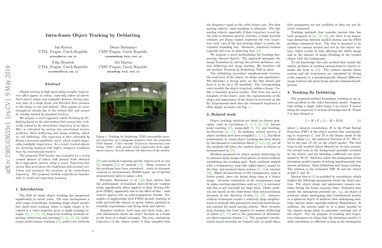
Objects moving at high speed along complex trajectories often appear in videos, especially videos of sports. Such objects elapse non-negligible distance during exposure time of a single frame and therefore their position in the frame is not well defined. They appear as semi-transparent streaks due to the motion blur and cannot be reliably tracked by standard trackers. We propose a novel approach called Tracking by Deblatting based on the observation that motion blur is directly related to the intra-frame trajectory of an object. Blur is estimated by solving two intertwined inverse problems, blind deblurring and image matting, which we call deblatting. The trajectory is then estimated by fitting a piecewise quadratic curve, which models physically justifiable trajectories. As a result, tracked objects are precisely localized with higher temporal resolution than by conventional trackers. The proposed TbD tracker was evaluated on a newly created dataset of videos with ground truth obtained by a high-speed camera using a novel Trajectory-IoU metric that generalizes the traditional Intersection over Union and measures the accuracy of the intra-frame trajectory. The proposed method outperforms baseline both in recall and trajectory accuracy.

Instruction tuning enables pretrained language models to perform new tasks from inference-time natural language descriptions. These approaches rely on vast amounts of human supervision in the form of crowdsourced datasets or user interactions. In this work, we introduce Unnatural Instructions: a large dataset of creative and diverse instructions, collected with virtually no human labor. We collect 64,000 examples by prompting a language model with three seed examples of instructions and eliciting a fourth. This set is then expanded by prompting the model to rephrase each instruction, creating a total of approximately 240,000 examples of instructions, inputs, and outputs. Experiments show that despite containing a fair amount of noise, training on Unnatural Instructions rivals the effectiveness of training on open-source manually-curated datasets, surpassing the performance of models such as T0++ and Tk-Instruct across various benchmarks. These results demonstrate the potential of model-generated data as a cost-effective alternative to crowdsourcing for dataset expansion and diversification.

Despite tremendous advancements in dialogue systems, stable evaluation still requires human judgments producing notoriously high-variance metrics due to their inherent subjectivity. Moreover, methods and labels in dialogue evaluation are not fully standardized, especially for open-domain chats, with a lack of work to compare and assess the validity of those approaches. The use of inconsistent evaluation can misinform the performance of a dialogue system, which becomes a major hurdle to enhance it. Thus, a dimensional evaluation of chat-oriented open-domain dialogue systems that reliably measures several aspects of dialogue capabilities is desired. This paper presents a novel human evaluation method to estimate the rates of many dialogue system behaviors. Our method is used to evaluate four state-of-the-art open-domain dialogue systems and compared with existing approaches. The analysis demonstrates that our behavior method is more suitable than alternative Likert-style or comparative approaches for dimensional evaluation of these systems.

Generative Artificial Intelligence (AI) has enabled the development of sophisticated models that are capable of producing high-caliber text, images, and other outputs through the utilization of large pre-trained models. Nevertheless, assessing the quality of the generation is an even more arduous task than the generation itself, and this issue has not been given adequate consideration recently. This paper proposes a novel evaluation framework, GPTScore, which utilizes the emergent abilities (e.g., zero-shot instruction) of generative pre-trained models to score generated texts. There are 19 pre-trained models explored in this paper, ranging in size from 80M (e.g., FLAN-T5-small) to 175B (e.g., GPT3). Experimental results on four text generation tasks, 22 evaluation aspects, and corresponding 37 datasets demonstrate that this approach can effectively allow us to achieve what one desires to evaluate for texts simply by natural language instructions. This nature helps us overcome several long-standing challenges in text evaluation--how to achieve customized, multi-faceted evaluation without the need for annotated samples. We make our code publicly available at https://github.com/jinlanfu/GPTScore.