
分享
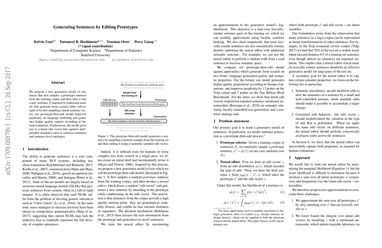
We propose a new generative model of sentences that first samples a prototype sentence from the training corpus and then edits it into a new sentence. Compared to traditional models that generate from scratch either left-to-right or by first sampling a latent sentence vector, our prototype-then-edit model improves perplexity on language modeling and generates higher quality outputs according to human evaluation. Furthermore, the model gives rise to a latent edit vector that captures interpretable semantics such as sentence similarity and sentence-level analogies.
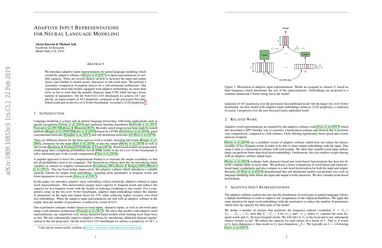
We introduce adaptive input representations for neural language modeling which extend the adaptive softmax of Grave et al. (2017) to input representations of variable capacity. There are several choices on how to factorize the input and output layers, and whether to model words, characters or sub-word units. We perform a systematic comparison of popular choices for a self-attentional architecture. Our experiments show that models equipped with adaptive embeddings are more than twice as fast to train than the popular character input CNN while having a lower number of parameters. On the WikiText-103 benchmark we achieve 18.7 perplexity, an improvement of 10.5 perplexity compared to the previously best published result and on the Billion Word benchmark, we achieve 23.02 perplexity.

Neural speech synthesis algorithms are a promising new approach for coding speech at very low bitrate. They have so far demonstrated quality that far exceeds traditional vocoders, at the cost of very high complexity. In this work, we present a low-bitrate neural vocoder based on the LPCNet model. The use of linear prediction and sparse recurrent networks makes it possible to achieve real-time operation on general-purpose hardware. We demonstrate that LPCNet operating at 1.6 kb/s achieves significantly higher quality than MELP and that uncompressed LPCNet can exceed the quality of a waveform codec operating at low bitrate. This opens the way for new codec designs based on neural synthesis models.
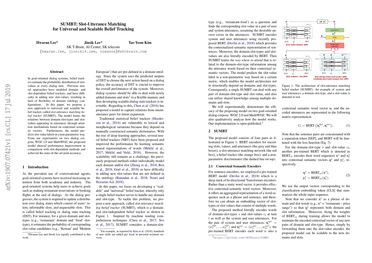
In goal-oriented dialog systems, belief trackers estimate the probability distribution of slot-values at every dialog turn. Previous neural approaches have modeled domain- and slot-dependent belief trackers, and have difficulty in adding new slot-values, resulting in lack of flexibility of domain ontology configurations. In this paper, we propose a new approach to universal and scalable belief tracker, called slot-utterance matching belief tracker (SUMBT). The model learns the relations between domain-slot-types and slot-values appearing in utterances through attention mechanisms based on contextual semantic vectors. Furthermore, the model predicts slot-value labels in a non-parametric way. From our experiments on two dialog corpora, WOZ 2.0 and MultiWOZ, the proposed model showed performance improvement in comparison with slot-dependent methods and achieved the state-of-the-art joint accuracy.
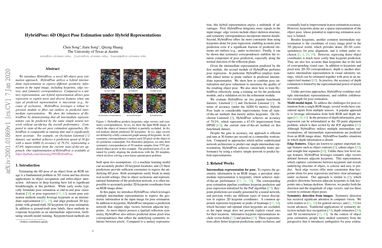
We introduce HybridPose, a novel 6D object pose estimation approach. HybridPose utilizes a hybrid intermediate representation to express different geometric information in the input image, including keypoints, edge vectors, and symmetry correspondences. Compared to a unitary representation, our hybrid representation allows pose regression to exploit more and diverse features when one type of predicted representation is inaccurate (e.g., because of occlusion). Different intermediate representations used by HybridPose can all be predicted by the same simple neural network, and outliers in predicted intermediate representations are filtered by a robust regression module. Compared to state-of-the-art pose estimation approaches, HybridPose is comparable in running time and accuracy. For example, on Occlusion Linemod dataset, our method achieves a prediction speed of 30 fps with a mean ADD(-S) accuracy of 47.5%, representing a state-of-the-art performance. The implementation of HybridPose is available at https://github.com/chensong1995/HybridPose.

Instruction tuning enables pretrained language models to perform new tasks from inference-time natural language descriptions. These approaches rely on vast amounts of human supervision in the form of crowdsourced datasets or user interactions. In this work, we introduce Unnatural Instructions: a large dataset of creative and diverse instructions, collected with virtually no human labor. We collect 64,000 examples by prompting a language model with three seed examples of instructions and eliciting a fourth. This set is then expanded by prompting the model to rephrase each instruction, creating a total of approximately 240,000 examples of instructions, inputs, and outputs. Experiments show that despite containing a fair amount of noise, training on Unnatural Instructions rivals the effectiveness of training on open-source manually-curated datasets, surpassing the performance of models such as T0++ and Tk-Instruct across various benchmarks. These results demonstrate the potential of model-generated data as a cost-effective alternative to crowdsourcing for dataset expansion and diversification.

Despite tremendous advancements in dialogue systems, stable evaluation still requires human judgments producing notoriously high-variance metrics due to their inherent subjectivity. Moreover, methods and labels in dialogue evaluation are not fully standardized, especially for open-domain chats, with a lack of work to compare and assess the validity of those approaches. The use of inconsistent evaluation can misinform the performance of a dialogue system, which becomes a major hurdle to enhance it. Thus, a dimensional evaluation of chat-oriented open-domain dialogue systems that reliably measures several aspects of dialogue capabilities is desired. This paper presents a novel human evaluation method to estimate the rates of many dialogue system behaviors. Our method is used to evaluate four state-of-the-art open-domain dialogue systems and compared with existing approaches. The analysis demonstrates that our behavior method is more suitable than alternative Likert-style or comparative approaches for dimensional evaluation of these systems.

This paper presents a novel end-to-end framework with Explicit box Detection for multi-person Pose estimation, called ED-Pose, where it unifies the contextual learning between human-level (global) and keypoint-level (local) information. Different from previous one-stage methods, ED-Pose re-considers this task as two explicit box detection processes with a unified representation and regression supervision. First, we introduce a human detection decoder from encoded tokens to extract global features. It can provide a good initialization for the latter keypoint detection, making the training process converge fast. Second, to bring in contextual information near keypoints, we regard pose estimation as a keypoint box detection problem to learn both box positions and contents for each keypoint. A human-to-keypoint detection decoder adopts an interactive learning strategy between human and keypoint features to further enhance global and local feature aggregation. In general, ED-Pose is conceptually simple without post-processing and dense heatmap supervision. It demonstrates its effectiveness and efficiency compared with both two-stage and one-stage methods. Notably, explicit box detection boosts the pose estimation performance by 4.5 AP on COCO and 9.9 AP on CrowdPose. For the first time, as a fully end-to-end framework with a L1 regression loss, ED-Pose surpasses heatmap-based Top-down methods under the same backbone by 1.2 AP on COCO and achieves the state-of-the-art with 76.6 AP on CrowdPose without bells and whistles. Code is available at https://github.com/IDEA-Research/ED-Pose.

Large Language Models (LLMs) have sparked significant interest in their generative capabilities, leading to the development of various commercial applications. The high cost of using the models drives application builders to maximize the value of generation under a limited inference budget. This paper presents a study of optimizing inference hyperparameters such as the number of responses, temperature and max tokens, which significantly affects the utility/cost of text generation. We design a framework named EcoOptiGen which leverages economical hyperparameter optimization and cost-based pruning. Experiments with the GPT-3.5/GPT-4 models on a variety of tasks verify its effectiveness. EcoOptiGen is implemented in the `autogen' package of the FLAML library: \url{https://aka.ms/autogen}.

This paper introduces a novel Token-and-Duration Transducer (TDT) architecture for sequence-to-sequence tasks. TDT extends conventional RNN-Transducer architectures by jointly predicting both a token and its duration, i.e. the number of input frames covered by the emitted token. This is achieved by using a joint network with two outputs which are independently normalized to generate distributions over tokens and durations. During inference, TDT models can skip input frames guided by the predicted duration output, which makes them significantly faster than conventional Transducers which process the encoder output frame by frame. TDT models achieve both better accuracy and significantly faster inference than conventional Transducers on different sequence transduction tasks. TDT models for Speech Recognition achieve better accuracy and up to 2.82X faster inference than conventional Transducers. TDT models for Speech Translation achieve an absolute gain of over 1 BLEU on the MUST-C test compared with conventional Transducers, and its inference is 2.27X faster. In Speech Intent Classification and Slot Filling tasks, TDT models improve the intent accuracy by up to over 1% (absolute) over conventional Transducers, while running up to 1.28X faster. Our implementation of the TDT model will be open-sourced with the NeMo (https://github.com/NVIDIA/NeMo) toolkit.

Prehensile object rearrangement in cluttered and confined spaces has broad applications but is also challenging. For instance, rearranging products in a grocery shelf means that the robot cannot directly access all objects and has limited free space. This is harder than tabletop rearrangement where objects are easily accessible with top-down grasps, which simplifies robot-object interactions. This work focuses on problems where such interactions are critical for completing tasks. It proposes a new efficient and complete solver under general constraints for monotone instances, which can be solved by moving each object at most once. The monotone solver reasons about robot-object constraints and uses them to effectively prune the search space. The new monotone solver is integrated with a global planner to solve non-monotone instances with high-quality solutions fast. Furthermore, this work contributes an effective pre-processing tool to significantly speed up online motion planning queries for rearrangement in confined spaces. Experiments further demonstrate that the proposed monotone solver, equipped with the pre-processing tool, results in 57.3% faster computation and 3 times higher success rate than state-of-the-art methods. Similarly, the resulting global planner is computationally more efficient and has a higher success rate, while producing high-quality solutions for non-monotone instances (i.e., only 1.3 additional actions are needed on average). Videos of demonstrating solutions on a real robotic system and codes can be found at https://github.com/Rui1223/uniform_object_rearrangement.

Generative Artificial Intelligence (AI) has enabled the development of sophisticated models that are capable of producing high-caliber text, images, and other outputs through the utilization of large pre-trained models. Nevertheless, assessing the quality of the generation is an even more arduous task than the generation itself, and this issue has not been given adequate consideration recently. This paper proposes a novel evaluation framework, GPTScore, which utilizes the emergent abilities (e.g., zero-shot instruction) of generative pre-trained models to score generated texts. There are 19 pre-trained models explored in this paper, ranging in size from 80M (e.g., FLAN-T5-small) to 175B (e.g., GPT3). Experimental results on four text generation tasks, 22 evaluation aspects, and corresponding 37 datasets demonstrate that this approach can effectively allow us to achieve what one desires to evaluate for texts simply by natural language instructions. This nature helps us overcome several long-standing challenges in text evaluation--how to achieve customized, multi-faceted evaluation without the need for annotated samples. We make our code publicly available at https://github.com/jinlanfu/GPTScore.