
分享
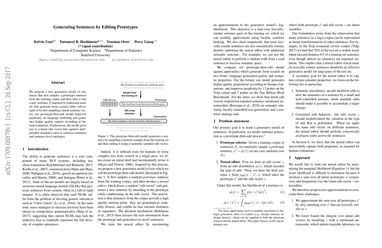
We propose a new generative model of sentences that first samples a prototype sentence from the training corpus and then edits it into a new sentence. Compared to traditional models that generate from scratch either left-to-right or by first sampling a latent sentence vector, our prototype-then-edit model improves perplexity on language modeling and generates higher quality outputs according to human evaluation. Furthermore, the model gives rise to a latent edit vector that captures interpretable semantics such as sentence similarity and sentence-level analogies.

Neural speech synthesis algorithms are a promising new approach for coding speech at very low bitrate. They have so far demonstrated quality that far exceeds traditional vocoders, at the cost of very high complexity. In this work, we present a low-bitrate neural vocoder based on the LPCNet model. The use of linear prediction and sparse recurrent networks makes it possible to achieve real-time operation on general-purpose hardware. We demonstrate that LPCNet operating at 1.6 kb/s achieves significantly higher quality than MELP and that uncompressed LPCNet can exceed the quality of a waveform codec operating at low bitrate. This opens the way for new codec designs based on neural synthesis models.
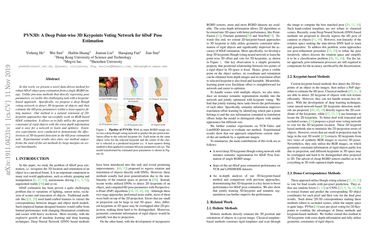
In this work, we present a novel data-driven method for robust 6DoF object pose estimation from a single RGBD image. Unlike previous methods that directly regressing pose parameters, we tackle this challenging task with a keypoint-based approach. Specifically, we propose a deep Hough voting network to detect 3D keypoints of objects and then estimate the 6D pose parameters within a least-squares fitting manner. Our method is a natural extension of 2D-keypoint approaches that successfully work on RGB based 6DoF estimation. It allows us to fully utilize the geometric constraint of rigid objects with the extra depth information and is easy for a network to learn and optimize. Extensive experiments were conducted to demonstrate the effectiveness of 3D-keypoint detection in the 6D pose estimation task. Experimental results also show our method outperforms the state-of-the-art methods by large margins on several benchmarks. Code and video are available at https://github.com/ethnhe/PVN3D.git.
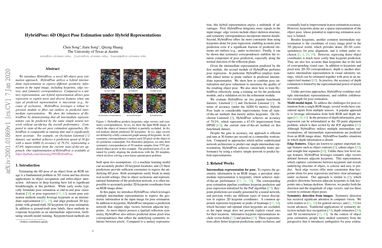
We introduce HybridPose, a novel 6D object pose estimation approach. HybridPose utilizes a hybrid intermediate representation to express different geometric information in the input image, including keypoints, edge vectors, and symmetry correspondences. Compared to a unitary representation, our hybrid representation allows pose regression to exploit more and diverse features when one type of predicted representation is inaccurate (e.g., because of occlusion). Different intermediate representations used by HybridPose can all be predicted by the same simple neural network, and outliers in predicted intermediate representations are filtered by a robust regression module. Compared to state-of-the-art pose estimation approaches, HybridPose is comparable in running time and accuracy. For example, on Occlusion Linemod dataset, our method achieves a prediction speed of 30 fps with a mean ADD(-S) accuracy of 47.5%, representing a state-of-the-art performance. The implementation of HybridPose is available at https://github.com/chensong1995/HybridPose.
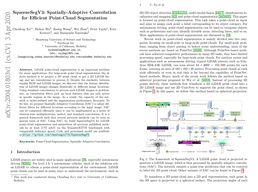
LiDAR point-cloud segmentation is an important problem for many applications. For large-scale point cloud segmentation, the \textit{de facto} method is to project a 3D point cloud to get a 2D LiDAR image and use convolutions to process it. Despite the similarity between regular RGB and LiDAR images, we discover that the feature distribution of LiDAR images changes drastically at different image locations. Using standard convolutions to process such LiDAR images is problematic, as convolution filters pick up local features that are only active in specific regions in the image. As a result, the capacity of the network is under-utilized and the segmentation performance decreases. To fix this, we propose Spatially-Adaptive Convolution (SAC) to adopt different filters for different locations according to the input image. SAC can be computed efficiently since it can be implemented as a series of element-wise multiplications, im2col, and standard convolution. It is a general framework such that several previous methods can be seen as special cases of SAC. Using SAC, we build SqueezeSegV3 for LiDAR point-cloud segmentation and outperform all previous published methods by at least 3.7% mIoU on the SemanticKITTI benchmark with comparable inference speed.
Traditional NLP has long held (supervised) syntactic parsing necessary for successful higher-level semantic language understanding (LU). The recent advent of end-to-end neural models, self-supervised via language modeling (LM), and their success on a wide range of LU tasks, however, questions this belief. In this work, we empirically investigate the usefulness of supervised parsing for semantic LU in the context of LM-pretrained transformer networks. Relying on the established fine-tuning paradigm, we first couple a pretrained transformer with a biaffine parsing head, aiming to infuse explicit syntactic knowledge from Universal Dependencies treebanks into the transformer. We then fine-tune the model for LU tasks and measure the effect of the intermediate parsing training (IPT) on downstream LU task performance. Results from both monolingual English and zero-shot language transfer experiments (with intermediate target-language parsing) show that explicit formalized syntax, injected into transformers through IPT, has very limited and inconsistent effect on downstream LU performance. Our results, coupled with our analysis of transformers' representation spaces before and after intermediate parsing, make a significant step towards providing answers to an essential question: how (un)availing is supervised parsing for high-level semantic natural language understanding in the era of large neural models?

This paper proposes a modification to RNN-Transducer (RNN-T) models for automatic speech recognition (ASR). In standard RNN-T, the emission of a blank symbol consumes exactly one input frame; in our proposed method, we introduce additional blank symbols, which consume two or more input frames when emitted. We refer to the added symbols as big blanks, and the method multi-blank RNN-T. For training multi-blank RNN-Ts, we propose a novel logit under-normalization method in order to prioritize emissions of big blanks. With experiments on multiple languages and datasets, we show that multi-blank RNN-T methods could bring relative speedups of over +90%/+139% to model inference for English Librispeech and German Multilingual Librispeech datasets, respectively. The multi-blank RNN-T method also improves ASR accuracy consistently. We will release our implementation of the method in the NeMo (https://github.com/NVIDIA/NeMo) toolkit.

We present speculative sampling, an algorithm for accelerating transformer decoding by enabling the generation of multiple tokens from each transformer call. Our algorithm relies on the observation that the latency of parallel scoring of short continuations, generated by a faster but less powerful draft model, is comparable to that of sampling a single token from the larger target model. This is combined with a novel modified rejection sampling scheme which preserves the distribution of the target model within hardware numerics. We benchmark speculative sampling with Chinchilla, a 70 billion parameter language model, achieving a 2-2.5x decoding speedup in a distributed setup, without compromising the sample quality or making modifications to the model itself.

This paper presents a novel end-to-end framework with Explicit box Detection for multi-person Pose estimation, called ED-Pose, where it unifies the contextual learning between human-level (global) and keypoint-level (local) information. Different from previous one-stage methods, ED-Pose re-considers this task as two explicit box detection processes with a unified representation and regression supervision. First, we introduce a human detection decoder from encoded tokens to extract global features. It can provide a good initialization for the latter keypoint detection, making the training process converge fast. Second, to bring in contextual information near keypoints, we regard pose estimation as a keypoint box detection problem to learn both box positions and contents for each keypoint. A human-to-keypoint detection decoder adopts an interactive learning strategy between human and keypoint features to further enhance global and local feature aggregation. In general, ED-Pose is conceptually simple without post-processing and dense heatmap supervision. It demonstrates its effectiveness and efficiency compared with both two-stage and one-stage methods. Notably, explicit box detection boosts the pose estimation performance by 4.5 AP on COCO and 9.9 AP on CrowdPose. For the first time, as a fully end-to-end framework with a L1 regression loss, ED-Pose surpasses heatmap-based Top-down methods under the same backbone by 1.2 AP on COCO and achieves the state-of-the-art with 76.6 AP on CrowdPose without bells and whistles. Code is available at https://github.com/IDEA-Research/ED-Pose.

We study the problem of watermarking large language models (LLMs) generated text -- one of the most promising approaches for addressing the safety challenges of LLM usage. In this paper, we propose a rigorous theoretical framework to quantify the effectiveness and robustness of LLM watermarks. We propose a robust and high-quality watermark method, Unigram-Watermark, by extending an existing approach with a simplified fixed grouping strategy. We prove that our watermark method enjoys guaranteed generation quality, correctness in watermark detection, and is robust against text editing and paraphrasing. Experiments on three varying LLMs and two datasets verify that our Unigram-Watermark achieves superior detection accuracy and comparable generation quality in perplexity, thus promoting the responsible use of LLMs. Code is available at https://github.com/XuandongZhao/Unigram-Watermark.

Prehensile object rearrangement in cluttered and confined spaces has broad applications but is also challenging. For instance, rearranging products in a grocery shelf means that the robot cannot directly access all objects and has limited free space. This is harder than tabletop rearrangement where objects are easily accessible with top-down grasps, which simplifies robot-object interactions. This work focuses on problems where such interactions are critical for completing tasks. It proposes a new efficient and complete solver under general constraints for monotone instances, which can be solved by moving each object at most once. The monotone solver reasons about robot-object constraints and uses them to effectively prune the search space. The new monotone solver is integrated with a global planner to solve non-monotone instances with high-quality solutions fast. Furthermore, this work contributes an effective pre-processing tool to significantly speed up online motion planning queries for rearrangement in confined spaces. Experiments further demonstrate that the proposed monotone solver, equipped with the pre-processing tool, results in 57.3% faster computation and 3 times higher success rate than state-of-the-art methods. Similarly, the resulting global planner is computationally more efficient and has a higher success rate, while producing high-quality solutions for non-monotone instances (i.e., only 1.3 additional actions are needed on average). Videos of demonstrating solutions on a real robotic system and codes can be found at https://github.com/Rui1223/uniform_object_rearrangement.

Generative Artificial Intelligence (AI) has enabled the development of sophisticated models that are capable of producing high-caliber text, images, and other outputs through the utilization of large pre-trained models. Nevertheless, assessing the quality of the generation is an even more arduous task than the generation itself, and this issue has not been given adequate consideration recently. This paper proposes a novel evaluation framework, GPTScore, which utilizes the emergent abilities (e.g., zero-shot instruction) of generative pre-trained models to score generated texts. There are 19 pre-trained models explored in this paper, ranging in size from 80M (e.g., FLAN-T5-small) to 175B (e.g., GPT3). Experimental results on four text generation tasks, 22 evaluation aspects, and corresponding 37 datasets demonstrate that this approach can effectively allow us to achieve what one desires to evaluate for texts simply by natural language instructions. This nature helps us overcome several long-standing challenges in text evaluation--how to achieve customized, multi-faceted evaluation without the need for annotated samples. We make our code publicly available at https://github.com/jinlanfu/GPTScore.