
分享
Structured prediction energy networks (SPENs; Belanger & McCallum 2016) use neural network architectures to define energy functions that can capture arbitrary dependencies among parts of structured outputs. Prior work used gradient descent for inference, relaxing the structured output to a set of continuous variables and then optimizing the energy with respect to them. We replace this use of gradient descent with a neural network trained to approximate structured argmax inference. This "inference network" outputs continuous values that we treat as the output structure. We develop large-margin training criteria for joint training of the structured energy function and inference network. On multi-label classification we report speed-ups of 10-60x compared to (Belanger et al, 2017) while also improving accuracy. For sequence labeling with simple structured energies, our approach performs comparably to exact inference while being much faster at test time. We then demonstrate improved accuracy by augmenting the energy with a "label language model" that scores entire output label sequences, showing it can improve handling of long-distance dependencies in part-of-speech tagging. Finally, we show how inference networks can replace dynamic programming for test-time inference in conditional random fields, suggestive for their general use for fast inference in structured settings.
Homography estimation between multiple aerial images can provide relative pose estimation for collaborative autonomous exploration and monitoring. The usage on a robotic system requires a fast and robust homography estimation algorithm. In this study, we propose an unsupervised learning algorithm that trains a Deep Convolutional Neural Network to estimate planar homographies. We compare the proposed algorithm to traditional feature-based and direct methods, as well as a corresponding supervised learning algorithm. Our empirical results demonstrate that compared to traditional approaches, the unsupervised algorithm achieves faster inference speed, while maintaining comparable or better accuracy and robustness to illumination variation. In addition, on both a synthetic dataset and representative real-world aerial dataset, our unsupervised method has superior adaptability and performance compared to the supervised deep learning method.
Large-scale distributed training requires significant communication bandwidth for gradient exchange that limits the scalability of multi-node training, and requires expensive high-bandwidth network infrastructure. The situation gets even worse with distributed training on mobile devices (federated learning), which suffers from higher latency, lower throughput, and intermittent poor connections. In this paper, we find 99.9% of the gradient exchange in distributed SGD is redundant, and propose Deep Gradient Compression (DGC) to greatly reduce the communication bandwidth. To preserve accuracy during compression, DGC employs four methods: momentum correction, local gradient clipping, momentum factor masking, and warm-up training. We have applied Deep Gradient Compression to image classification, speech recognition, and language modeling with multiple datasets including Cifar10, ImageNet, Penn Treebank, and Librispeech Corpus. On these scenarios, Deep Gradient Compression achieves a gradient compression ratio from 270x to 600x without losing accuracy, cutting the gradient size of ResNet-50 from 97MB to 0.35MB, and for DeepSpeech from 488MB to 0.74MB. Deep gradient compression enables large-scale distributed training on inexpensive commodity 1Gbps Ethernet and facilitates distributed training on mobile. Code is available at: https://github.com/synxlin/deep-gradient-compression.
Human face-to-face communication is a complex multimodal signal. We use words (language modality), gestures (vision modality) and changes in tone (acoustic modality) to convey our intentions. Humans easily process and understand face-to-face communication, however, comprehending this form of communication remains a significant challenge for Artificial Intelligence (AI). AI must understand each modality and the interactions between them that shape human communication. In this paper, we present a novel neural architecture for understanding human communication called the Multi-attention Recurrent Network (MARN). The main strength of our model comes from discovering interactions between modalities through time using a neural component called the Multi-attention Block (MAB) and storing them in the hybrid memory of a recurrent component called the Long-short Term Hybrid Memory (LSTHM). We perform extensive comparisons on six publicly available datasets for multimodal sentiment analysis, speaker trait recognition and emotion recognition. MARN shows state-of-the-art performance on all the datasets.
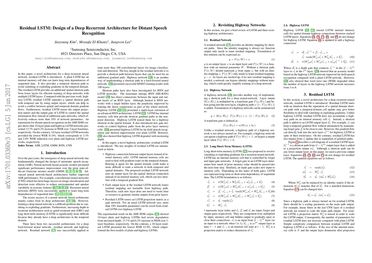
In this paper, a novel architecture for a deep recurrent neural network, residual LSTM is introduced. A plain LSTM has an internal memory cell that can learn long term dependencies of sequential data. It also provides a temporal shortcut path to avoid vanishing or exploding gradients in the temporal domain. The residual LSTM provides an additional spatial shortcut path from lower layers for efficient training of deep networks with multiple LSTM layers. Compared with the previous work, highway LSTM, residual LSTM separates a spatial shortcut path with temporal one by using output layers, which can help to avoid a conflict between spatial and temporal-domain gradient flows. Furthermore, residual LSTM reuses the output projection matrix and the output gate of LSTM to control the spatial information flow instead of additional gate networks, which effectively reduces more than 10% of network parameters. An experiment for distant speech recognition on the AMI SDM corpus shows that 10-layer plain and highway LSTM networks presented 13.7% and 6.2% increase in WER over 3-layer aselines, respectively. On the contrary, 10-layer residual LSTM networks provided the lowest WER 41.0%, which corresponds to 3.3% and 2.8% WER reduction over plain and highway LSTM networks, respectively.
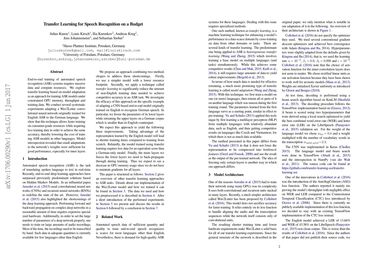
End-to-end training of automated speech recognition (ASR) systems requires massive data and compute resources. We explore transfer learning based on model adaptation as an approach for training ASR models under constrained GPU memory, throughput and training data. We conduct several systematic experiments adapting a Wav2Letter convolutional neural network originally trained for English ASR to the German language. We show that this technique allows faster training on consumer-grade resources while requiring less training data in order to achieve the same accuracy, thereby lowering the cost of training ASR models in other languages. Model introspection revealed that small adaptations to the network's weights were sufficient for good performance, especially for inner layers.
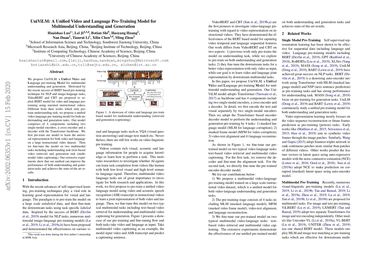
With the recent success of the pre-training technique for NLP and image-linguistic tasks, some video-linguistic pre-training works are gradually developed to improve video-text related downstream tasks. However, most of the existing multimodal models are pre-trained for understanding tasks, leading to a pretrain-finetune discrepancy for generation tasks. This paper proposes UniVL: a Unified Video and Language pre-training model for both multimodal understanding and generation. It comprises four components, including two single-modal encoders, a cross encoder, and a decoder with the Transformer backbone. Five objectives, including video-text joint, conditioned masked language model (CMLM), conditioned masked frame model (CMFM), video-text alignment, and language reconstruction, are designed to train each of the components. We further develop two pre-training strategies, stage by stage pre-training (StagedP) and enhanced video representation (EnhancedV), to make the training process of the UniVL more effective. The pre-train is carried out on a sizeable instructional video dataset HowTo100M. Experimental results demonstrate that the UniVL can learn strong video-text representation and achieves state-of-the-art results on five downstream tasks.
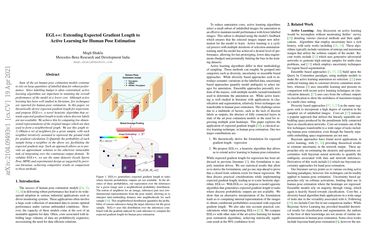
Active learning algorithms select a subset of data for annotation to maximize the model performance on a budget. One such algorithm is Expected Gradient Length, which as the name suggests uses the approximate gradient induced per example in the sampling process. While Expected Gradient Length has been successfully used for classification and regression, the formulation for regression remains intuitively driven. Hence, our theoretical contribution involves deriving this formulation, thereby supporting the experimental evidence. Subsequently, we show that expected gradient length in regression is equivalent to Bayesian uncertainty. If certain assumptions are infeasible, our algorithmic contribution (EGL++) approximates the effect of ensembles with a single deterministic network. Instead of computing multiple possible inferences per input, we leverage previously annotated samples to quantify the probability of previous labels being the true label. Such an approach allows us to extend expected gradient length to a new task: human pose estimation. We perform experimental validation on two human pose datasets (MPII and LSP/LSPET), highlighting the interpretability and competitiveness of EGL++ with different active learning algorithms for human pose estimation.

Generating texts which express complex ideas spanning multiple sentences requires a structured representation of their content (document plan), but these representations are prohibitively expensive to manually produce. In this work, we address the problem of generating coherent multi-sentence texts from the output of an information extraction system, and in particular a knowledge graph. Graphical knowledge representations are ubiquitous in computing, but pose a significant challenge for text generation techniques due to their non-hierarchical nature, collapsing of long-distance dependencies, and structural variety. We introduce a novel graph transforming encoder which can leverage the relational structure of such knowledge graphs without imposing linearization or hierarchical constraints. Incorporated into an encoder-decoder setup, we provide an end-to-end trainable system for graph-to-text generation that we apply to the domain of scientific text. Automatic and human evaluations show that our technique produces more informative texts which exhibit better document structure than competitive encoder-decoder methods.

Graph convolution networks (GCN) have been widely used in skeleton-based action recognition. We note that existing GCN-based approaches primarily rely on prescribed graphical structures (ie., a manually defined topology of skeleton joints), which limits their flexibility to capture complicated correlations between joints. To move beyond this limitation, we propose a new framework for skeleton-based action recognition, namely Dynamic Group Spatio-Temporal GCN (DG-STGCN). It consists of two modules, DG-GCN and DG-TCN, respectively, for spatial and temporal modeling. In particular, DG-GCN uses learned affinity matrices to capture dynamic graphical structures instead of relying on a prescribed one, while DG-TCN performs group-wise temporal convolutions with varying receptive fields and incorporates a dynamic joint-skeleton fusion module for adaptive multi-level temporal modeling. On a wide range of benchmarks, including NTURGB+D, Kinetics-Skeleton, BABEL, and Toyota SmartHome, DG-STGCN consistently outperforms state-of-the-art methods, often by a notable margin.

This paper proposes a modification to RNN-Transducer (RNN-T) models for automatic speech recognition (ASR). In standard RNN-T, the emission of a blank symbol consumes exactly one input frame; in our proposed method, we introduce additional blank symbols, which consume two or more input frames when emitted. We refer to the added symbols as big blanks, and the method multi-blank RNN-T. For training multi-blank RNN-Ts, we propose a novel logit under-normalization method in order to prioritize emissions of big blanks. With experiments on multiple languages and datasets, we show that multi-blank RNN-T methods could bring relative speedups of over +90%/+139% to model inference for English Librispeech and German Multilingual Librispeech datasets, respectively. The multi-blank RNN-T method also improves ASR accuracy consistently. We will release our implementation of the method in the NeMo (https://github.com/NVIDIA/NeMo) toolkit.

Despite tremendous advancements in dialogue systems, stable evaluation still requires human judgments producing notoriously high-variance metrics due to their inherent subjectivity. Moreover, methods and labels in dialogue evaluation are not fully standardized, especially for open-domain chats, with a lack of work to compare and assess the validity of those approaches. The use of inconsistent evaluation can misinform the performance of a dialogue system, which becomes a major hurdle to enhance it. Thus, a dimensional evaluation of chat-oriented open-domain dialogue systems that reliably measures several aspects of dialogue capabilities is desired. This paper presents a novel human evaluation method to estimate the rates of many dialogue system behaviors. Our method is used to evaluate four state-of-the-art open-domain dialogue systems and compared with existing approaches. The analysis demonstrates that our behavior method is more suitable than alternative Likert-style or comparative approaches for dimensional evaluation of these systems.