
分享
Robust speech processing in multi-talker environments requires effective speech separation. Recent deep learning systems have made significant progress toward solving this problem, yet it remains challenging particularly in real-time, short latency applications. Most methods attempt to construct a mask for each source in time-frequency representation of the mixture signal which is not necessarily an optimal representation for speech separation. In addition, time-frequency decomposition results in inherent problems such as phase/magnitude decoupling and long time window which is required to achieve sufficient frequency resolution. We propose Time-domain Audio Separation Network (TasNet) to overcome these limitations. We directly model the signal in the time-domain using an encoder-decoder framework and perform the source separation on nonnegative encoder outputs. This method removes the frequency decomposition step and reduces the separation problem to estimation of source masks on encoder outputs which is then synthesized by the decoder. Our system outperforms the current state-of-the-art causal and noncausal speech separation algorithms, reduces the computational cost of speech separation, and significantly reduces the minimum required latency of the output. This makes TasNet suitable for applications where low-power, real-time implementation is desirable such as in hearable and telecommunication devices.
Structured prediction energy networks (SPENs; Belanger & McCallum 2016) use neural network architectures to define energy functions that can capture arbitrary dependencies among parts of structured outputs. Prior work used gradient descent for inference, relaxing the structured output to a set of continuous variables and then optimizing the energy with respect to them. We replace this use of gradient descent with a neural network trained to approximate structured argmax inference. This "inference network" outputs continuous values that we treat as the output structure. We develop large-margin training criteria for joint training of the structured energy function and inference network. On multi-label classification we report speed-ups of 10-60x compared to (Belanger et al, 2017) while also improving accuracy. For sequence labeling with simple structured energies, our approach performs comparably to exact inference while being much faster at test time. We then demonstrate improved accuracy by augmenting the energy with a "label language model" that scores entire output label sequences, showing it can improve handling of long-distance dependencies in part-of-speech tagging. Finally, we show how inference networks can replace dynamic programming for test-time inference in conditional random fields, suggestive for their general use for fast inference in structured settings.
Homography estimation between multiple aerial images can provide relative pose estimation for collaborative autonomous exploration and monitoring. The usage on a robotic system requires a fast and robust homography estimation algorithm. In this study, we propose an unsupervised learning algorithm that trains a Deep Convolutional Neural Network to estimate planar homographies. We compare the proposed algorithm to traditional feature-based and direct methods, as well as a corresponding supervised learning algorithm. Our empirical results demonstrate that compared to traditional approaches, the unsupervised algorithm achieves faster inference speed, while maintaining comparable or better accuracy and robustness to illumination variation. In addition, on both a synthetic dataset and representative real-world aerial dataset, our unsupervised method has superior adaptability and performance compared to the supervised deep learning method.
Large-scale distributed training requires significant communication bandwidth for gradient exchange that limits the scalability of multi-node training, and requires expensive high-bandwidth network infrastructure. The situation gets even worse with distributed training on mobile devices (federated learning), which suffers from higher latency, lower throughput, and intermittent poor connections. In this paper, we find 99.9% of the gradient exchange in distributed SGD is redundant, and propose Deep Gradient Compression (DGC) to greatly reduce the communication bandwidth. To preserve accuracy during compression, DGC employs four methods: momentum correction, local gradient clipping, momentum factor masking, and warm-up training. We have applied Deep Gradient Compression to image classification, speech recognition, and language modeling with multiple datasets including Cifar10, ImageNet, Penn Treebank, and Librispeech Corpus. On these scenarios, Deep Gradient Compression achieves a gradient compression ratio from 270x to 600x without losing accuracy, cutting the gradient size of ResNet-50 from 97MB to 0.35MB, and for DeepSpeech from 488MB to 0.74MB. Deep gradient compression enables large-scale distributed training on inexpensive commodity 1Gbps Ethernet and facilitates distributed training on mobile. Code is available at: https://github.com/synxlin/deep-gradient-compression.
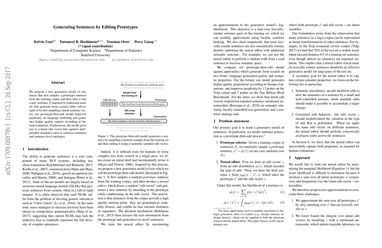
We propose a new generative model of sentences that first samples a prototype sentence from the training corpus and then edits it into a new sentence. Compared to traditional models that generate from scratch either left-to-right or by first sampling a latent sentence vector, our prototype-then-edit model improves perplexity on language modeling and generates higher quality outputs according to human evaluation. Furthermore, the model gives rise to a latent edit vector that captures interpretable semantics such as sentence similarity and sentence-level analogies.
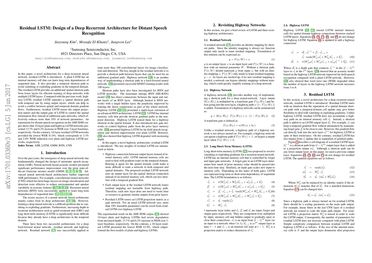
In this paper, a novel architecture for a deep recurrent neural network, residual LSTM is introduced. A plain LSTM has an internal memory cell that can learn long term dependencies of sequential data. It also provides a temporal shortcut path to avoid vanishing or exploding gradients in the temporal domain. The residual LSTM provides an additional spatial shortcut path from lower layers for efficient training of deep networks with multiple LSTM layers. Compared with the previous work, highway LSTM, residual LSTM separates a spatial shortcut path with temporal one by using output layers, which can help to avoid a conflict between spatial and temporal-domain gradient flows. Furthermore, residual LSTM reuses the output projection matrix and the output gate of LSTM to control the spatial information flow instead of additional gate networks, which effectively reduces more than 10% of network parameters. An experiment for distant speech recognition on the AMI SDM corpus shows that 10-layer plain and highway LSTM networks presented 13.7% and 6.2% increase in WER over 3-layer aselines, respectively. On the contrary, 10-layer residual LSTM networks provided the lowest WER 41.0%, which corresponds to 3.3% and 2.8% WER reduction over plain and highway LSTM networks, respectively.
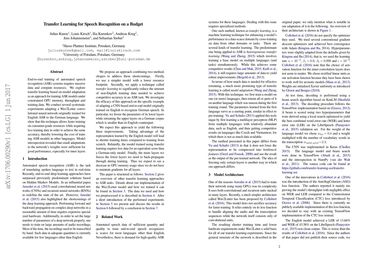
End-to-end training of automated speech recognition (ASR) systems requires massive data and compute resources. We explore transfer learning based on model adaptation as an approach for training ASR models under constrained GPU memory, throughput and training data. We conduct several systematic experiments adapting a Wav2Letter convolutional neural network originally trained for English ASR to the German language. We show that this technique allows faster training on consumer-grade resources while requiring less training data in order to achieve the same accuracy, thereby lowering the cost of training ASR models in other languages. Model introspection revealed that small adaptations to the network's weights were sufficient for good performance, especially for inner layers.
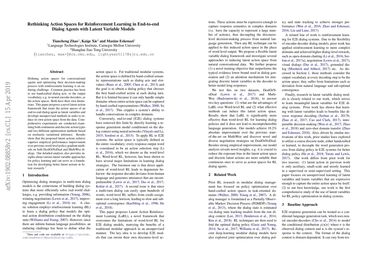
Defining action spaces for conversational agents and optimizing their decision-making process with reinforcement learning is an enduring challenge. Common practice has been to use handcrafted dialog acts, or the output vocabulary, e.g. in neural encoder decoders, as the action spaces. Both have their own limitations. This paper proposes a novel latent action framework that treats the action spaces of an end-to-end dialog agent as latent variables and develops unsupervised methods in order to induce its own action space from the data. Comprehensive experiments are conducted examining both continuous and discrete action types and two different optimization methods based on stochastic variational inference. Results show that the proposed latent actions achieve superior empirical performance improvement over previous word-level policy gradient methods on both DealOrNoDeal and MultiWoz dialogs. Our detailed analysis also provides insights about various latent variable approaches for policy learning and can serve as a foundation for developing better latent actions in future research.
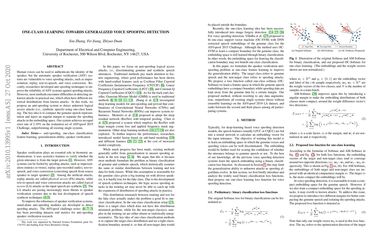
Human voices can be used to authenticate the identity of the speaker, but the automatic speaker verification (ASV) systems are vulnerable to voice spoofing attacks, such as impersonation, replay, text-to-speech, and voice conversion. Recently, researchers developed anti-spoofing techniques to improve the reliability of ASV systems against spoofing attacks. However, most methods encounter difficulties in detecting unknown attacks in practical use, which often have different statistical distributions from known attacks. In this work, we propose an anti-spoofing system to detect unknown logical access attacks (i.e., synthetic speech) using one-class learning. The key idea is to compact the genuine speech representation and inject an angular margin to separate the spoofing attacks in the embedding space. Our system achieves an equal error rate of 2.19% on the evaluation set of ASVspoof 2019 Challenge, outperforming all existing single systems.
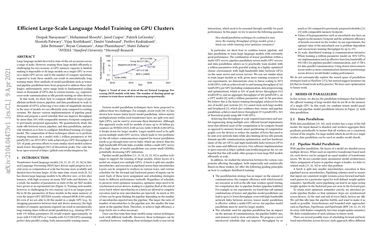
Large language models have led to state-of-the-art accuracies across a range of tasks. However, training these models efficiently is challenging for two reasons: a) GPU memory capacity is limited, making it impossible to fit large models on even a multi-GPU server, and b) the number of compute operations required to train these models can result in unrealistically long training times. Consequently, new methods of model parallelism such as tensor and pipeline parallelism have been proposed. Unfortunately, naive usage of these methods leads to fundamental scaling issues at thousands of GPUs, e.g., due to expensive cross-node communication or devices spending significant time waiting on other devices to make progress. In this paper, we show how different types of parallelism methods (tensor, pipeline, and data parallelism) can be composed to scale to thousands of GPUs and models with trillions of parameters. We survey techniques for pipeline parallelism and propose a novel interleaved pipeline parallelism schedule that can improve throughput by 10+% with memory footprint comparable to existing approaches. We quantitatively study the trade-offs between tensor, pipeline, and data parallelism, and provide intuition as to how to configure distributed training of a large model. Our approach allows us to perform training iterations on a model with 1 trillion parameters at 502 petaFLOP/s on 3072 GPUs with achieved per-GPU throughput of 52% of theoretical peak. Our code is open sourced at https://github.com/nvidia/megatron-lm.

We are living in a three-dimensional space while moving forward through a fourth dimension: time. To allow artificial intelligence to develop a comprehensive understanding of such a 4D environment, we introduce 4D Panoptic Scene Graph (PSG-4D), a new representation that bridges the raw visual data perceived in a dynamic 4D world and high-level visual understanding. Specifically, PSG-4D abstracts rich 4D sensory data into nodes, which represent entities with precise location and status information, and edges, which capture the temporal relations. To facilitate research in this new area, we build a richly annotated PSG-4D dataset consisting of 3K RGB-D videos with a total of 1M frames, each of which is labeled with 4D panoptic segmentation masks as well as fine-grained, dynamic scene graphs. To solve PSG-4D, we propose PSG4DFormer, a Transformer-based model that can predict panoptic segmentation masks, track masks along the time axis, and generate the corresponding scene graphs via a relation component. Extensive experiments on the new dataset show that our method can serve as a strong baseline for future research on PSG-4D. In the end, we provide a real-world application example to demonstrate how we can achieve dynamic scene understanding by integrating a large language model into our PSG-4D system.

GPT-$3$ has attracted lots of attention due to its superior performance across a wide range of NLP tasks, especially with its powerful and versatile in-context few-shot learning ability. Despite its success, we found that the empirical results of GPT-$3$ depend heavily on the choice of in-context examples. In this work, we investigate whether there are more effective strategies for judiciously selecting in-context examples (relative to random sampling) that better leverage GPT-$3$'s few-shot capabilities. Inspired by the recent success of leveraging a retrieval module to augment large-scale neural network models, we propose to retrieve examples that are semantically-similar to a test sample to formulate its corresponding prompt. Intuitively, the in-context examples selected with such a strategy may serve as more informative inputs to unleash GPT-$3$'s extensive knowledge. We evaluate the proposed approach on several natural language understanding and generation benchmarks, where the retrieval-based prompt selection approach consistently outperforms the random baseline. Moreover, it is observed that the sentence encoders fine-tuned on task-related datasets yield even more helpful retrieval results. Notably, significant gains are observed on tasks such as table-to-text generation (41.9% on the ToTTo dataset) and open-domain question answering (45.5% on the NQ dataset). We hope our investigation could help understand the behaviors of GPT-$3$ and large-scale pre-trained LMs in general and enhance their few-shot capabilities.