
分享
Robust speech processing in multi-talker environments requires effective speech separation. Recent deep learning systems have made significant progress toward solving this problem, yet it remains challenging particularly in real-time, short latency applications. Most methods attempt to construct a mask for each source in time-frequency representation of the mixture signal which is not necessarily an optimal representation for speech separation. In addition, time-frequency decomposition results in inherent problems such as phase/magnitude decoupling and long time window which is required to achieve sufficient frequency resolution. We propose Time-domain Audio Separation Network (TasNet) to overcome these limitations. We directly model the signal in the time-domain using an encoder-decoder framework and perform the source separation on nonnegative encoder outputs. This method removes the frequency decomposition step and reduces the separation problem to estimation of source masks on encoder outputs which is then synthesized by the decoder. Our system outperforms the current state-of-the-art causal and noncausal speech separation algorithms, reduces the computational cost of speech separation, and significantly reduces the minimum required latency of the output. This makes TasNet suitable for applications where low-power, real-time implementation is desirable such as in hearable and telecommunication devices.
We present a box-free bottom-up approach for the tasks of pose estimation and instance segmentation of people in multi-person images using an efficient single-shot model. The proposed PersonLab model tackles both semantic-level reasoning and object-part associations using part-based modeling. Our model employs a convolutional network which learns to detect individual keypoints and predict their relative displacements, allowing us to group keypoints into person pose instances. Further, we propose a part-induced geometric embedding descriptor which allows us to associate semantic person pixels with their corresponding person instance, delivering instance-level person segmentations. Our system is based on a fully-convolutional architecture and allows for efficient inference, with runtime essentially independent of the number of people present in the scene. Trained on COCO data alone, our system achieves COCO test-dev keypoint average precision of 0.665 using single-scale inference and 0.687 using multi-scale inference, significantly outperforming all previous bottom-up pose estimation systems. We are also the first bottom-up method to report competitive results for the person class in the COCO instance segmentation task, achieving a person category average precision of 0.417.
In this paper we present a data-driven, integrated approach to speaker verification, which maps a test utterance and a few reference utterances directly to a single score for verification and jointly optimizes the system's components using the same evaluation protocol and metric as at test time. Such an approach will result in simple and efficient systems, requiring little domain-specific knowledge and making few model assumptions. We implement the idea by formulating the problem as a single neural network architecture, including the estimation of a speaker model on only a few utterances, and evaluate it on our internal "Ok Google" benchmark for text-dependent speaker verification. The proposed approach appears to be very effective for big data applications like ours that require highly accurate, easy-to-maintain systems with a small footprint.
This paper presents an unsupervised segment-based method for robust voice activity detection (rVAD). The method consists of two passes of denoising followed by a voice activity detection (VAD) stage. In the first pass, high-energy segments in a speech signal are detected by using a posteriori signal-to-noise ratio (SNR) weighted energy difference and if no pitch is detected within a segment, the segment is considered as a high-energy noise segment and set to zero. In the second pass, the speech signal is denoised by a speech enhancement method, for which several methods are explored. Next, neighbouring frames with pitch are grouped together to form pitch segments, and based on speech statistics, the pitch segments are further extended from both ends in order to include both voiced and unvoiced sounds and likely non-speech parts as well. In the end, a posteriori SNR weighted energy difference is applied to the extended pitch segments of the denoised speech signal for detecting voice activity. We evaluate the VAD performance of the proposed method using two databases, RATS and Aurora-2, which contain a large variety of noise conditions. The rVAD method is further evaluated, in terms of speaker verification performance, on the RedDots 2016 challenge database and its noise-corrupted versions. Experiment results show that rVAD is compared favourably with a number of existing methods. In addition, we present a modified version of rVAD where computationally intensive pitch extraction is replaced by computationally efficient spectral flatness calculation. The modified version significantly reduces the computational complexity at the cost of moderately inferior VAD performance, which is an advantage when processing a large amount of data and running on low resource devices. The source code of rVAD is made publicly available.
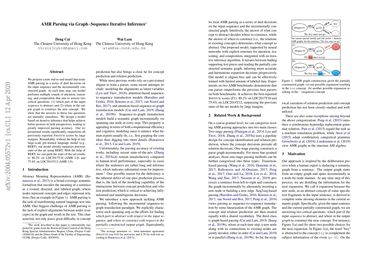
We propose a new end-to-end model that treats AMR parsing as a series of dual decisions on the input sequence and the incrementally constructed graph. At each time step, our model performs multiple rounds of attention, reasoning, and composition that aim to answer two critical questions: (1) which part of the input \textit{sequence} to abstract; and (2) where in the output \textit{graph} to construct the new concept. We show that the answers to these two questions are mutually causalities. We design a model based on iterative inference that helps achieve better answers in both perspectives, leading to greatly improved parsing accuracy. Our experimental results significantly outperform all previously reported \textsc{Smatch} scores by large margins. Remarkably, without the help of any large-scale pre-trained language model (e.g., BERT), our model already surpasses previous state-of-the-art using BERT. With the help of BERT, we can push the state-of-the-art results to 80.2\% on LDC2017T10 (AMR 2.0) and 75.4\% on LDC2014T12 (AMR 1.0).
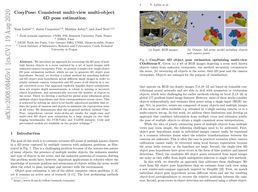
We introduce an approach for recovering the 6D pose of multiple known objects in a scene captured by a set of input images with unknown camera viewpoints. First, we present a single-view single-object 6D pose estimation method, which we use to generate 6D object pose hypotheses. Second, we develop a robust method for matching individual 6D object pose hypotheses across different input images in order to jointly estimate camera viewpoints and 6D poses of all objects in a single consistent scene. Our approach explicitly handles object symmetries, does not require depth measurements, is robust to missing or incorrect object hypotheses, and automatically recovers the number of objects in the scene. Third, we develop a method for global scene refinement given multiple object hypotheses and their correspondences across views. This is achieved by solving an object-level bundle adjustment problem that refines the poses of cameras and objects to minimize the reprojection error in all views. We demonstrate that the proposed method, dubbed CosyPose, outperforms current state-of-the-art results for single-view and multi-view 6D object pose estimation by a large margin on two challenging benchmarks: the YCB-Video and T-LESS datasets. Code and pre-trained models are available on the project webpage https://www.di.ens.fr/willow/research/cosypose/.
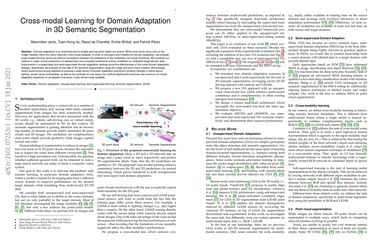
Domain adaptation is an important task to enable learning when labels are scarce. While most works focus only on the image modality, there are many important multi-modal datasets. In order to leverage multi-modality for domain adaptation, we propose cross-modal learning, where we enforce consistency between the predictions of two modalities via mutual mimicking. We constrain our network to make correct predictions on labeled data and consistent predictions across modalities on unlabeled target-domain data. Experiments in unsupervised and semi-supervised domain adaptation settings prove the effectiveness of this novel domain adaptation strategy. Specifically, we evaluate on the task of 3D semantic segmentation using the image and point cloud modality. We leverage recent autonomous driving datasets to produce a wide variety of domain adaptation scenarios including changes in scene layout, lighting, sensor setup and weather, as well as the synthetic-to-real setup. Our method significantly improves over previous uni-modal adaptation baselines on all adaption scenarios. Code will be made available.
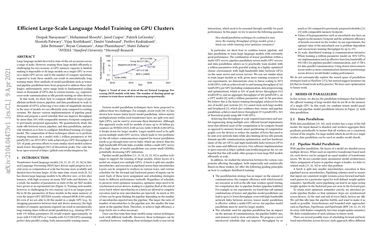
Large language models have led to state-of-the-art accuracies across a range of tasks. However, training these models efficiently is challenging for two reasons: a) GPU memory capacity is limited, making it impossible to fit large models on even a multi-GPU server, and b) the number of compute operations required to train these models can result in unrealistically long training times. Consequently, new methods of model parallelism such as tensor and pipeline parallelism have been proposed. Unfortunately, naive usage of these methods leads to fundamental scaling issues at thousands of GPUs, e.g., due to expensive cross-node communication or devices spending significant time waiting on other devices to make progress. In this paper, we show how different types of parallelism methods (tensor, pipeline, and data parallelism) can be composed to scale to thousands of GPUs and models with trillions of parameters. We survey techniques for pipeline parallelism and propose a novel interleaved pipeline parallelism schedule that can improve throughput by 10+% with memory footprint comparable to existing approaches. We quantitatively study the trade-offs between tensor, pipeline, and data parallelism, and provide intuition as to how to configure distributed training of a large model. Our approach allows us to perform training iterations on a model with 1 trillion parameters at 502 petaFLOP/s on 3072 GPUs with achieved per-GPU throughput of 52% of theoretical peak. Our code is open sourced at https://github.com/nvidia/megatron-lm.

This paper proposes a modification to RNN-Transducer (RNN-T) models for automatic speech recognition (ASR). In standard RNN-T, the emission of a blank symbol consumes exactly one input frame; in our proposed method, we introduce additional blank symbols, which consume two or more input frames when emitted. We refer to the added symbols as big blanks, and the method multi-blank RNN-T. For training multi-blank RNN-Ts, we propose a novel logit under-normalization method in order to prioritize emissions of big blanks. With experiments on multiple languages and datasets, we show that multi-blank RNN-T methods could bring relative speedups of over +90%/+139% to model inference for English Librispeech and German Multilingual Librispeech datasets, respectively. The multi-blank RNN-T method also improves ASR accuracy consistently. We will release our implementation of the method in the NeMo (https://github.com/NVIDIA/NeMo) toolkit.

High performance face detection remains a very challenging problem, especially when there exists many tiny faces. This paper presents a novel single-shot face detector, named Selective Refinement Network (SRN), which introduces novel two-step classification and regression operations selectively into an anchor-based face detector to reduce false positives and improve location accuracy simultaneously. In particular, the SRN consists of two modules: the Selective Two-step Classification (STC) module and the Selective Two-step Regression (STR) module. The STC aims to filter out most simple negative anchors from low level detection layers to reduce the search space for the subsequent classifier, while the STR is designed to coarsely adjust the locations and sizes of anchors from high level detection layers to provide better initialization for the subsequent regressor. Moreover, we design a Receptive Field Enhancement (RFE) block to provide more diverse receptive field, which helps to better capture faces in some extreme poses. As a consequence, the proposed SRN detector achieves state-of-the-art performance on all the widely used face detection benchmarks, including AFW, PASCAL face, FDDB, and WIDER FACE datasets. Codes will be released to facilitate further studies on the face detection problem.

GPT-$3$ has attracted lots of attention due to its superior performance across a wide range of NLP tasks, especially with its powerful and versatile in-context few-shot learning ability. Despite its success, we found that the empirical results of GPT-$3$ depend heavily on the choice of in-context examples. In this work, we investigate whether there are more effective strategies for judiciously selecting in-context examples (relative to random sampling) that better leverage GPT-$3$'s few-shot capabilities. Inspired by the recent success of leveraging a retrieval module to augment large-scale neural network models, we propose to retrieve examples that are semantically-similar to a test sample to formulate its corresponding prompt. Intuitively, the in-context examples selected with such a strategy may serve as more informative inputs to unleash GPT-$3$'s extensive knowledge. We evaluate the proposed approach on several natural language understanding and generation benchmarks, where the retrieval-based prompt selection approach consistently outperforms the random baseline. Moreover, it is observed that the sentence encoders fine-tuned on task-related datasets yield even more helpful retrieval results. Notably, significant gains are observed on tasks such as table-to-text generation (41.9% on the ToTTo dataset) and open-domain question answering (45.5% on the NQ dataset). We hope our investigation could help understand the behaviors of GPT-$3$ and large-scale pre-trained LMs in general and enhance their few-shot capabilities.

A wide variety of NLP applications, such as machine translation, summarization, and dialog, involve text generation. One major challenge for these applications is how to evaluate whether such generated texts are actually fluent, accurate, or effective. In this work, we conceptualize the evaluation of generated text as a text generation problem, modeled using pre-trained sequence-to-sequence models. The general idea is that models trained to convert the generated text to/from a reference output or the source text will achieve higher scores when the generated text is better. We operationalize this idea using BART, an encoder-decoder based pre-trained model, and propose a metric BARTScore with a number of variants that can be flexibly applied in an unsupervised fashion to evaluation of text from different perspectives (e.g. informativeness, fluency, or factuality). BARTScore is conceptually simple and empirically effective. It can outperform existing top-scoring metrics in 16 of 22 test settings, covering evaluation of 16 datasets (e.g., machine translation, text summarization) and 7 different perspectives (e.g., informativeness, factuality). Code to calculate BARTScore is available at https://github.com/neulab/BARTScore, and we have released an interactive leaderboard for meta-evaluation at http://explainaboard.nlpedia.ai/leaderboard/task-meval/ on the ExplainaBoard platform, which allows us to interactively understand the strengths, weaknesses, and complementarity of each metric.