
分享
Robust speech processing in multi-talker environments requires effective speech separation. Recent deep learning systems have made significant progress toward solving this problem, yet it remains challenging particularly in real-time, short latency applications. Most methods attempt to construct a mask for each source in time-frequency representation of the mixture signal which is not necessarily an optimal representation for speech separation. In addition, time-frequency decomposition results in inherent problems such as phase/magnitude decoupling and long time window which is required to achieve sufficient frequency resolution. We propose Time-domain Audio Separation Network (TasNet) to overcome these limitations. We directly model the signal in the time-domain using an encoder-decoder framework and perform the source separation on nonnegative encoder outputs. This method removes the frequency decomposition step and reduces the separation problem to estimation of source masks on encoder outputs which is then synthesized by the decoder. Our system outperforms the current state-of-the-art causal and noncausal speech separation algorithms, reduces the computational cost of speech separation, and significantly reduces the minimum required latency of the output. This makes TasNet suitable for applications where low-power, real-time implementation is desirable such as in hearable and telecommunication devices.
We present a box-free bottom-up approach for the tasks of pose estimation and instance segmentation of people in multi-person images using an efficient single-shot model. The proposed PersonLab model tackles both semantic-level reasoning and object-part associations using part-based modeling. Our model employs a convolutional network which learns to detect individual keypoints and predict their relative displacements, allowing us to group keypoints into person pose instances. Further, we propose a part-induced geometric embedding descriptor which allows us to associate semantic person pixels with their corresponding person instance, delivering instance-level person segmentations. Our system is based on a fully-convolutional architecture and allows for efficient inference, with runtime essentially independent of the number of people present in the scene. Trained on COCO data alone, our system achieves COCO test-dev keypoint average precision of 0.665 using single-scale inference and 0.687 using multi-scale inference, significantly outperforming all previous bottom-up pose estimation systems. We are also the first bottom-up method to report competitive results for the person class in the COCO instance segmentation task, achieving a person category average precision of 0.417.
Structured prediction energy networks (SPENs; Belanger & McCallum 2016) use neural network architectures to define energy functions that can capture arbitrary dependencies among parts of structured outputs. Prior work used gradient descent for inference, relaxing the structured output to a set of continuous variables and then optimizing the energy with respect to them. We replace this use of gradient descent with a neural network trained to approximate structured argmax inference. This "inference network" outputs continuous values that we treat as the output structure. We develop large-margin training criteria for joint training of the structured energy function and inference network. On multi-label classification we report speed-ups of 10-60x compared to (Belanger et al, 2017) while also improving accuracy. For sequence labeling with simple structured energies, our approach performs comparably to exact inference while being much faster at test time. We then demonstrate improved accuracy by augmenting the energy with a "label language model" that scores entire output label sequences, showing it can improve handling of long-distance dependencies in part-of-speech tagging. Finally, we show how inference networks can replace dynamic programming for test-time inference in conditional random fields, suggestive for their general use for fast inference in structured settings.
In this paper we present a data-driven, integrated approach to speaker verification, which maps a test utterance and a few reference utterances directly to a single score for verification and jointly optimizes the system's components using the same evaluation protocol and metric as at test time. Such an approach will result in simple and efficient systems, requiring little domain-specific knowledge and making few model assumptions. We implement the idea by formulating the problem as a single neural network architecture, including the estimation of a speaker model on only a few utterances, and evaluate it on our internal "Ok Google" benchmark for text-dependent speaker verification. The proposed approach appears to be very effective for big data applications like ours that require highly accurate, easy-to-maintain systems with a small footprint.
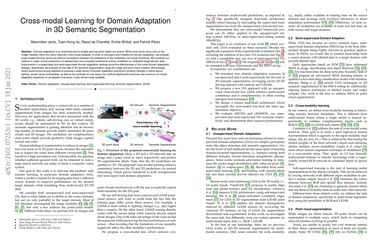
Domain adaptation is an important task to enable learning when labels are scarce. While most works focus only on the image modality, there are many important multi-modal datasets. In order to leverage multi-modality for domain adaptation, we propose cross-modal learning, where we enforce consistency between the predictions of two modalities via mutual mimicking. We constrain our network to make correct predictions on labeled data and consistent predictions across modalities on unlabeled target-domain data. Experiments in unsupervised and semi-supervised domain adaptation settings prove the effectiveness of this novel domain adaptation strategy. Specifically, we evaluate on the task of 3D semantic segmentation using the image and point cloud modality. We leverage recent autonomous driving datasets to produce a wide variety of domain adaptation scenarios including changes in scene layout, lighting, sensor setup and weather, as well as the synthetic-to-real setup. Our method significantly improves over previous uni-modal adaptation baselines on all adaption scenarios. Code will be made available.
DIHARD III was the third in a series of speaker diarization challenges intended to improve the robustness of diarization systems to variability in recording equipment, noise conditions, and conversational domain. Speaker diarization was evaluated under two speech activity conditions (diarization from a reference speech activity vs. diarization from scratch) and 11 diverse domains. The domains span a range of recording conditions and interaction types, including read audio-books, meeting speech, clinical interviews, web videos, and, for the first time, conversational telephone speech. A total of 30 organizations (forming 21teams) from industry and academia submitted 499 valid system outputs. The evaluation results indicate that speaker diarization has improved markedly since DIHARD I, particularly for two-party interactions, but that for many domains (e.g., web video) the problem remains far from solved.
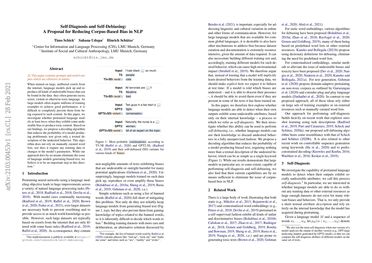
When trained on large, unfiltered crawls from the internet, language models pick up and reproduce all kinds of undesirable biases that can be found in the data: they often generate racist, sexist, violent or otherwise toxic language. As large models require millions of training examples to achieve good performance, it is difficult to completely prevent them from being exposed to such content. In this paper, we first demonstrate a surprising finding: pretrained language models recognize, to a considerable degree, their undesirable biases and the toxicity of the content they produce. We refer to this capability as self-diagnosis. Based on this finding, we then propose a decoding algorithm that, given only a textual description of the undesired behavior, reduces the probability of a language model producing problematic text. We refer to this approach as self-debiasing. Self-debiasing does not rely on manually curated word lists, nor does it require any training data or changes to the model's parameters. While we by no means eliminate the issue of language models generating biased text, we believe our approach to be an important step in this direction.
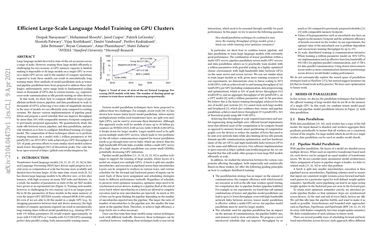
Large language models have led to state-of-the-art accuracies across a range of tasks. However, training these models efficiently is challenging for two reasons: a) GPU memory capacity is limited, making it impossible to fit large models on even a multi-GPU server, and b) the number of compute operations required to train these models can result in unrealistically long training times. Consequently, new methods of model parallelism such as tensor and pipeline parallelism have been proposed. Unfortunately, naive usage of these methods leads to fundamental scaling issues at thousands of GPUs, e.g., due to expensive cross-node communication or devices spending significant time waiting on other devices to make progress. In this paper, we show how different types of parallelism methods (tensor, pipeline, and data parallelism) can be composed to scale to thousands of GPUs and models with trillions of parameters. We survey techniques for pipeline parallelism and propose a novel interleaved pipeline parallelism schedule that can improve throughput by 10+% with memory footprint comparable to existing approaches. We quantitatively study the trade-offs between tensor, pipeline, and data parallelism, and provide intuition as to how to configure distributed training of a large model. Our approach allows us to perform training iterations on a model with 1 trillion parameters at 502 petaFLOP/s on 3072 GPUs with achieved per-GPU throughput of 52% of theoretical peak. Our code is open sourced at https://github.com/nvidia/megatron-lm.

We study the problem of watermarking large language models (LLMs) generated text -- one of the most promising approaches for addressing the safety challenges of LLM usage. In this paper, we propose a rigorous theoretical framework to quantify the effectiveness and robustness of LLM watermarks. We propose a robust and high-quality watermark method, Unigram-Watermark, by extending an existing approach with a simplified fixed grouping strategy. We prove that our watermark method enjoys guaranteed generation quality, correctness in watermark detection, and is robust against text editing and paraphrasing. Experiments on three varying LLMs and two datasets verify that our Unigram-Watermark achieves superior detection accuracy and comparable generation quality in perplexity, thus promoting the responsible use of LLMs. Code is available at https://github.com/XuandongZhao/Unigram-Watermark.

Recent work on generative modeling of text has found that variational auto-encoders (VAE) incorporating LSTM decoders perform worse than simpler LSTM language models (Bowman et al., 2015). This negative result is so far poorly understood, but has been attributed to the propensity of LSTM decoders to ignore conditioning information from the encoder. In this paper, we experiment with a new type of decoder for VAE: a dilated CNN. By changing the decoder's dilation architecture, we control the effective context from previously generated words. In experiments, we find that there is a trade off between the contextual capacity of the decoder and the amount of encoding information used. We show that with the right decoder, VAE can outperform LSTM language models. We demonstrate perplexity gains on two datasets, representing the first positive experimental result on the use VAE for generative modeling of text. Further, we conduct an in-depth investigation of the use of VAE (with our new decoding architecture) for semi-supervised and unsupervised labeling tasks, demonstrating gains over several strong baselines.

High performance face detection remains a very challenging problem, especially when there exists many tiny faces. This paper presents a novel single-shot face detector, named Selective Refinement Network (SRN), which introduces novel two-step classification and regression operations selectively into an anchor-based face detector to reduce false positives and improve location accuracy simultaneously. In particular, the SRN consists of two modules: the Selective Two-step Classification (STC) module and the Selective Two-step Regression (STR) module. The STC aims to filter out most simple negative anchors from low level detection layers to reduce the search space for the subsequent classifier, while the STR is designed to coarsely adjust the locations and sizes of anchors from high level detection layers to provide better initialization for the subsequent regressor. Moreover, we design a Receptive Field Enhancement (RFE) block to provide more diverse receptive field, which helps to better capture faces in some extreme poses. As a consequence, the proposed SRN detector achieves state-of-the-art performance on all the widely used face detection benchmarks, including AFW, PASCAL face, FDDB, and WIDER FACE datasets. Codes will be released to facilitate further studies on the face detection problem.

A wide variety of NLP applications, such as machine translation, summarization, and dialog, involve text generation. One major challenge for these applications is how to evaluate whether such generated texts are actually fluent, accurate, or effective. In this work, we conceptualize the evaluation of generated text as a text generation problem, modeled using pre-trained sequence-to-sequence models. The general idea is that models trained to convert the generated text to/from a reference output or the source text will achieve higher scores when the generated text is better. We operationalize this idea using BART, an encoder-decoder based pre-trained model, and propose a metric BARTScore with a number of variants that can be flexibly applied in an unsupervised fashion to evaluation of text from different perspectives (e.g. informativeness, fluency, or factuality). BARTScore is conceptually simple and empirically effective. It can outperform existing top-scoring metrics in 16 of 22 test settings, covering evaluation of 16 datasets (e.g., machine translation, text summarization) and 7 different perspectives (e.g., informativeness, factuality). Code to calculate BARTScore is available at https://github.com/neulab/BARTScore, and we have released an interactive leaderboard for meta-evaluation at http://explainaboard.nlpedia.ai/leaderboard/task-meval/ on the ExplainaBoard platform, which allows us to interactively understand the strengths, weaknesses, and complementarity of each metric.