
分享
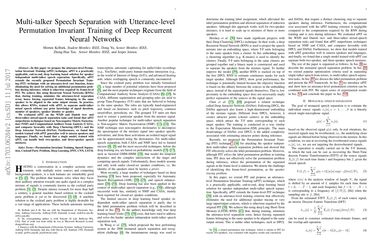
In this paper we propose the utterance-level Permutation Invariant Training (uPIT) technique. uPIT is a practically applicable, end-to-end, deep learning based solution for speaker independent multi-talker speech separation. Specifically, uPIT extends the recently proposed Permutation Invariant Training (PIT) technique with an utterance-level cost function, hence eliminating the need for solving an additional permutation problem during inference, which is otherwise required by frame-level PIT. We achieve this using Recurrent Neural Networks (RNNs) that, during training, minimize the utterance-level separation error, hence forcing separated frames belonging to the same speaker to be aligned to the same output stream. In practice, this allows RNNs, trained with uPIT, to separate multi-talker mixed speech without any prior knowledge of signal duration, number of speakers, speaker identity or gender. We evaluated uPIT on the WSJ0 and Danish two- and three-talker mixed-speech separation tasks and found that uPIT outperforms techniques based on Non-negative Matrix Factorization (NMF) and Computational Auditory Scene Analysis (CASA), and compares favorably with Deep Clustering (DPCL) and the Deep Attractor Network (DANet). Furthermore, we found that models trained with uPIT generalize well to unseen speakers and languages. Finally, we found that a single model, trained with uPIT, can handle both two-speaker, and three-speaker speech mixtures.
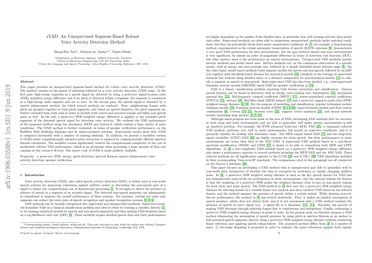
This paper presents an unsupervised segment-based method for robust voice activity detection (rVAD). The method consists of two passes of denoising followed by a voice activity detection (VAD) stage. In the first pass, high-energy segments in a speech signal are detected by using a posteriori signal-to-noise ratio (SNR) weighted energy difference and if no pitch is detected within a segment, the segment is considered as a high-energy noise segment and set to zero. In the second pass, the speech signal is denoised by a speech enhancement method, for which several methods are explored. Next, neighbouring frames with pitch are grouped together to form pitch segments, and based on speech statistics, the pitch segments are further extended from both ends in order to include both voiced and unvoiced sounds and likely non-speech parts as well. In the end, a posteriori SNR weighted energy difference is applied to the extended pitch segments of the denoised speech signal for detecting voice activity. We evaluate the VAD performance of the proposed method using two databases, RATS and Aurora-2, which contain a large variety of noise conditions. The rVAD method is further evaluated, in terms of speaker verification performance, on the RedDots 2016 challenge database and its noise-corrupted versions. Experiment results show that rVAD is compared favourably with a number of existing methods. In addition, we present a modified version of rVAD where computationally intensive pitch extraction is replaced by computationally efficient spectral flatness calculation. The modified version significantly reduces the computational complexity at the cost of moderately inferior VAD performance, which is an advantage when processing a large amount of data and running on low resource devices. The source code of rVAD is made publicly available.
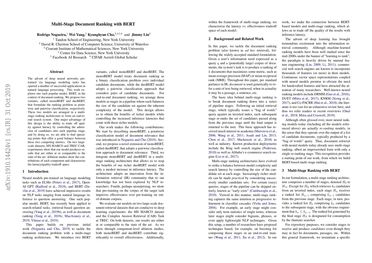
The advent of deep neural networks pre-trained via language modeling tasks has spurred a number of successful applications in natural language processing. This work explores one such popular model, BERT, in the context of document ranking. We propose two variants, called monoBERT and duoBERT, that formulate the ranking problem as pointwise and pairwise classification, respectively. These two models are arranged in a multi-stage ranking architecture to form an end-to-end search system. One major advantage of this design is the ability to trade off quality against latency by controlling the admission of candidates into each pipeline stage, and by doing so, we are able to find operating points that offer a good balance between these two competing metrics. On two large-scale datasets, MS MARCO and TREC CAR, experiments show that our model produces results that are either at or comparable to the state of the art. Ablation studies show the contributions of each component and characterize the latency/quality tradeoff space.
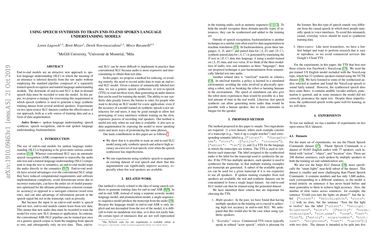
End-to-end models are an attractive new approach to spoken language understanding (SLU) in which the meaning of an utterance is inferred directly from the raw audio without employing the standard pipeline composed of a separately trained speech recognizer and natural language understanding module. The downside of end-to-end SLU is that in-domain speech data must be recorded to train the model. In this paper, we propose a strategy for overcoming this requirement in which speech synthesis is used to generate a large synthetic training dataset from several artificial speakers. Experiments on two open-source SLU datasets confirm the effectiveness of our approach, both as a sole source of training data and as a form of data augmentation.
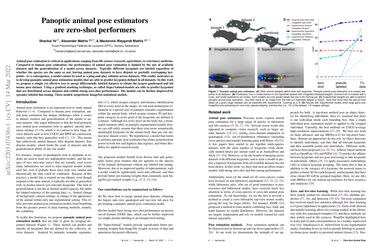
Animal pose estimation is critical in applications ranging from life science research, agriculture, to veterinary medicine. Compared to human pose estimation, the performance of animal pose estimation is limited by the size of available datasets and the generalization of a model across datasets. Typically different keypoints are labeled regardless of whether the species are the same or not, leaving animal pose datasets to have disjoint or partially overlapping keypoints. As a consequence, a model cannot be used as a plug-and-play solution across datasets. This reality motivates us to develop panoptic animal pose estimation models that are able to predict keypoints defined in all datasets. In this work we propose a simple yet effective way to merge differentially labeled datasets to obtain the largest quadruped and lab mouse pose dataset. Using a gradient masking technique, so called SuperAnimal-models are able to predict keypoints that are distributed across datasets and exhibit strong zero-shot performance. The models can be further improved by (pseudo) labeled fine-tuning. These models outperform ImageNet-initialized models.

In this paper, we propose Test-Time Training, a general approach for improving the performance of predictive models when training and test data come from different distributions. We turn a single unlabeled test sample into a self-supervised learning problem, on which we update the model parameters before making a prediction. This also extends naturally to data in an online stream. Our simple approach leads to improvements on diverse image classification benchmarks aimed at evaluating robustness to distribution shifts.

The formalization of existing mathematical proofs is a notoriously difficult process. Despite decades of research on automation and proof assistants, writing formal proofs remains arduous and only accessible to a few experts. While previous studies to automate formalization focused on powerful search algorithms, no attempts were made to take advantage of available informal proofs. In this work, we introduce Draft, Sketch, and Prove (DSP), a method that maps informal proofs to formal proof sketches, and uses the sketches to guide an automated prover by directing its search to easier sub-problems. We investigate two relevant setups where informal proofs are either written by humans or generated by a language model. Our experiments and ablation studies show that large language models are able to produce well-structured formal sketches that follow the same reasoning steps as the informal proofs. Guiding an automated prover with these sketches enhances its performance from 20.9% to 39.3% on a collection of mathematical competition problems.

Personal assistants, automatic speech recognizers and dialogue understanding systems are becoming more critical in our interconnected digital world. A clear example is air traffic control (ATC) communications. ATC aims at guiding aircraft and controlling the airspace in a safe and optimal manner. These voice-based dialogues are carried between an air traffic controller (ATCO) and pilots via very-high frequency radio channels. In order to incorporate these novel technologies into ATC (low-resource domain), large-scale annotated datasets are required to develop the data-driven AI systems. Two examples are automatic speech recognition (ASR) and natural language understanding (NLU). In this paper, we introduce the ATCO2 corpus, a dataset that aims at fostering research on the challenging ATC field, which has lagged behind due to lack of annotated data. The ATCO2 corpus covers 1) data collection and pre-processing, 2) pseudo-annotations of speech data, and 3) extraction of ATC-related named entities. The ATCO2 corpus is split into three subsets. 1) ATCO2-test-set corpus contains 4 hours of ATC speech with manual transcripts and a subset with gold annotations for named-entity recognition (callsign, command, value). 2) The ATCO2-PL-set corpus consists of 5281 hours of unlabeled ATC data enriched with automatic transcripts from an in-domain speech recognizer, contextual information, speaker turn information, signal-to-noise ratio estimate and English language detection score per sample. Both available for purchase through ELDA at http://catalog.elra.info/en-us/repository/browse/ELRA-S0484. 3) The ATCO2-test-set-1h corpus is a one-hour subset from the original test set corpus, that we are offering for free at https://www.atco2.org/data. We expect the ATCO2 corpus will foster research on robust ASR and NLU not only in the field of ATC communications but also in the general research community.

Graph plays a significant role in representing and analyzing complex relationships in real-world applications such as citation networks, social networks, and biological data. Recently, Large Language Models (LLMs), which have achieved tremendous success in various domains, have also been leveraged in graph-related tasks to surpass traditional Graph Neural Networks (GNNs) based methods and yield state-of-the-art performance. In this survey, we first present a comprehensive review and analysis of existing methods that integrate LLMs with graphs. First of all, we propose a new taxonomy, which organizes existing methods into three categories based on the role (i.e., enhancer, predictor, and alignment component) played by LLMs in graph-related tasks. Then we systematically survey the representative methods along the three categories of the taxonomy. Finally, we discuss the remaining limitations of existing studies and highlight promising avenues for future research. The relevant papers are summarized and will be consistently updated at: https://github.com/yhLeeee/Awesome-LLMs-in-Graph-tasks.

Optimization can be found in many real-life applications. Designing an effective algorithm for a specific optimization problem typically requires a tedious amount of effort from human experts with domain knowledge and algorithm design skills. In this paper, we propose a novel approach called Algorithm Evolution using Large Language Model (AEL). It utilizes a large language model (LLM) to automatically generate optimization algorithms via an evolutionary framework. AEL does algorithm-level evolution without model training. Human effort and requirements for domain knowledge can be significantly reduced. We take constructive methods for the salesman traveling problem as a test example, we show that the constructive algorithm obtained by AEL outperforms simple hand-crafted and LLM-generated heuristics. Compared with other domain deep learning model-based algorithms, these methods exhibit excellent scalability across different problem sizes. AEL is also very different from previous attempts that utilize LLMs as search operators in algorithms.

In this paper, we explore a new way for user targeting, where non-expert marketers could select their target users solely given demands in natural language form. The key to this issue is how to transform natural languages into practical structured logical languages, i.e., the structured understanding of marketer demands. In practical scenarios, the demands of non-expert marketers are often abstract and diverse. Considering the impressive natural language processing ability of large language models (LLMs), we try to leverage LLMs to solve this issue. To stimulate the LLMs' reasoning ability, the chain-of-thought (CoT) prompting method is widely used, but existing methods still have some limitations in our scenario: (1) Previous methods either use simple "Let's think step by step" spells or provide fixed examples in demonstrations without considering compatibility between prompts and concrete questions, making LLMs ineffective when the marketers' demands are abstract and diverse. (2) Previous methods are often implemented in closed-source models or excessively large models, which is not suitable in industrial practical scenarios. Based on these, we propose ARALLM (i.e., Analogical Reasoning Augmented Large Language Models) consisting of two modules: Analogical Reasoning based Prompting and Reasoning-Augmented Multi-Task Model Distillation. Part of our data and code can be found at https://github.com/alipay/Analogic-Reasoning-Augmented-Large-Language-Model.

GPT-$3$ has attracted lots of attention due to its superior performance across a wide range of NLP tasks, especially with its powerful and versatile in-context few-shot learning ability. Despite its success, we found that the empirical results of GPT-$3$ depend heavily on the choice of in-context examples. In this work, we investigate whether there are more effective strategies for judiciously selecting in-context examples (relative to random sampling) that better leverage GPT-$3$'s few-shot capabilities. Inspired by the recent success of leveraging a retrieval module to augment large-scale neural network models, we propose to retrieve examples that are semantically-similar to a test sample to formulate its corresponding prompt. Intuitively, the in-context examples selected with such a strategy may serve as more informative inputs to unleash GPT-$3$'s extensive knowledge. We evaluate the proposed approach on several natural language understanding and generation benchmarks, where the retrieval-based prompt selection approach consistently outperforms the random baseline. Moreover, it is observed that the sentence encoders fine-tuned on task-related datasets yield even more helpful retrieval results. Notably, significant gains are observed on tasks such as table-to-text generation (41.9% on the ToTTo dataset) and open-domain question answering (45.5% on the NQ dataset). We hope our investigation could help understand the behaviors of GPT-$3$ and large-scale pre-trained LMs in general and enhance their few-shot capabilities.