
分享
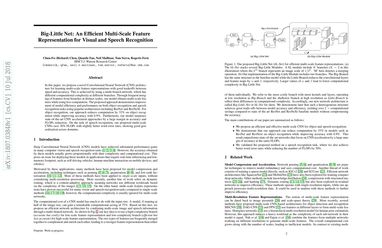
In this paper, we propose a novel Convolutional Neural Network (CNN) architecture for learning multi-scale feature representations with good tradeoffs between speed and accuracy. This is achieved by using a multi-branch network, which has different computational complexity at different branches. Through frequent merging of features from branches at distinct scales, our model obtains multi-scale features while using less computation. The proposed approach demonstrates improvement of model efficiency and performance on both object recognition and speech recognition tasks,using popular architectures including ResNet and ResNeXt. For object recognition, our approach reduces computation by 33% on object recognition while improving accuracy with 0.9%. Furthermore, our model surpasses state-of-the-art CNN acceleration approaches by a large margin in accuracy and FLOPs reduction. On the task of speech recognition, our proposed multi-scale CNNs save 30% FLOPs with slightly better word error rates, showing good generalization across domains. The codes are available at https://github.com/IBM/BigLittleNet
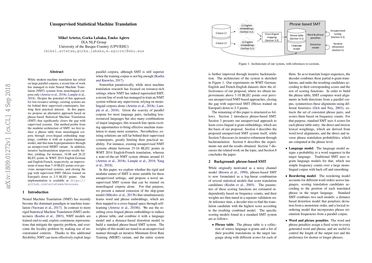
While modern machine translation has relied on large parallel corpora, a recent line of work has managed to train Neural Machine Translation (NMT) systems from monolingual corpora only (Artetxe et al., 2018c; Lample et al., 2018). Despite the potential of this approach for low-resource settings, existing systems are far behind their supervised counterparts, limiting their practical interest. In this paper, we propose an alternative approach based on phrase-based Statistical Machine Translation (SMT) that significantly closes the gap with supervised systems. Our method profits from the modular architecture of SMT: we first induce a phrase table from monolingual corpora through cross-lingual embedding mappings, combine it with an n-gram language model, and fine-tune hyperparameters through an unsupervised MERT variant. In addition, iterative backtranslation improves results further, yielding, for instance, 14.08 and 26.22 BLEU points in WMT 2014 English-German and English-French, respectively, an improvement of more than 7-10 BLEU points over previous unsupervised systems, and closing the gap with supervised SMT (Moses trained on Europarl) down to 2-5 BLEU points. Our implementation is available at https://github.com/artetxem/monoses
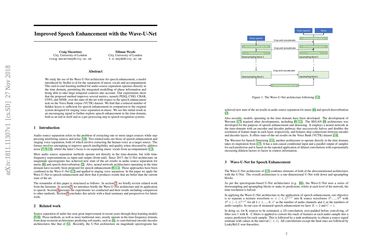
We study the use of the Wave-U-Net architecture for speech enhancement, a model introduced by Stoller et al for the separation of music vocals and accompaniment. This end-to-end learning method for audio source separation operates directly in the time domain, permitting the integrated modelling of phase information and being able to take large temporal contexts into account. Our experiments show that the proposed method improves several metrics, namely PESQ, CSIG, CBAK, COVL and SSNR, over the state-of-the-art with respect to the speech enhancement task on the Voice Bank corpus (VCTK) dataset. We find that a reduced number of hidden layers is sufficient for speech enhancement in comparison to the original system designed for singing voice separation in music. We see this initial result as an encouraging signal to further explore speech enhancement in the time-domain, both as an end in itself and as a pre-processing step to speech recognition systems.
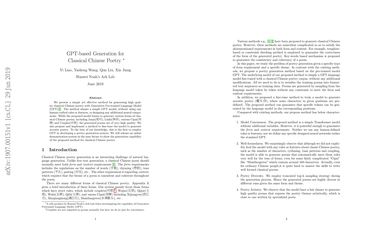
We present a simple yet effective method for generating high quality classical Chinese poetry with Generative Pre-trained Language Model (GPT). The method adopts a simple GPT model, without using any human crafted rules or features, or designing any additional neural components. While the proposed model learns to generate various forms of classical Chinese poems, including Jueju, L\"{u}shi, various Cipai and Couples, the generated poems are of very high quality. We also propose and implement a method to fine-tune the model to generate acrostic poetry. To the best of our knowledge, this is the first to employ GPT in developing a poetry generation system. We have released an online mini demonstration program on Wechat to show the generation capability of the proposed method for classical Chinese poetry.
We propose vq-wav2vec to learn discrete representations of audio segments through a wav2vec-style self-supervised context prediction task. The algorithm uses either a gumbel softmax or online k-means clustering to quantize the dense representations. Discretization enables the direct application of algorithms from the NLP community which require discrete inputs. Experiments show that BERT pre-training achieves a new state of the art on TIMIT phoneme classification and WSJ speech recognition.
Sequential fine-tuning and multi-task learning are methods aiming to incorporate knowledge from multiple tasks; however, they suffer from catastrophic forgetting and difficulties in dataset balancing. To address these shortcomings, we propose AdapterFusion, a new two stage learning algorithm that leverages knowledge from multiple tasks. First, in the knowledge extraction stage we learn task specific parameters called adapters, that encapsulate the task-specific information. We then combine the adapters in a separate knowledge composition step. We show that by separating the two stages, i.e., knowledge extraction and knowledge composition, the classifier can effectively exploit the representations learned from multiple tasks in a non-destructive manner. We empirically evaluate AdapterFusion on 16 diverse NLU tasks, and find that it effectively combines various types of knowledge at different layers of the model. We show that our approach outperforms traditional strategies such as full fine-tuning as well as multi-task learning. Our code and adapters are available at AdapterHub.ml.
We present HERO, a novel framework for large-scale video+language omni-representation learning. HERO encodes multimodal inputs in a hierarchical structure, where local context of a video frame is captured by a Cross-modal Transformer via multimodal fusion, and global video context is captured by a Temporal Transformer. In addition to standard Masked Language Modeling (MLM) and Masked Frame Modeling (MFM) objectives, we design two new pre-training tasks: (i) Video-Subtitle Matching (VSM), where the model predicts both global and local temporal alignment; and (ii) Frame Order Modeling (FOM), where the model predicts the right order of shuffled video frames. HERO is jointly trained on HowTo100M and large-scale TV datasets to gain deep understanding of complex social dynamics with multi-character interactions. Comprehensive experiments demonstrate that HERO achieves new state of the art on multiple benchmarks over Text-based Video/Video-moment Retrieval, Video Question Answering (QA), Video-and-language Inference and Video Captioning tasks across different domains. We also introduce two new challenging benchmarks How2QA and How2R for Video QA and Retrieval, collected from diverse video content over multimodalities.
In this paper, we introduce ELECTRA-style tasks to cross-lingual language model pre-training. Specifically, we present two pre-training tasks, namely multilingual replaced token detection, and translation replaced token detection. Besides, we pretrain the model, named as XLM-E, on both multilingual and parallel corpora. Our model outperforms the baseline models on various cross-lingual understanding tasks with much less computation cost. Moreover, analysis shows that XLM-E tends to obtain better cross-lingual transferability.
Recent pretraining models in Chinese neglect two important aspects specific to the Chinese language: glyph and pinyin, which carry significant syntax and semantic information for language understanding. In this work, we propose ChineseBERT, which incorporates both the {\it glyph} and {\it pinyin} information of Chinese characters into language model pretraining. The glyph embedding is obtained based on different fonts of a Chinese character, being able to capture character semantics from the visual features, and the pinyin embedding characterizes the pronunciation of Chinese characters, which handles the highly prevalent heteronym phenomenon in Chinese (the same character has different pronunciations with different meanings). Pretrained on large-scale unlabeled Chinese corpus, the proposed ChineseBERT model yields significant performance boost over baseline models with fewer training steps. The porpsoed model achieves new SOTA performances on a wide range of Chinese NLP tasks, including machine reading comprehension, natural language inference, text classification, sentence pair matching, and competitive performances in named entity recognition. Code and pretrained models are publicly available at https://github.com/ShannonAI/ChineseBert.

Recent work on generative modeling of text has found that variational auto-encoders (VAE) incorporating LSTM decoders perform worse than simpler LSTM language models (Bowman et al., 2015). This negative result is so far poorly understood, but has been attributed to the propensity of LSTM decoders to ignore conditioning information from the encoder. In this paper, we experiment with a new type of decoder for VAE: a dilated CNN. By changing the decoder's dilation architecture, we control the effective context from previously generated words. In experiments, we find that there is a trade off between the contextual capacity of the decoder and the amount of encoding information used. We show that with the right decoder, VAE can outperform LSTM language models. We demonstrate perplexity gains on two datasets, representing the first positive experimental result on the use VAE for generative modeling of text. Further, we conduct an in-depth investigation of the use of VAE (with our new decoding architecture) for semi-supervised and unsupervised labeling tasks, demonstrating gains over several strong baselines.

Many deep learning models, developed in recent years, reach higher ImageNet accuracy than ResNet50, with fewer or comparable FLOPS count. While FLOPs are often seen as a proxy for network efficiency, when measuring actual GPU training and inference throughput, vanilla ResNet50 is usually significantly faster than its recent competitors, offering better throughput-accuracy trade-off. In this work, we introduce a series of architecture modifications that aim to boost neural networks' accuracy, while retaining their GPU training and inference efficiency. We first demonstrate and discuss the bottlenecks induced by FLOPs-optimizations. We then suggest alternative designs that better utilize GPU structure and assets. Finally, we introduce a new family of GPU-dedicated models, called TResNet, which achieve better accuracy and efficiency than previous ConvNets. Using a TResNet model, with similar GPU throughput to ResNet50, we reach 80.8 top-1 accuracy on ImageNet. Our TResNet models also transfer well and achieve state-of-the-art accuracy on competitive single-label classification datasets such as Stanford cars (96.0%), CIFAR-10 (99.0%), CIFAR-100 (91.5%) and Oxford-Flowers (99.1%). They also perform well on multi-label classification and object detection tasks. Implementation is available at: https://github.com/mrT23/TResNet.

At the heart of machine learning lies the question of generalizability of learned rules over previously unseen data. While over-parameterized models based on neural networks are now ubiquitous in machine learning applications, our understanding of their generalization capabilities is incomplete. This task is made harder by the non-convexity of the underlying learning problems. We provide a general framework to characterize the asymptotic generalization error for single-layer neural networks (i.e., generalized linear models) with arbitrary non-linearities, making it applicable to regression as well as classification problems. This framework enables analyzing the effect of (i) over-parameterization and non-linearity during modeling; and (ii) choices of loss function, initialization, and regularizer during learning. Our model also captures mismatch between training and test distributions. As examples, we analyze a few special cases, namely linear regression and logistic regression. We are also able to rigorously and analytically explain the \emph{double descent} phenomenon in generalized linear models.