
分享
We compare the fast training and decoding speed of RETURNN of attention models for translation, due to fast CUDA LSTM kernels, and a fast pure TensorFlow beam search decoder. We show that a layer-wise pretraining scheme for recurrent attention models gives over 1% BLEU improvement absolute and it allows to train deeper recurrent encoder networks. Promising preliminary results on max. expected BLEU training are presented. We are able to train state-of-the-art models for translation and end-to-end models for speech recognition and show results on WMT 2017 and Switchboard. The flexibility of RETURNN allows a fast research feedback loop to experiment with alternative architectures, and its generality allows to use it on a wide range of applications.
Neural task-oriented dialogue systems often struggle to smoothly interface with a knowledge base. In this work, we seek to address this problem by proposing a new neural dialogue agent that is able to effectively sustain grounded, multi-domain discourse through a novel key-value retrieval mechanism. The model is end-to-end differentiable and does not need to explicitly model dialogue state or belief trackers. We also release a new dataset of 3,031 dialogues that are grounded through underlying knowledge bases and span three distinct tasks in the in-car personal assistant space: calendar scheduling, weather information retrieval, and point-of-interest navigation. Our architecture is simultaneously trained on data from all domains and significantly outperforms a competitive rule-based system and other existing neural dialogue architectures on the provided domains according to both automatic and human evaluation metrics.
In this paper, we propose a novel Convolutional Neural Network (CNN) architecture for learning multi-scale feature representations with good tradeoffs between speed and accuracy. This is achieved by using a multi-branch network, which has different computational complexity at different branches. Through frequent merging of features from branches at distinct scales, our model obtains multi-scale features while using less computation. The proposed approach demonstrates improvement of model efficiency and performance on both object recognition and speech recognition tasks,using popular architectures including ResNet and ResNeXt. For object recognition, our approach reduces computation by 33% on object recognition while improving accuracy with 0.9%. Furthermore, our model surpasses state-of-the-art CNN acceleration approaches by a large margin in accuracy and FLOPs reduction. On the task of speech recognition, our proposed multi-scale CNNs save 30% FLOPs with slightly better word error rates, showing good generalization across domains. The codes are available at https://github.com/IBM/BigLittleNet
While modern machine translation has relied on large parallel corpora, a recent line of work has managed to train Neural Machine Translation (NMT) systems from monolingual corpora only (Artetxe et al., 2018c; Lample et al., 2018). Despite the potential of this approach for low-resource settings, existing systems are far behind their supervised counterparts, limiting their practical interest. In this paper, we propose an alternative approach based on phrase-based Statistical Machine Translation (SMT) that significantly closes the gap with supervised systems. Our method profits from the modular architecture of SMT: we first induce a phrase table from monolingual corpora through cross-lingual embedding mappings, combine it with an n-gram language model, and fine-tune hyperparameters through an unsupervised MERT variant. In addition, iterative backtranslation improves results further, yielding, for instance, 14.08 and 26.22 BLEU points in WMT 2014 English-German and English-French, respectively, an improvement of more than 7-10 BLEU points over previous unsupervised systems, and closing the gap with supervised SMT (Moses trained on Europarl) down to 2-5 BLEU points. Our implementation is available at https://github.com/artetxem/monoses
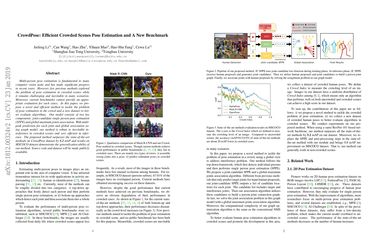
Multi-person pose estimation is fundamental to many computer vision tasks and has made significant progress in recent years. However, few previous methods explored the problem of pose estimation in crowded scenes while it remains challenging and inevitable in many scenarios. Moreover, current benchmarks cannot provide an appropriate evaluation for such cases. In this paper, we propose a novel and efficient method to tackle the problem of pose estimation in the crowd and a new dataset to better evaluate algorithms. Our model consists of two key components: joint-candidate single person pose estimation (SPPE) and global maximum joints association. With multi-peak prediction for each joint and global association using graph model, our method is robust to inevitable interference in crowded scenes and very efficient in inference. The proposed method surpasses the state-of-the-art methods on CrowdPose dataset by 5.2 mAP and results on MSCOCO dataset demonstrate the generalization ability of our method. Source code and dataset will be made publicly available.
We present a simple yet effective method for generating high quality classical Chinese poetry with Generative Pre-trained Language Model (GPT). The method adopts a simple GPT model, without using any human crafted rules or features, or designing any additional neural components. While the proposed model learns to generate various forms of classical Chinese poems, including Jueju, L\"{u}shi, various Cipai and Couples, the generated poems are of very high quality. We also propose and implement a method to fine-tune the model to generate acrostic poetry. To the best of our knowledge, this is the first to employ GPT in developing a poetry generation system. We have released an online mini demonstration program on Wechat to show the generation capability of the proposed method for classical Chinese poetry.
Many advances in Natural Language Processing have been based upon more expressive models for how inputs interact with the context in which they occur. Recurrent networks, which have enjoyed a modicum of success, still lack the generalization and systematicity ultimately required for modelling language. In this work, we propose an extension to the venerable Long Short-Term Memory in the form of mutual gating of the current input and the previous output. This mechanism affords the modelling of a richer space of interactions between inputs and their context. Equivalently, our model can be viewed as making the transition function given by the LSTM context-dependent. Experiments demonstrate markedly improved generalization on language modelling in the range of 3-4 perplexity points on Penn Treebank and Wikitext-2, and 0.01-0.05 bpc on four character-based datasets. We establish a new state of the art on all datasets with the exception of Enwik8, where we close a large gap between the LSTM and Transformer models.
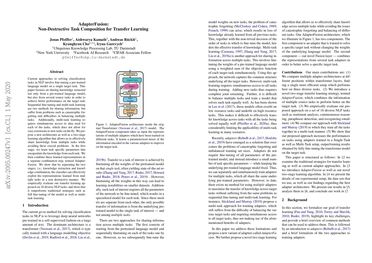
Sequential fine-tuning and multi-task learning are methods aiming to incorporate knowledge from multiple tasks; however, they suffer from catastrophic forgetting and difficulties in dataset balancing. To address these shortcomings, we propose AdapterFusion, a new two stage learning algorithm that leverages knowledge from multiple tasks. First, in the knowledge extraction stage we learn task specific parameters called adapters, that encapsulate the task-specific information. We then combine the adapters in a separate knowledge composition step. We show that by separating the two stages, i.e., knowledge extraction and knowledge composition, the classifier can effectively exploit the representations learned from multiple tasks in a non-destructive manner. We empirically evaluate AdapterFusion on 16 diverse NLU tasks, and find that it effectively combines various types of knowledge at different layers of the model. We show that our approach outperforms traditional strategies such as full fine-tuning as well as multi-task learning. Our code and adapters are available at AdapterHub.ml.
We present HERO, a novel framework for large-scale video+language omni-representation learning. HERO encodes multimodal inputs in a hierarchical structure, where local context of a video frame is captured by a Cross-modal Transformer via multimodal fusion, and global video context is captured by a Temporal Transformer. In addition to standard Masked Language Modeling (MLM) and Masked Frame Modeling (MFM) objectives, we design two new pre-training tasks: (i) Video-Subtitle Matching (VSM), where the model predicts both global and local temporal alignment; and (ii) Frame Order Modeling (FOM), where the model predicts the right order of shuffled video frames. HERO is jointly trained on HowTo100M and large-scale TV datasets to gain deep understanding of complex social dynamics with multi-character interactions. Comprehensive experiments demonstrate that HERO achieves new state of the art on multiple benchmarks over Text-based Video/Video-moment Retrieval, Video Question Answering (QA), Video-and-language Inference and Video Captioning tasks across different domains. We also introduce two new challenging benchmarks How2QA and How2R for Video QA and Retrieval, collected from diverse video content over multimodalities.

We consider a set of probabilistic functions of some input variables as a representation of the inputs. We present bounds on how informative a representation is about input data. We extend these bounds to hierarchical representations so that we can quantify the contribution of each layer towards capturing the information in the original data. The special form of these bounds leads to a simple, bottom-up optimization procedure to construct hierarchical representations that are also maximally informative about the data. This optimization has linear computational complexity and constant sample complexity in the number of variables. These results establish a new approach to unsupervised learning of deep representations that is both principled and practical. We demonstrate the usefulness of the approach on both synthetic and real-world data.

This paper presents a unified Vision-Language Pre-training (VLP) model. The model is unified in that (1) it can be fine-tuned for either vision-language generation (e.g., image captioning) or understanding (e.g., visual question answering) tasks, and (2) it uses a shared multi-layer transformer network for both encoding and decoding, which differs from many existing methods where the encoder and decoder are implemented using separate models. The unified VLP model is pre-trained on a large amount of image-text pairs using the unsupervised learning objectives of two tasks: bidirectional and sequence-to-sequence (seq2seq) masked vision-language prediction. The two tasks differ solely in what context the prediction conditions on. This is controlled by utilizing specific self-attention masks for the shared transformer network. To the best of our knowledge, VLP is the first reported model that achieves state-of-the-art results on both vision-language generation and understanding tasks, as disparate as image captioning and visual question answering, across three challenging benchmark datasets: COCO Captions, Flickr30k Captions, and VQA 2.0. The code and the pre-trained models are available at https://github.com/LuoweiZhou/VLP.

At the heart of machine learning lies the question of generalizability of learned rules over previously unseen data. While over-parameterized models based on neural networks are now ubiquitous in machine learning applications, our understanding of their generalization capabilities is incomplete. This task is made harder by the non-convexity of the underlying learning problems. We provide a general framework to characterize the asymptotic generalization error for single-layer neural networks (i.e., generalized linear models) with arbitrary non-linearities, making it applicable to regression as well as classification problems. This framework enables analyzing the effect of (i) over-parameterization and non-linearity during modeling; and (ii) choices of loss function, initialization, and regularizer during learning. Our model also captures mismatch between training and test distributions. As examples, we analyze a few special cases, namely linear regression and logistic regression. We are also able to rigorously and analytically explain the \emph{double descent} phenomenon in generalized linear models.