
分享
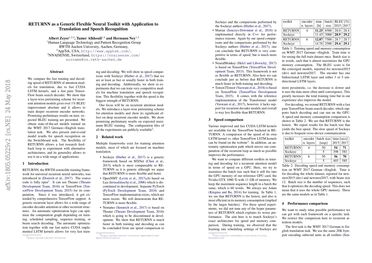
We compare the fast training and decoding speed of RETURNN of attention models for translation, due to fast CUDA LSTM kernels, and a fast pure TensorFlow beam search decoder. We show that a layer-wise pretraining scheme for recurrent attention models gives over 1% BLEU improvement absolute and it allows to train deeper recurrent encoder networks. Promising preliminary results on max. expected BLEU training are presented. We are able to train state-of-the-art models for translation and end-to-end models for speech recognition and show results on WMT 2017 and Switchboard. The flexibility of RETURNN allows a fast research feedback loop to experiment with alternative architectures, and its generality allows to use it on a wide range of applications.
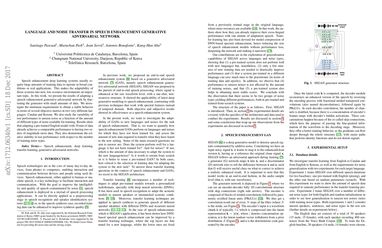
Speech enhancement deep learning systems usually require large amounts of training data to operate in broad conditions or real applications. This makes the adaptability of those systems into new, low resource environments an important topic. In this work, we present the results of adapting a speech enhancement generative adversarial network by finetuning the generator with small amounts of data. We investigate the minimum requirements to obtain a stable behavior in terms of several objective metrics in two very different languages: Catalan and Korean. We also study the variability of test performance to unseen noise as a function of the amount of different types of noise available for training. Results show that adapting a pre-trained English model with 10 min of data already achieves a comparable performance to having two orders of magnitude more data. They also demonstrate the relative stability in test performance with respect to the number of training noise types.
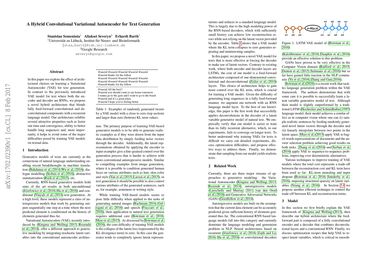
In this paper we explore the effect of architectural choices on learning a Variational Autoencoder (VAE) for text generation. In contrast to the previously introduced VAE model for text where both the encoder and decoder are RNNs, we propose a novel hybrid architecture that blends fully feed-forward convolutional and deconvolutional components with a recurrent language model. Our architecture exhibits several attractive properties such as faster run time and convergence, ability to better handle long sequences and, more importantly, it helps to avoid some of the major difficulties posed by training VAE models on textual data.
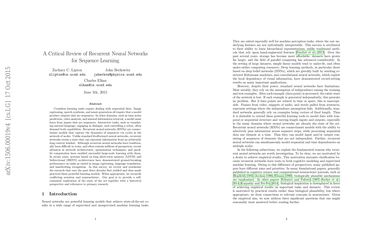
Countless learning tasks require dealing with sequential data. Image captioning, speech synthesis, and music generation all require that a model produce outputs that are sequences. In other domains, such as time series prediction, video analysis, and musical information retrieval, a model must learn from inputs that are sequences. Interactive tasks, such as translating natural language, engaging in dialogue, and controlling a robot, often demand both capabilities. Recurrent neural networks (RNNs) are connectionist models that capture the dynamics of sequences via cycles in the network of nodes. Unlike standard feedforward neural networks, recurrent networks retain a state that can represent information from an arbitrarily long context window. Although recurrent neural networks have traditionally been difficult to train, and often contain millions of parameters, recent advances in network architectures, optimization techniques, and parallel computation have enabled successful large-scale learning with them. In recent years, systems based on long short-term memory (LSTM) and bidirectional (BRNN) architectures have demonstrated ground-breaking performance on tasks as varied as image captioning, language translation, and handwriting recognition. In this survey, we review and synthesize the research that over the past three decades first yielded and then made practical these powerful learning models. When appropriate, we reconcile conflicting notation and nomenclature. Our goal is to provide a self-contained explication of the state of the art together with a historical perspective and references to primary research.
Most methods of voice restoration for patients suffering from aphonia either produce whispered or monotone speech. Apart from intelligibility, this type of speech lacks expressiveness and naturalness due to the absence of pitch (whispered speech) or artificial generation of it (monotone speech). Existing techniques to restore prosodic information typically combine a vocoder, which parameterises the speech signal, with machine learning techniques that predict prosodic information. In contrast, this paper describes an end-to-end neural approach for estimating a fully-voiced speech waveform from whispered alaryngeal speech. By adapting our previous work in speech enhancement with generative adversarial networks, we develop a speaker-dependent model to perform whispered-to-voiced speech conversion. Preliminary qualitative results show effectiveness in re-generating voiced speech, with the creation of realistic pitch contours.
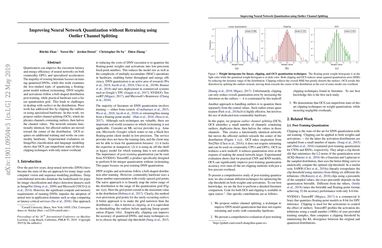
Quantization can improve the execution latency and energy efficiency of neural networks on both commodity GPUs and specialized accelerators. The majority of existing literature focuses on training quantized DNNs, while this work examines the less-studied topic of quantizing a floating-point model without (re)training. DNN weights and activations follow a bell-shaped distribution post-training, while practical hardware uses a linear quantization grid. This leads to challenges in dealing with outliers in the distribution. Prior work has addressed this by clipping the outliers or using specialized hardware. In this work, we propose outlier channel splitting (OCS), which duplicates channels containing outliers, then halves the channel values. The network remains functionally identical, but affected outliers are moved toward the center of the distribution. OCS requires no additional training and works on commodity hardware. Experimental evaluation on ImageNet classification and language modeling shows that OCS can outperform state-of-the-art clipping techniques with only minor overhead.
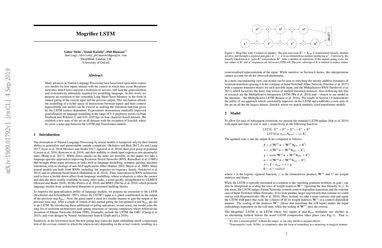
Many advances in Natural Language Processing have been based upon more expressive models for how inputs interact with the context in which they occur. Recurrent networks, which have enjoyed a modicum of success, still lack the generalization and systematicity ultimately required for modelling language. In this work, we propose an extension to the venerable Long Short-Term Memory in the form of mutual gating of the current input and the previous output. This mechanism affords the modelling of a richer space of interactions between inputs and their context. Equivalently, our model can be viewed as making the transition function given by the LSTM context-dependent. Experiments demonstrate markedly improved generalization on language modelling in the range of 3-4 perplexity points on Penn Treebank and Wikitext-2, and 0.01-0.05 bpc on four character-based datasets. We establish a new state of the art on all datasets with the exception of Enwik8, where we close a large gap between the LSTM and Transformer models.
We present HERO, a novel framework for large-scale video+language omni-representation learning. HERO encodes multimodal inputs in a hierarchical structure, where local context of a video frame is captured by a Cross-modal Transformer via multimodal fusion, and global video context is captured by a Temporal Transformer. In addition to standard Masked Language Modeling (MLM) and Masked Frame Modeling (MFM) objectives, we design two new pre-training tasks: (i) Video-Subtitle Matching (VSM), where the model predicts both global and local temporal alignment; and (ii) Frame Order Modeling (FOM), where the model predicts the right order of shuffled video frames. HERO is jointly trained on HowTo100M and large-scale TV datasets to gain deep understanding of complex social dynamics with multi-character interactions. Comprehensive experiments demonstrate that HERO achieves new state of the art on multiple benchmarks over Text-based Video/Video-moment Retrieval, Video Question Answering (QA), Video-and-language Inference and Video Captioning tasks across different domains. We also introduce two new challenging benchmarks How2QA and How2R for Video QA and Retrieval, collected from diverse video content over multimodalities.
We present KoSpeech, an open-source software, which is modular and extensible end-to-end Korean automatic speech recognition (ASR) toolkit based on the deep learning library PyTorch. Several automatic speech recognition open-source toolkits have been released, but all of them deal with non-Korean languages, such as English (e.g. ESPnet, Espresso). Although AI Hub opened 1,000 hours of Korean speech corpus known as KsponSpeech, there is no established preprocessing method and baseline model to compare model performances. Therefore, we propose preprocessing methods for KsponSpeech corpus and a baseline model for benchmarks. Our baseline model is based on Listen, Attend and Spell (LAS) architecture and ables to customize various training hyperparameters conveniently. By KoSpeech, we hope this could be a guideline for those who research Korean speech recognition. Our baseline model achieved 10.31% character error rate (CER) at KsponSpeech corpus only with the acoustic model. Our source code is available here.

We focus on the cross-domain context-dependent text-to-SQL generation task. Based on the observation that adjacent natural language questions are often linguistically dependent and their corresponding SQL queries tend to overlap, we utilize the interaction history by editing the previous predicted query to improve the generation quality. Our editing mechanism views SQL as sequences and reuses generation results at the token level in a simple manner. It is flexible to change individual tokens and robust to error propagation. Furthermore, to deal with complex table structures in different domains, we employ an utterance-table encoder and a table-aware decoder to incorporate the context of the user utterance and the table schema. We evaluate our approach on the SParC dataset and demonstrate the benefit of editing compared with the state-of-the-art baselines which generate SQL from scratch. Our code is available at https://github.com/ryanzhumich/sparc_atis_pytorch.

We present an approach to training neural networks to generate sequences using actor-critic methods from reinforcement learning (RL). Current log-likelihood training methods are limited by the discrepancy between their training and testing modes, as models must generate tokens conditioned on their previous guesses rather than the ground-truth tokens. We address this problem by introducing a \textit{critic} network that is trained to predict the value of an output token, given the policy of an \textit{actor} network. This results in a training procedure that is much closer to the test phase, and allows us to directly optimize for a task-specific score such as BLEU. Crucially, since we leverage these techniques in the supervised learning setting rather than the traditional RL setting, we condition the critic network on the ground-truth output. We show that our method leads to improved performance on both a synthetic task, and for German-English machine translation. Our analysis paves the way for such methods to be applied in natural language generation tasks, such as machine translation, caption generation, and dialogue modelling.

We consider a set of probabilistic functions of some input variables as a representation of the inputs. We present bounds on how informative a representation is about input data. We extend these bounds to hierarchical representations so that we can quantify the contribution of each layer towards capturing the information in the original data. The special form of these bounds leads to a simple, bottom-up optimization procedure to construct hierarchical representations that are also maximally informative about the data. This optimization has linear computational complexity and constant sample complexity in the number of variables. These results establish a new approach to unsupervised learning of deep representations that is both principled and practical. We demonstrate the usefulness of the approach on both synthetic and real-world data.