
分享
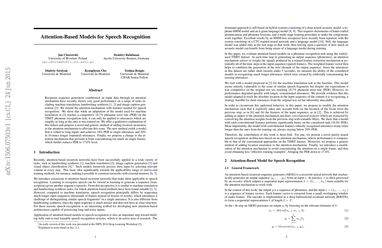
Recurrent sequence generators conditioned on input data through an attention mechanism have recently shown very good performance on a range of tasks in- cluding machine translation, handwriting synthesis and image caption gen- eration. We extend the attention-mechanism with features needed for speech recognition. We show that while an adaptation of the model used for machine translation in reaches a competitive 18.7% phoneme error rate (PER) on the TIMIT phoneme recognition task, it can only be applied to utterances which are roughly as long as the ones it was trained on. We offer a qualitative explanation of this failure and propose a novel and generic method of adding location-awareness to the attention mechanism to alleviate this issue. The new method yields a model that is robust to long inputs and achieves 18% PER in single utterances and 20% in 10-times longer (repeated) utterances. Finally, we propose a change to the at- tention mechanism that prevents it from concentrating too much on single frames, which further reduces PER to 17.6% level.
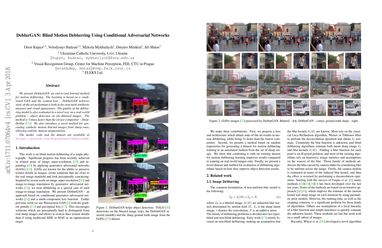
We present DeblurGAN, an end-to-end learned method for motion deblurring. The learning is based on a conditional GAN and the content loss . DeblurGAN achieves state-of-the art performance both in the structural similarity measure and visual appearance. The quality of the deblurring model is also evaluated in a novel way on a real-world problem -- object detection on (de-)blurred images. The method is 5 times faster than the closest competitor -- DeepDeblur. We also introduce a novel method for generating synthetic motion blurred images from sharp ones, allowing realistic dataset augmentation. The model, code and the dataset are available at https://github.com/KupynOrest/DeblurGAN
Many of the leading approaches in language modeling introduce novel, complex and specialized architectures. We take existing state-of-the-art word level language models based on LSTMs and QRNNs and extend them to both larger vocabularies as well as character-level granularity. When properly tuned, LSTMs and QRNNs achieve state-of-the-art results on character-level (Penn Treebank, enwik8) and word-level (WikiText-103) datasets, respectively. Results are obtained in only 12 hours (WikiText-103) to 2 days (enwik8) using a single modern GPU.
We show that BERT (Devlin et al., 2018) is a Markov random field language model. This formulation gives way to a natural procedure to sample sentences from BERT. We generate from BERT and find that it can produce high-quality, fluent generations. Compared to the generations of a traditional left-to-right language model, BERT generates sentences that are more diverse but of slightly worse quality.
We propose Parallel WaveGAN, a distillation-free, fast, and small-footprint waveform generation method using a generative adversarial network. In the proposed method, a non-autoregressive WaveNet is trained by jointly optimizing multi-resolution spectrogram and adversarial loss functions, which can effectively capture the time-frequency distribution of the realistic speech waveform. As our method does not require density distillation used in the conventional teacher-student framework, the entire model can be easily trained. Furthermore, our model is able to generate high-fidelity speech even with its compact architecture. In particular, the proposed Parallel WaveGAN has only 1.44 M parameters and can generate 24 kHz speech waveform 28.68 times faster than real-time on a single GPU environment. Perceptual listening test results verify that our proposed method achieves 4.16 mean opinion score within a Transformer-based text-to-speech framework, which is comparative to the best distillation-based Parallel WaveNet system.
Deep networks often suffer from vanishing or exploding gradients due to inefficient signal propagation, leading to long training times or convergence difficulties. Various architecture designs, sophisticated residual-style networks, and initialization schemes have been shown to improve deep signal propagation. Recently, Pennington et al. used free probability theory to show that dynamical isometry plays an integral role in efficient deep learning. We show that the simplest architecture change of gating each residual connection using a single zero-initialized parameter satisfies initial dynamical isometry and outperforms more complex approaches. Although much simpler than its predecessors, this gate enables training thousands of fully connected layers with fast convergence and better test performance for ResNets trained on CIFAR-10. We apply this technique to language modeling and find that we can easily train 120-layer Transformers. When applied to 12 layer Transformers, it converges 56% faster on enwiki8.
Transformers, which are popular for language modeling, have been explored for solving vision tasks recently, e.g., the Vision Transformer (ViT) for image classification. The ViT model splits each image into a sequence of tokens with fixed length and then applies multiple Transformer layers to model their global relation for classification. However, ViT achieves inferior performance to CNNs when trained from scratch on a midsize dataset like ImageNet. We find it is because: 1) the simple tokenization of input images fails to model the important local structure such as edges and lines among neighboring pixels, leading to low training sample efficiency; 2) the redundant attention backbone design of ViT leads to limited feature richness for fixed computation budgets and limited training samples. To overcome such limitations, we propose a new Tokens-To-Token Vision Transformer (T2T-ViT), which incorporates 1) a layer-wise Tokens-to-Token (T2T) transformation to progressively structurize the image to tokens by recursively aggregating neighboring Tokens into one Token (Tokens-to-Token), such that local structure represented by surrounding tokens can be modeled and tokens length can be reduced; 2) an efficient backbone with a deep-narrow structure for vision transformer motivated by CNN architecture design after empirical study. Notably, T2T-ViT reduces the parameter count and MACs of vanilla ViT by half, while achieving more than 3.0\% improvement when trained from scratch on ImageNet. It also outperforms ResNets and achieves comparable performance with MobileNets by directly training on ImageNet. For example, T2T-ViT with comparable size to ResNet50 (21.5M parameters) can achieve 83.3\% top1 accuracy in image resolution 384$\times$384 on ImageNet. (Code: https://github.com/yitu-opensource/T2T-ViT)
We introduce Codex, a GPT language model fine-tuned on publicly available code from GitHub, and study its Python code-writing capabilities. A distinct production version of Codex powers GitHub Copilot. On HumanEval, a new evaluation set we release to measure functional correctness for synthesizing programs from docstrings, our model solves 28.8% of the problems, while GPT-3 solves 0% and GPT-J solves 11.4%. Furthermore, we find that repeated sampling from the model is a surprisingly effective strategy for producing working solutions to difficult prompts. Using this method, we solve 70.2% of our problems with 100 samples per problem. Careful investigation of our model reveals its limitations, including difficulty with docstrings describing long chains of operations and with binding operations to variables. Finally, we discuss the potential broader impacts of deploying powerful code generation technologies, covering safety, security, and economics.
One of the major drawbacks of modularized task-completion dialogue systems is that each module is trained individually, which presents several challenges. For example, downstream modules are affected by earlier modules, and the performance of the entire system is not robust to the accumulated errors. This paper presents a novel end-to-end learning framework for task-completion dialogue systems to tackle such issues. Our neural dialogue system can directly interact with a structured database to assist users in accessing information and accomplishing certain tasks. The reinforcement learning based dialogue manager offers robust capabilities to handle noises caused by other components of the dialogue system. Our experiments in a movie-ticket booking domain show that our end-to-end system not only outperforms modularized dialogue system baselines for both objective and subjective evaluation, but also is robust to noises as demonstrated by several systematic experiments with different error granularity and rates specific to the language understanding module.

The explosive growth in video streaming gives rise to challenges on performing video understanding at high accuracy and low computation cost. Conventional 2D CNNs are computationally cheap but cannot capture temporal relationships; 3D CNN based methods can achieve good performance but are computationally intensive, making it expensive to deploy. In this paper, we propose a generic and effective Temporal Shift Module (TSM) that enjoys both high efficiency and high performance. Specifically, it can achieve the performance of 3D CNN but maintain 2D CNN's complexity. TSM shifts part of the channels along the temporal dimension; thus facilitate information exchanged among neighboring frames. It can be inserted into 2D CNNs to achieve temporal modeling at zero computation and zero parameters. We also extended TSM to online setting, which enables real-time low-latency online video recognition and video object detection. TSM is accurate and efficient: it ranks the first place on the Something-Something leaderboard upon publication; on Jetson Nano and Galaxy Note8, it achieves a low latency of 13ms and 35ms for online video recognition. The code is available at: https://github.com/mit-han-lab/temporal-shift-module.

We study the capabilities of speech processing systems trained simply to predict large amounts of transcripts of audio on the internet. When scaled to 680,000 hours of multilingual and multitask supervision, the resulting models generalize well to standard benchmarks and are often competitive with prior fully supervised results but in a zero-shot transfer setting without the need for any fine-tuning. When compared to humans, the models approach their accuracy and robustness. We are releasing models and inference code to serve as a foundation for further work on robust speech processing.

Recently, very deep convolutional neural networks (CNNs) have shown outstanding performance in object recognition and have also been the first choice for dense classification problems such as semantic segmentation. However, repeated subsampling operations like pooling or convolution striding in deep CNNs lead to a significant decrease in the initial image resolution. Here, we present RefineNet, a generic multi-path refinement network that explicitly exploits all the information available along the down-sampling process to enable high-resolution prediction using long-range residual connections. In this way, the deeper layers that capture high-level semantic features can be directly refined using fine-grained features from earlier convolutions. The individual components of RefineNet employ residual connections following the identity mapping mindset, which allows for effective end-to-end training. Further, we introduce chained residual pooling, which captures rich background context in an efficient manner. We carry out comprehensive experiments and set new state-of-the-art results on seven public datasets. In particular, we achieve an intersection-over-union score of 83.4 on the challenging PASCAL VOC 2012 dataset, which is the best reported result to date.