
分享
Recurrent neural networks (RNNs) stand at the forefront of many recent developments in deep learning. Yet a major difficulty with these models is their tendency to overfit, with dropout shown to fail when applied to recurrent layers. Recent results at the intersection of Bayesian modelling and deep learning offer a Bayesian interpretation of common deep learning techniques such as dropout. This grounding of dropout in approximate Bayesian inference suggests an extension of the theoretical results, offering insights into the use of dropout with RNN models. We apply this new variational inference based dropout technique in LSTM and GRU models, assessing it on language modelling and sentiment analysis tasks. The new approach outperforms existing techniques, and to the best of our knowledge improves on the single model state-of-the-art in language modelling with the Penn Treebank (73.4 test perplexity). This extends our arsenal of variational tools in deep learning.
We present DeepWalk, a novel approach for learning latent representations of vertices in a network. These latent representations encode social relations in a continuous vector space, which is easily exploited by statistical models. DeepWalk generalizes recent advancements in language modeling and unsupervised feature learning (or deep learning) from sequences of words to graphs. DeepWalk uses local information obtained from truncated random walks to learn latent representations by treating walks as the equivalent of sentences. We demonstrate DeepWalk's latent representations on several multi-label network classification tasks for social networks such as BlogCatalog, Flickr, and YouTube. Our results show that DeepWalk outperforms challenging baselines which are allowed a global view of the network, especially in the presence of missing information. DeepWalk's representations can provide $F_1$ scores up to 10% higher than competing methods when labeled data is sparse. In some experiments, DeepWalk's representations are able to outperform all baseline methods while using 60% less training data. DeepWalk is also scalable. It is an online learning algorithm which builds useful incremental results, and is trivially parallelizable. These qualities make it suitable for a broad class of real world applications such as network classification, and anomaly detection.

We explore the use of Vector Quantized Variational AutoEncoder (VQ-VAE) models for large scale image generation. To this end, we scale and enhance the autoregressive priors used in VQ-VAE to generate synthetic samples of much higher coherence and fidelity than possible before. We use simple feed-forward encoder and decoder networks, making our model an attractive candidate for applications where the encoding and/or decoding speed is critical. Additionally, VQ-VAE requires sampling an autoregressive model only in the compressed latent space, which is an order of magnitude faster than sampling in the pixel space, especially for large images. We demonstrate that a multi-scale hierarchical organization of VQ-VAE, augmented with powerful priors over the latent codes, is able to generate samples with quality that rivals that of state of the art Generative Adversarial Networks on multifaceted datasets such as ImageNet, while not suffering from GAN's known shortcomings such as mode collapse and lack of diversity.
Despite the fast developmental pace of new sentence embedding methods, it is still challenging to find comprehensive evaluations of these different techniques. In the past years, we saw significant improvements in the field of sentence embeddings and especially towards the development of universal sentence encoders that could provide inductive transfer to a wide variety of downstream tasks. In this work, we perform a comprehensive evaluation of recent methods using a wide variety of downstream and linguistic feature probing tasks. We show that a simple approach using bag-of-words with a recently introduced language model for deep context-dependent word embeddings proved to yield better results in many tasks when compared to sentence encoders trained on entailment datasets. We also show, however, that we are still far away from a universal encoder that can perform consistently across several downstream tasks.
This paper proposes a method that allows non-parallel many-to-many voice conversion (VC) by using a variant of a generative adversarial network (GAN) called StarGAN. Our method, which we call StarGAN-VC, is noteworthy in that it (1) requires no parallel utterances, transcriptions, or time alignment procedures for speech generator training, (2) simultaneously learns many-to-many mappings across different attribute domains using a single generator network, (3) is able to generate converted speech signals quickly enough to allow real-time implementations and (4) requires only several minutes of training examples to generate reasonably realistic-sounding speech. Subjective evaluation experiments on a non-parallel many-to-many speaker identity conversion task revealed that the proposed method obtained higher sound quality and speaker similarity than a state-of-the-art method based on variational autoencoding GANs.
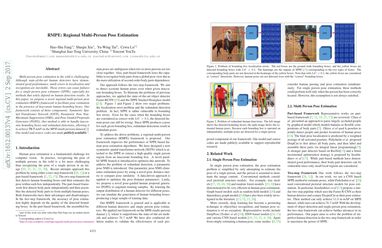
Multi-person pose estimation in the wild is challenging. Although state-of-the-art human detectors have demonstrated good performance, small errors in localization and recognition are inevitable. These errors can cause failures for a single-person pose estimator (SPPE), especially for methods that solely depend on human detection results. In this paper, we propose a novel regional multi-person pose estimation (RMPE) framework to facilitate pose estimation in the presence of inaccurate human bounding boxes. Our framework consists of three components: Symmetric Spatial Transformer Network (SSTN), Parametric Pose Non-Maximum-Suppression (NMS), and Pose-Guided Proposals Generator (PGPG). Our method is able to handle inaccurate bounding boxes and redundant detections, allowing it to achieve a 17% increase in mAP over the state-of-the-art methods on the MPII (multi person) dataset.Our model and source codes are publicly available.
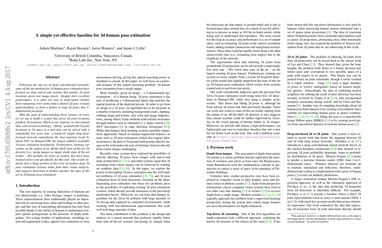
Following the success of deep convolutional networks, state-of-the-art methods for 3d human pose estimation have focused on deep end-to-end systems that predict 3d joint locations given raw image pixels. Despite their excellent performance, it is often not easy to understand whether their remaining error stems from a limited 2d pose (visual) understanding, or from a failure to map 2d poses into 3-dimensional positions. With the goal of understanding these sources of error, we set out to build a system that given 2d joint locations predicts 3d positions. Much to our surprise, we have found that, with current technology, "lifting" ground truth 2d joint locations to 3d space is a task that can be solved with a remarkably low error rate: a relatively simple deep feed-forward network outperforms the best reported result by about 30\% on Human3.6M, the largest publicly available 3d pose estimation benchmark. Furthermore, training our system on the output of an off-the-shelf state-of-the-art 2d detector (\ie, using images as input) yields state of the art results -- this includes an array of systems that have been trained end-to-end specifically for this task. Our results indicate that a large portion of the error of modern deep 3d pose estimation systems stems from their visual analysis, and suggests directions to further advance the state of the art in 3d human pose estimation.
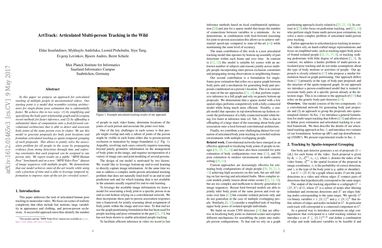
In this paper we propose an approach for articulated tracking of multiple people in unconstrained videos. Our starting point is a model that resembles existing architectures for single-frame pose estimation but is substantially faster. We achieve this in two ways: (1) by simplifying and sparsifying the body-part relationship graph and leveraging recent methods for faster inference, and (2) by offloading a substantial share of computation onto a feed-forward convolutional architecture that is able to detect and associate body joints of the same person even in clutter. We use this model to generate proposals for body joint locations and formulate articulated tracking as spatio-temporal grouping of such proposals. This allows to jointly solve the association problem for all people in the scene by propagating evidence from strong detections through time and enforcing constraints that each proposal can be assigned to one person only. We report results on a public MPII Human Pose benchmark and on a new MPII Video Pose dataset of image sequences with multiple people. We demonstrate that our model achieves state-of-the-art results while using only a fraction of time and is able to leverage temporal information to improve state-of-the-art for crowded scenes.
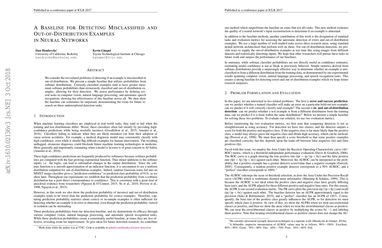
We consider the two related problems of detecting if an example is misclassified or out-of-distribution. We present a simple baseline that utilizes probabilities from softmax distributions. Correctly classified examples tend to have greater maximum softmax probabilities than erroneously classified and out-of-distribution examples, allowing for their detection. We assess performance by defining several tasks in computer vision, natural language processing, and automatic speech recognition, showing the effectiveness of this baseline across all. We then show the baseline can sometimes be surpassed, demonstrating the room for future research on these underexplored detection tasks.
We propose an extension to neural network language models to adapt their prediction to the recent history. Our model is a simplified version of memory augmented networks, which stores past hidden activations as memory and accesses them through a dot product with the current hidden activation. This mechanism is very efficient and scales to very large memory sizes. We also draw a link between the use of external memory in neural network and cache models used with count based language models. We demonstrate on several language model datasets that our approach performs significantly better than recent memory augmented networks.
Recurrent sequence generators conditioned on input data through an attention mechanism have recently shown very good performance on a range of tasks in- cluding machine translation, handwriting synthesis and image caption gen- eration. We extend the attention-mechanism with features needed for speech recognition. We show that while an adaptation of the model used for machine translation in reaches a competitive 18.7% phoneme error rate (PER) on the TIMIT phoneme recognition task, it can only be applied to utterances which are roughly as long as the ones it was trained on. We offer a qualitative explanation of this failure and propose a novel and generic method of adding location-awareness to the attention mechanism to alleviate this issue. The new method yields a model that is robust to long inputs and achieves 18% PER in single utterances and 20% in 10-times longer (repeated) utterances. Finally, we propose a change to the at- tention mechanism that prevents it from concentrating too much on single frames, which further reduces PER to 17.6% level.
Fine-tuning is the de facto way to leverage large pretrained language models to perform downstream tasks. However, it modifies all the language model parameters and therefore necessitates storing a full copy for each task. In this paper, we propose prefix-tuning, a lightweight alternative to fine-tuning for natural language generation tasks, which keeps language model parameters frozen, but optimizes a small continuous task-specific vector (called the prefix). Prefix-tuning draws inspiration from prompting, allowing subsequent tokens to attend to this prefix as if it were "virtual tokens". We apply prefix-tuning to GPT-2 for table-to-text generation and to BART for summarization. We find that by learning only 0.1\% of the parameters, prefix-tuning obtains comparable performance in the full data setting, outperforms fine-tuning in low-data settings, and extrapolates better to examples with topics unseen during training.