
分享

We focus on the challenging task of real-time semantic segmentation in this paper. It finds many practical applications and yet is with fundamental difficulty of reducing a large portion of computation for pixel-wise label inference. We propose an image cascade network (ICNet) that incorporates multi-resolution branches under proper label guidance to address this challenge. We provide in-depth analysis of our framework and introduce the cascade feature fusion unit to quickly achieve high-quality segmentation. Our system yields real-time inference on a single GPU card with decent quality results evaluated on challenging datasets like Cityscapes, CamVid and COCO-Stuff.

Policy gradient methods are an appealing approach in reinforcement learning because they directly optimize the cumulative reward and can straightforwardly be used with nonlinear function approximators such as neural networks. The two main challenges are the large number of samples typically required, and the difficulty of obtaining stable and steady improvement despite the nonstationarity of the incoming data. We address the first challenge by using value functions to substantially reduce the variance of policy gradient estimates at the cost of some bias, with an exponentially-weighted estimator of the advantage function that is analogous to TD(lambda). We address the second challenge by using trust region optimization procedure for both the policy and the value function, which are represented by neural networks. Our approach yields strong empirical results on highly challenging 3D locomotion tasks, learning running gaits for bipedal and quadrupedal simulated robots, and learning a policy for getting the biped to stand up from starting out lying on the ground. In contrast to a body of prior work that uses hand-crafted policy representations, our neural network policies map directly from raw kinematics to joint torques. Our algorithm is fully model-free, and the amount of simulated experience required for the learning tasks on 3D bipeds corresponds to 1-2 weeks of real time.
Sequence-to-sequence attention-based models on subword units allow simple open-vocabulary end-to-end speech recognition. In this work, we show that such models can achieve competitive results on the Switchboard 300h and LibriSpeech 1000h tasks. In particular, we report the state-of-the-art word error rates (WER) of 3.54% on the dev-clean and 3.82% on the test-clean evaluation subsets of LibriSpeech. We introduce a new pretraining scheme by starting with a high time reduction factor and lowering it during training, which is crucial both for convergence and final performance. In some experiments, we also use an auxiliary CTC loss function to help the convergence. In addition, we train long short-term memory (LSTM) language models on subword units. By shallow fusion, we report up to 27% relative improvements in WER over the attention baseline without a language model.
Sequential models achieve state-of-the-art results in audio, visual and textual domains with respect to both estimating the data distribution and generating high-quality samples. Efficient sampling for this class of models has however remained an elusive problem. With a focus on text-to-speech synthesis, we describe a set of general techniques for reducing sampling time while maintaining high output quality. We first describe a single-layer recurrent neural network, the WaveRNN, with a dual softmax layer that matches the quality of the state-of-the-art WaveNet model. The compact form of the network makes it possible to generate 24kHz 16-bit audio 4x faster than real time on a GPU. Second, we apply a weight pruning technique to reduce the number of weights in the WaveRNN. We find that, for a constant number of parameters, large sparse networks perform better than small dense networks and this relationship holds for sparsity levels beyond 96%. The small number of weights in a Sparse WaveRNN makes it possible to sample high-fidelity audio on a mobile CPU in real time. Finally, we propose a new generation scheme based on subscaling that folds a long sequence into a batch of shorter sequences and allows one to generate multiple samples at once. The Subscale WaveRNN produces 16 samples per step without loss of quality and offers an orthogonal method for increasing sampling efficiency.
The goal of this paper is to advance the state-of-the-art of articulated pose estimation in scenes with multiple people. To that end we contribute on three fronts. We propose (1) improved body part detectors that generate effective bottom-up proposals for body parts; (2) novel image-conditioned pairwise terms that allow to assemble the proposals into a variable number of consistent body part configurations; and (3) an incremental optimization strategy that explores the search space more efficiently thus leading both to better performance and significant speed-up factors. Evaluation is done on two single-person and two multi-person pose estimation benchmarks. The proposed approach significantly outperforms best known multi-person pose estimation results while demonstrating competitive performance on the task of single person pose estimation. Models and code available at http://pose.mpi-inf.mpg.de
Language model pre-training has proven to be useful in learning universal language representations. As a state-of-the-art language model pre-training model, BERT (Bidirectional Encoder Representations from Transformers) has achieved amazing results in many language understanding tasks. In this paper, we conduct exhaustive experiments to investigate different fine-tuning methods of BERT on text classification task and provide a general solution for BERT fine-tuning. Finally, the proposed solution obtains new state-of-the-art results on eight widely-studied text classification datasets.
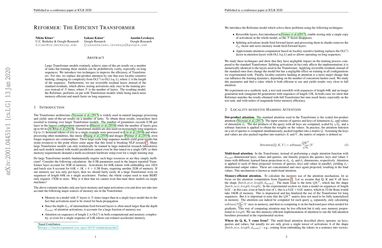
Large Transformer models routinely achieve state-of-the-art results on a number of tasks but training these models can be prohibitively costly, especially on long sequences. We introduce two techniques to improve the efficiency of Transformers. For one, we replace dot-product attention by one that uses locality-sensitive hashing, changing its complexity from O($L^2$) to O($L\log L$), where $L$ is the length of the sequence. Furthermore, we use reversible residual layers instead of the standard residuals, which allows storing activations only once in the training process instead of $N$ times, where $N$ is the number of layers. The resulting model, the Reformer, performs on par with Transformer models while being much more memory-efficient and much faster on long sequences.

Generative Pre-trained Transformer models, known as GPT or OPT, set themselves apart through breakthrough performance across complex language modelling tasks, but also by their extremely high computational and storage costs. Specifically, due to their massive size, even inference for large, highly-accurate GPT models may require multiple performant GPUs, which limits the usability of such models. While there is emerging work on relieving this pressure via model compression, the applicability and performance of existing compression techniques is limited by the scale and complexity of GPT models. In this paper, we address this challenge, and propose GPTQ, a new one-shot weight quantization method based on approximate second-order information, that is both highly-accurate and highly-efficient. Specifically, GPTQ can quantize GPT models with 175 billion parameters in approximately four GPU hours, reducing the bitwidth down to 3 or 4 bits per weight, with negligible accuracy degradation relative to the uncompressed baseline. Our method more than doubles the compression gains relative to previously-proposed one-shot quantization methods, preserving accuracy, allowing us for the first time to execute an 175 billion-parameter model inside a single GPU for generative inference. Moreover, we also show that our method can still provide reasonable accuracy in the extreme quantization regime, in which weights are quantized to 2-bit or even ternary quantization levels. We show experimentally that these improvements can be leveraged for end-to-end inference speedups over FP16, of around 3.25x when using high-end GPUs (NVIDIA A100) and 4.5x when using more cost-effective ones (NVIDIA A6000). The implementation is available at https://github.com/IST-DASLab/gptq.
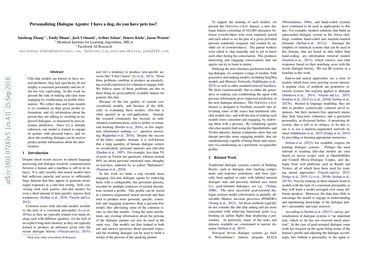
Chit-chat models are known to have several problems: they lack specificity, do not display a consistent personality and are often not very captivating. In this work we present the task of making chit-chat more engaging by conditioning on profile information. We collect data and train models to (i) condition on their given profile information; and (ii) information about the person they are talking to, resulting in improved dialogues, as measured by next utterance prediction. Since (ii) is initially unknown our model is trained to engage its partner with personal topics, and we show the resulting dialogue can be used to predict profile information about the interlocutors.
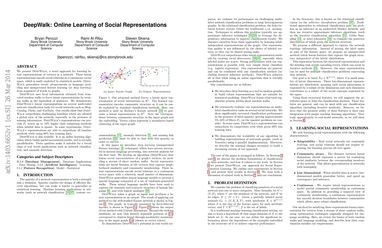
We present DeepWalk, a novel approach for learning latent representations of vertices in a network. These latent representations encode social relations in a continuous vector space, which is easily exploited by statistical models. DeepWalk generalizes recent advancements in language modeling and unsupervised feature learning (or deep learning) from sequences of words to graphs. DeepWalk uses local information obtained from truncated random walks to learn latent representations by treating walks as the equivalent of sentences. We demonstrate DeepWalk's latent representations on several multi-label network classification tasks for social networks such as BlogCatalog, Flickr, and YouTube. Our results show that DeepWalk outperforms challenging baselines which are allowed a global view of the network, especially in the presence of missing information. DeepWalk's representations can provide $F_1$ scores up to 10% higher than competing methods when labeled data is sparse. In some experiments, DeepWalk's representations are able to outperform all baseline methods while using 60% less training data. DeepWalk is also scalable. It is an online learning algorithm which builds useful incremental results, and is trivially parallelizable. These qualities make it suitable for a broad class of real world applications such as network classification, and anomaly detection.
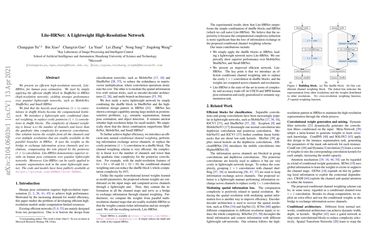
We present an efficient high-resolution network, Lite-HRNet, for human pose estimation. We start by simply applying the efficient shuffle block in ShuffleNet to HRNet (high-resolution network), yielding stronger performance over popular lightweight networks, such as MobileNet, ShuffleNet, and Small HRNet. We find that the heavily-used pointwise (1x1) convolutions in shuffle blocks become the computational bottleneck. We introduce a lightweight unit, conditional channel weighting, to replace costly pointwise (1x1) convolutions in shuffle blocks. The complexity of channel weighting is linear w.r.t the number of channels and lower than the quadratic time complexity for pointwise convolutions. Our solution learns the weights from all the channels and over multiple resolutions that are readily available in the parallel branches in HRNet. It uses the weights as the bridge to exchange information across channels and resolutions, compensating the role played by the pointwise (1x1) convolution. Lite-HRNet demonstrates superior results on human pose estimation over popular lightweight networks. Moreover, Lite-HRNet can be easily applied to semantic segmentation task in the same lightweight manner. The code and models have been publicly available at https://github.com/HRNet/Lite-HRNet.

We present QLoRA, an efficient finetuning approach that reduces memory usage enough to finetune a 65B parameter model on a single 48GB GPU while preserving full 16-bit finetuning task performance. QLoRA backpropagates gradients through a frozen, 4-bit quantized pretrained language model into Low Rank Adapters~(LoRA). Our best model family, which we name Guanaco, outperforms all previous openly released models on the Vicuna benchmark, reaching 99.3% of the performance level of ChatGPT while only requiring 24 hours of finetuning on a single GPU. QLoRA introduces a number of innovations to save memory without sacrificing performance: (a) 4-bit NormalFloat (NF4), a new data type that is information theoretically optimal for normally distributed weights (b) double quantization to reduce the average memory footprint by quantizing the quantization constants, and (c) paged optimziers to manage memory spikes. We use QLoRA to finetune more than 1,000 models, providing a detailed analysis of instruction following and chatbot performance across 8 instruction datasets, multiple model types (LLaMA, T5), and model scales that would be infeasible to run with regular finetuning (e.g. 33B and 65B parameter models). Our results show that QLoRA finetuning on a small high-quality dataset leads to state-of-the-art results, even when using smaller models than the previous SoTA. We provide a detailed analysis of chatbot performance based on both human and GPT-4 evaluations showing that GPT-4 evaluations are a cheap and reasonable alternative to human evaluation. Furthermore, we find that current chatbot benchmarks are not trustworthy to accurately evaluate the performance levels of chatbots. A lemon-picked analysis demonstrates where Guanaco fails compared to ChatGPT. We release all of our models and code, including CUDA kernels for 4-bit training.