
分享
We formulate language modeling as a matrix factorization problem, and show that the expressiveness of Softmax-based models (including the majority of neural language models) is limited by a Softmax bottleneck. Given that natural language is highly context-dependent, this further implies that in practice Softmax with distributed word embeddings does not have enough capacity to model natural language. We propose a simple and effective method to address this issue, and improve the state-of-the-art perplexities on Penn Treebank and WikiText-2 to 47.69 and 40.68 respectively. The proposed method also excels on the large-scale 1B Word dataset, outperforming the baseline by over 5.6 points in perplexity.
We propose a parallel-data-free voice-conversion (VC) method that can learn a mapping from source to target speech without relying on parallel data. The proposed method is general purpose, high quality, and parallel-data free and works without any extra data, modules, or alignment procedure. It also avoids over-smoothing, which occurs in many conventional statistical model-based VC methods. Our method, called CycleGAN-VC, uses a cycle-consistent adversarial network (CycleGAN) with gated convolutional neural networks (CNNs) and an identity-mapping loss. A CycleGAN learns forward and inverse mappings simultaneously using adversarial and cycle-consistency losses. This makes it possible to find an optimal pseudo pair from unpaired data. Furthermore, the adversarial loss contributes to reducing over-smoothing of the converted feature sequence. We configure a CycleGAN with gated CNNs and train it with an identity-mapping loss. This allows the mapping function to capture sequential and hierarchical structures while preserving linguistic information. We evaluated our method on a parallel-data-free VC task. An objective evaluation showed that the converted feature sequence was near natural in terms of global variance and modulation spectra. A subjective evaluation showed that the quality of the converted speech was comparable to that obtained with a Gaussian mixture model-based method under advantageous conditions with parallel and twice the amount of data.
With recent progress in graphics, it has become more tractable to train models on synthetic images, potentially avoiding the need for expensive annotations. However, learning from synthetic images may not achieve the desired performance due to a gap between synthetic and real image distributions. To reduce this gap, we propose Simulated+Unsupervised (S+U) learning, where the task is to learn a model to improve the realism of a simulator's output using unlabeled real data, while preserving the annotation information from the simulator. We develop a method for S+U learning that uses an adversarial network similar to Generative Adversarial Networks (GANs), but with synthetic images as inputs instead of random vectors. We make several key modifications to the standard GAN algorithm to preserve annotations, avoid artifacts, and stabilize training: (i) a 'self-regularization' term, (ii) a local adversarial loss, and (iii) updating the discriminator using a history of refined images. We show that this enables generation of highly realistic images, which we demonstrate both qualitatively and with a user study. We quantitatively evaluate the generated images by training models for gaze estimation and hand pose estimation. We show a significant improvement over using synthetic images, and achieve state-of-the-art results on the MPIIGaze dataset without any labeled real data.
A number of recent works have proposed attention models for Visual Question Answering (VQA) that generate spatial maps highlighting image regions relevant to answering the question. In this paper, we argue that in addition to modeling "where to look" or visual attention, it is equally important to model "what words to listen to" or question attention. We present a novel co-attention model for VQA that jointly reasons about image and question attention. In addition, our model reasons about the question (and consequently the image via the co-attention mechanism) in a hierarchical fashion via a novel 1-dimensional convolution neural networks (CNN). Our model improves the state-of-the-art on the VQA dataset from 60.3% to 60.5%, and from 61.6% to 63.3% on the COCO-QA dataset. By using ResNet, the performance is further improved to 62.1% for VQA and 65.4% for COCO-QA.
This paper presents a simple end-to-end model for speech recognition, combining a convolutional network based acoustic model and a graph decoding. It is trained to output letters, with transcribed speech, without the need for force alignment of phonemes. We introduce an automatic segmentation criterion for training from sequence annotation without alignment that is on par with CTC while being simpler. We show competitive results in word error rate on the Librispeech corpus with MFCC features, and promising results from raw waveform.
Recurrent Neural Networks can be trained to produce sequences of tokens given some input, as exemplified by recent results in machine translation and image captioning. The current approach to training them consists of maximizing the likelihood of each token in the sequence given the current (recurrent) state and the previous token. At inference, the unknown previous token is then replaced by a token generated by the model itself. This discrepancy between training and inference can yield errors that can accumulate quickly along the generated sequence. We propose a curriculum learning strategy to gently change the training process from a fully guided scheme using the true previous token, towards a less guided scheme which mostly uses the generated token instead. Experiments on several sequence prediction tasks show that this approach yields significant improvements. Moreover, it was used successfully in our winning entry to the MSCOCO image captioning challenge, 2015.
One challenge for dialogue agents is recognizing feelings in the conversation partner and replying accordingly, a key communicative skill. While it is straightforward for humans to recognize and acknowledge others' feelings in a conversation, this is a significant challenge for AI systems due to the paucity of suitable publicly-available datasets for training and evaluation. This work proposes a new benchmark for empathetic dialogue generation and EmpatheticDialogues, a novel dataset of 25k conversations grounded in emotional situations. Our experiments indicate that dialogue models that use our dataset are perceived to be more empathetic by human evaluators, compared to models merely trained on large-scale Internet conversation data. We also present empirical comparisons of dialogue model adaptations for empathetic responding, leveraging existing models or datasets without requiring lengthy re-training of the full model.
The goal of this paper is to estimate the 6D pose and dimensions of unseen object instances in an RGB-D image. Contrary to "instance-level" 6D pose estimation tasks, our problem assumes that no exact object CAD models are available during either training or testing time. To handle different and unseen object instances in a given category, we introduce a Normalized Object Coordinate Space (NOCS)---a shared canonical representation for all possible object instances within a category. Our region-based neural network is then trained to directly infer the correspondence from observed pixels to this shared object representation (NOCS) along with other object information such as class label and instance mask. These predictions can be combined with the depth map to jointly estimate the metric 6D pose and dimensions of multiple objects in a cluttered scene. To train our network, we present a new context-aware technique to generate large amounts of fully annotated mixed reality data. To further improve our model and evaluate its performance on real data, we also provide a fully annotated real-world dataset with large environment and instance variation. Extensive experiments demonstrate that the proposed method is able to robustly estimate the pose and size of unseen object instances in real environments while also achieving state-of-the-art performance on standard 6D pose estimation benchmarks.
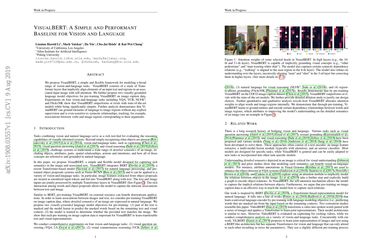
We propose VisualBERT, a simple and flexible framework for modeling a broad range of vision-and-language tasks. VisualBERT consists of a stack of Transformer layers that implicitly align elements of an input text and regions in an associated input image with self-attention. We further propose two visually-grounded language model objectives for pre-training VisualBERT on image caption data. Experiments on four vision-and-language tasks including VQA, VCR, NLVR2, and Flickr30K show that VisualBERT outperforms or rivals with state-of-the-art models while being significantly simpler. Further analysis demonstrates that VisualBERT can ground elements of language to image regions without any explicit supervision and is even sensitive to syntactic relationships, tracking, for example, associations between verbs and image regions corresponding to their arguments.
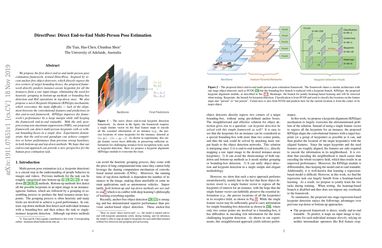
We propose the first direct end-to-end multi-person pose estimation framework, termed DirectPose. Inspired by recent anchor-free object detectors, which directly regress the two corners of target bounding-boxes, the proposed framework directly predicts instance-aware keypoints for all the instances from a raw input image, eliminating the need for heuristic grouping in bottom-up methods or bounding-box detection and RoI operations in top-down ones. We also propose a novel Keypoint Alignment (KPAlign) mechanism, which overcomes the main difficulty: lack of the alignment between the convolutional features and predictions in this end-to-end framework. KPAlign improves the framework's performance by a large margin while still keeping the framework end-to-end trainable. With the only postprocessing non-maximum suppression (NMS), our proposed framework can detect multi-person keypoints with or without bounding-boxes in a single shot. Experiments demonstrate that the end-to-end paradigm can achieve competitive or better performance than previous strong baselines, in both bottom-up and top-down methods. We hope that our end-to-end approach can provide a new perspective for the human pose estimation task.
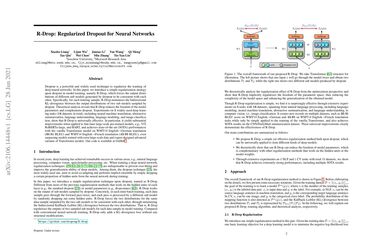
Dropout is a powerful and widely used technique to regularize the training of deep neural networks. In this paper, we introduce a simple regularization strategy upon dropout in model training, namely R-Drop, which forces the output distributions of different sub models generated by dropout to be consistent with each other. Specifically, for each training sample, R-Drop minimizes the bidirectional KL-divergence between the output distributions of two sub models sampled by dropout. Theoretical analysis reveals that R-Drop reduces the freedom of the model parameters and complements dropout. Experiments on $\bf{5}$ widely used deep learning tasks ($\bf{18}$ datasets in total), including neural machine translation, abstractive summarization, language understanding, language modeling, and image classification, show that R-Drop is universally effective. In particular, it yields substantial improvements when applied to fine-tune large-scale pre-trained models, e.g., ViT, RoBERTa-large, and BART, and achieves state-of-the-art (SOTA) performances with the vanilla Transformer model on WMT14 English$\to$German translation ($\bf{30.91}$ BLEU) and WMT14 English$\to$French translation ($\bf{43.95}$ BLEU), even surpassing models trained with extra large-scale data and expert-designed advanced variants of Transformer models. Our code is available at GitHub{\url{https://github.com/dropreg/R-Drop}}.
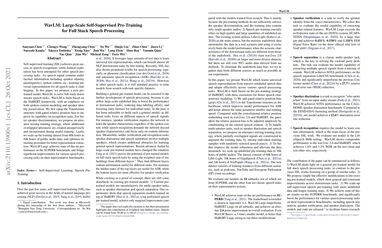
Self-supervised learning (SSL) achieves great success in speech recognition, while limited exploration has been attempted for other speech processing tasks. As speech signal contains multi-faceted information including speaker identity, paralinguistics, spoken content, etc., learning universal representations for all speech tasks is challenging. To tackle the problem, we propose a new pre-trained model, WavLM, to solve full-stack downstream speech tasks. WavLM jointly learns masked speech prediction and denoising in pre-training. By this means, WavLM does not only keep the speech content modeling capability by the masked speech prediction, but also improves the potential to non-ASR tasks by the speech denoising. In addition, WavLM employs gated relative position bias for the Transformer structure to better capture sequence ordering of input speech, and scale up the training dataset from 60k hours to 94k hours. WavLM Large achieves state-of-the-art performance on the SUPERB benchmark, and brings significant improvements for various speech processing tasks on their representative benchmarks. The code and pre-trained models are available at https://aka.ms/wavlm.