
分享
This paper presents a simple end-to-end model for speech recognition, combining a convolutional network based acoustic model and a graph decoding. It is trained to output letters, with transcribed speech, without the need for force alignment of phonemes. We introduce an automatic segmentation criterion for training from sequence annotation without alignment that is on par with CTC while being simpler. We show competitive results in word error rate on the Librispeech corpus with MFCC features, and promising results from raw waveform.
This paper presents a new Unified pre-trained Language Model (UniLM) that can be fine-tuned for both natural language understanding and generation tasks. The model is pre-trained using three types of language modeling tasks: unidirectional, bidirectional, and sequence-to-sequence prediction. The unified modeling is achieved by employing a shared Transformer network and utilizing specific self-attention masks to control what context the prediction conditions on. UniLM compares favorably with BERT on the GLUE benchmark, and the SQuAD 2.0 and CoQA question answering tasks. Moreover, UniLM achieves new state-of-the-art results on five natural language generation datasets, including improving the CNN/DailyMail abstractive summarization ROUGE-L to 40.51 (2.04 absolute improvement), the Gigaword abstractive summarization ROUGE-L to 35.75 (0.86 absolute improvement), the CoQA generative question answering F1 score to 82.5 (37.1 absolute improvement), the SQuAD question generation BLEU-4 to 22.12 (3.75 absolute improvement), and the DSTC7 document-grounded dialog response generation NIST-4 to 2.67 (human performance is 2.65). The code and pre-trained models are available at https://github.com/microsoft/unilm.
In recent years Deep Learning reached significant results in many practical problems, such as computer vision, natural language processing, speech recognition and many others. For many years the main goal of the research was to improve the quality of models, even if the complexity was impractically high. However, for the production solutions, which often require real-time work, the latency of the model plays a very important role. Current state-of-the-art architectures are found with neural architecture search (NAS) taking model complexity into account. However, designing of the search space suitable for specific hardware is still a challenging task. To address this problem we propose a measure of hardware efficiency of neural architecture search space - matrix efficiency measure (MEM); a search space comprising of hardware-efficient operations; a latency-aware scaling method; and ISyNet - a set of architectures designed to be fast on the specialized neural processing unit (NPU) hardware and accurate at the same time. We show the advantage of the designed architectures for the NPU devices on ImageNet and the generalization ability for the downstream classification and detection tasks.
Self-supervised learning (SSL) achieves great success in speech recognition, while limited exploration has been attempted for other speech processing tasks. As speech signal contains multi-faceted information including speaker identity, paralinguistics, spoken content, etc., learning universal representations for all speech tasks is challenging. To tackle the problem, we propose a new pre-trained model, WavLM, to solve full-stack downstream speech tasks. WavLM jointly learns masked speech prediction and denoising in pre-training. By this means, WavLM does not only keep the speech content modeling capability by the masked speech prediction, but also improves the potential to non-ASR tasks by the speech denoising. In addition, WavLM employs gated relative position bias for the Transformer structure to better capture sequence ordering of input speech, and scale up the training dataset from 60k hours to 94k hours. WavLM Large achieves state-of-the-art performance on the SUPERB benchmark, and brings significant improvements for various speech processing tasks on their representative benchmarks. The code and pre-trained models are available at https://aka.ms/wavlm.

A central goal of sequence modeling is designing a single principled model that can address sequence data across a range of modalities and tasks, particularly on long-range dependencies. Although conventional models including RNNs, CNNs, and Transformers have specialized variants for capturing long dependencies, they still struggle to scale to very long sequences of $10000$ or more steps. A promising recent approach proposed modeling sequences by simulating the fundamental state space model (SSM) \( x'(t) = Ax(t) + Bu(t), y(t) = Cx(t) + Du(t) \), and showed that for appropriate choices of the state matrix \( A \), this system could handle long-range dependencies mathematically and empirically. However, this method has prohibitive computation and memory requirements, rendering it infeasible as a general sequence modeling solution. We propose the Structured State Space sequence model (S4) based on a new parameterization for the SSM, and show that it can be computed much more efficiently than prior approaches while preserving their theoretical strengths. Our technique involves conditioning \( A \) with a low-rank correction, allowing it to be diagonalized stably and reducing the SSM to the well-studied computation of a Cauchy kernel. S4 achieves strong empirical results across a diverse range of established benchmarks, including (i) 91\% accuracy on sequential CIFAR-10 with no data augmentation or auxiliary losses, on par with a larger 2-D ResNet, (ii) substantially closing the gap to Transformers on image and language modeling tasks, while performing generation $60\times$ faster (iii) SoTA on every task from the Long Range Arena benchmark, including solving the challenging Path-X task of length 16k that all prior work fails on, while being as efficient as all competitors.
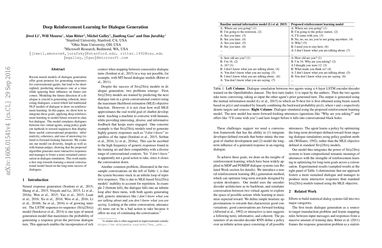
Recent neural models of dialogue generation offer great promise for generating responses for conversational agents, but tend to be shortsighted, predicting utterances one at a time while ignoring their influence on future outcomes. Modeling the future direction of a dialogue is crucial to generating coherent, interesting dialogues, a need which led traditional NLP models of dialogue to draw on reinforcement learning. In this paper, we show how to integrate these goals, applying deep reinforcement learning to model future reward in chatbot dialogue. The model simulates dialogues between two virtual agents, using policy gradient methods to reward sequences that display three useful conversational properties: informativity (non-repetitive turns), coherence, and ease of answering (related to forward-looking function). We evaluate our model on diversity, length as well as with human judges, showing that the proposed algorithm generates more interactive responses and manages to foster a more sustained conversation in dialogue simulation. This work marks a first step towards learning a neural conversational model based on the long-term success of dialogues.
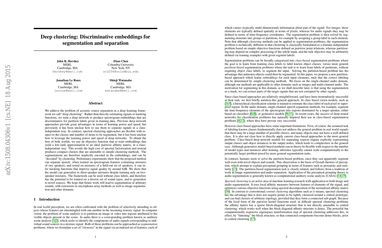
We address the problem of acoustic source separation in a deep learning framework we call "deep clustering." Rather than directly estimating signals or masking functions, we train a deep network to produce spectrogram embeddings that are discriminative for partition labels given in training data. Previous deep network approaches provide great advantages in terms of learning power and speed, but previously it has been unclear how to use them to separate signals in a class-independent way. In contrast, spectral clustering approaches are flexible with respect to the classes and number of items to be segmented, but it has been unclear how to leverage the learning power and speed of deep networks. To obtain the best of both worlds, we use an objective function that to train embeddings that yield a low-rank approximation to an ideal pairwise affinity matrix, in a class-independent way. This avoids the high cost of spectral factorization and instead produces compact clusters that are amenable to simple clustering methods. The segmentations are therefore implicitly encoded in the embeddings, and can be "decoded" by clustering. Preliminary experiments show that the proposed method can separate speech: when trained on spectrogram features containing mixtures of two speakers, and tested on mixtures of a held-out set of speakers, it can infer masking functions that improve signal quality by around 6dB. We show that the model can generalize to three-speaker mixtures despite training only on two-speaker mixtures. The framework can be used without class labels, and therefore has the potential to be trained on a diverse set of sound types, and to generalize to novel sources. We hope that future work will lead to segmentation of arbitrary sounds, with extensions to microphone array methods as well as image segmentation and other domains.
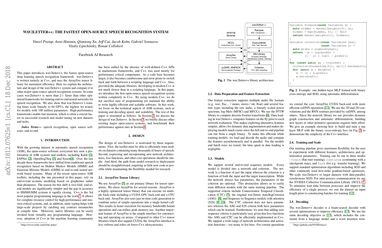
This paper introduces wav2letter++, the fastest open-source deep learning speech recognition framework. wav2letter++ is written entirely in C++, and uses the ArrayFire tensor library for maximum efficiency. Here we explain the architecture and design of the wav2letter++ system and compare it to other major open-source speech recognition systems. In some cases wav2letter++ is more than 2x faster than other optimized frameworks for training end-to-end neural networks for speech recognition. We also show that wav2letter++'s training times scale linearly to 64 GPUs, the highest we tested, for models with 100 million parameters. High-performance frameworks enable fast iteration, which is often a crucial factor in successful research and model tuning on new datasets and tasks.
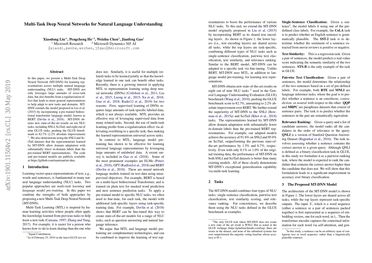
In this paper, we present a Multi-Task Deep Neural Network (MT-DNN) for learning representations across multiple natural language understanding (NLU) tasks. MT-DNN not only leverages large amounts of cross-task data, but also benefits from a regularization effect that leads to more general representations in order to adapt to new tasks and domains. MT-DNN extends the model proposed in Liu et al. (2015) by incorporating a pre-trained bidirectional transformer language model, known as BERT (Devlin et al., 2018). MT-DNN obtains new state-of-the-art results on ten NLU tasks, including SNLI, SciTail, and eight out of nine GLUE tasks, pushing the GLUE benchmark to 82.7% (2.2% absolute improvement). We also demonstrate using the SNLI and SciTail datasets that the representations learned by MT-DNN allow domain adaptation with substantially fewer in-domain labels than the pre-trained BERT representations. The code and pre-trained models are publicly available at https://github.com/namisan/mt-dnn.
We rethink a well-know bottom-up approach for multi-person pose estimation and propose an improved one. The improved approach surpasses the baseline significantly thanks to (1) an intuitional yet more sensible representation, which we refer to as body parts to encode the connection information between keypoints, (2) an improved stacked hourglass network with attention mechanisms, (3) a novel focal L2 loss which is dedicated to hard keypoint and keypoint association (body part) mining, and (4) a robust greedy keypoint assignment algorithm for grouping the detected keypoints into individual poses. Our approach not only works straightforwardly but also outperforms the baseline by about 15% in average precision and is comparable to the state of the art on the MS-COCO test-dev dataset. The code and pre-trained models are publicly available online.
There have been various types of pretraining architectures including autoencoding models (e.g., BERT), autoregressive models (e.g., GPT), and encoder-decoder models (e.g., T5). However, none of the pretraining frameworks performs the best for all tasks of three main categories including natural language understanding (NLU), unconditional generation, and conditional generation. We propose a General Language Model (GLM) based on autoregressive blank infilling to address this challenge. GLM improves blank filling pretraining by adding 2D positional encodings and allowing an arbitrary order to predict spans, which results in performance gains over BERT and T5 on NLU tasks. Meanwhile, GLM can be pretrained for different types of tasks by varying the number and lengths of blanks. On a wide range of tasks across NLU, conditional and unconditional generation, GLM outperforms BERT, T5, and GPT given the same model sizes and data, and achieves the best performance from a single pretrained model with 1.25x parameters of BERT Large , demonstrating its generalizability to different downstream tasks.
Building open-domain chatbots is a challenging area for machine learning research. While prior work has shown that scaling neural models in the number of parameters and the size of the data they are trained on gives improved results, we show that other ingredients are important for a high-performing chatbot. Good conversation requires a number of skills that an expert conversationalist blends in a seamless way: providing engaging talking points and listening to their partners, and displaying knowledge, empathy and personality appropriately, while maintaining a consistent persona. We show that large scale models can learn these skills when given appropriate training data and choice of generation strategy. We build variants of these recipes with 90M, 2.7B and 9.4B parameter models, and make our models and code publicly available. Human evaluations show our best models are superior to existing approaches in multi-turn dialogue in terms of engagingness and humanness measurements. We then discuss the limitations of this work by analyzing failure cases of our models.