
分享
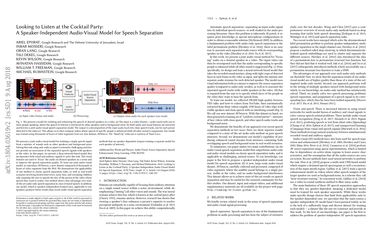
We present a joint audio-visual model for isolating a single speech signal from a mixture of sounds such as other speakers and background noise. Solving this task using only audio as input is extremely challenging and does not provide an association of the separated speech signals with speakers in the video. In this paper, we present a deep network-based model that incorporates both visual and auditory signals to solve this task. The visual features are used to "focus" the audio on desired speakers in a scene and to improve the speech separation quality. To train our joint audio-visual model, we introduce AVSpeech, a new dataset comprised of thousands of hours of video segments from the Web. We demonstrate the applicability of our method to classic speech separation tasks, as well as real-world scenarios involving heated interviews, noisy bars, and screaming children, only requiring the user to specify the face of the person in the video whose speech they want to isolate. Our method shows clear advantage over state-of-the-art audio-only speech separation in cases of mixed speech. In addition, our model, which is speaker-independent (trained once, applicable to any speaker), produces better results than recent audio-visual speech separation methods that are speaker-dependent (require training a separate model for each speaker of interest).
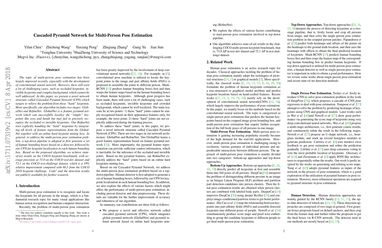
The topic of multi-person pose estimation has been largely improved recently, especially with the development of convolutional neural network. However, there still exist a lot of challenging cases, such as occluded keypoints, invisible keypoints and complex background, which cannot be well addressed. In this paper, we present a novel network structure called Cascaded Pyramid Network (CPN) which targets to relieve the problem from these "hard" keypoints. More specifically, our algorithm includes two stages: GlobalNet and RefineNet. GlobalNet is a feature pyramid network which can successfully localize the "simple" keypoints like eyes and hands but may fail to precisely recognize the occluded or invisible keypoints. Our RefineNet tries explicitly handling the "hard" keypoints by integrating all levels of feature representations from the GlobalNet together with an online hard keypoint mining loss. In general, to address the multi-person pose estimation problem, a top-down pipeline is adopted to first generate a set of human bounding boxes based on a detector, followed by our CPN for keypoint localization in each human bounding box. Based on the proposed algorithm, we achieve state-of-art results on the COCO keypoint benchmark, with average precision at 73.0 on the COCO test-dev dataset and 72.1 on the COCO test-challenge dataset, which is a 19% relative improvement compared with 60.5 from the COCO 2016 keypoint challenge.Code (https://github.com/chenyilun95/tf-cpn.git) and the detection results are publicly available for further research.
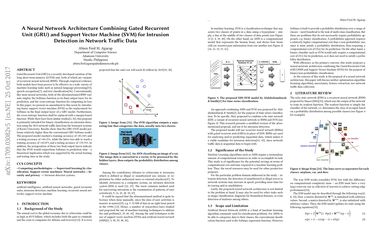
Gated Recurrent Unit (GRU) is a recently-developed variation of the long short-term memory (LSTM) unit, both of which are types of recurrent neural network (RNN). Through empirical evidence, both models have been proven to be effective in a wide variety of machine learning tasks such as natural language processing (Wen et al., 2015), speech recognition (Chorowski et al., 2015), and text classification (Yang et al., 2016). Conventionally, like most neural networks, both of the aforementioned RNN variants employ the Softmax function as its final output layer for its prediction, and the cross-entropy function for computing its loss. In this paper, we present an amendment to this norm by introducing linear support vector machine (SVM) as the replacement for Softmax in the final output layer of a GRU model. Furthermore, the cross-entropy function shall be replaced with a margin-based function. While there have been similar studies (Alalshekmubarak & Smith, 2013; Tang, 2013), this proposal is primarily intended for binary classification on intrusion detection using the 2013 network traffic data from the honeypot systems of Kyoto University. Results show that the GRU-SVM model performs relatively higher than the conventional GRU-Softmax model. The proposed model reached a training accuracy of ~81.54% and a testing accuracy of ~84.15%, while the latter was able to reach a training accuracy of ~63.07% and a testing accuracy of ~70.75%. In addition, the juxtaposition of these two final output layers indicate that the SVM would outperform Softmax in prediction time - a theoretical implication which was supported by the actual training and testing time in the study.
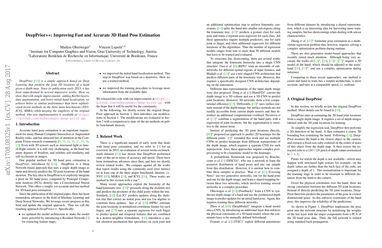
DeepPrior is a simple approach based on Deep Learning that predicts the joint 3D locations of a hand given a depth map. Since its publication early 2015, it has been outperformed by several impressive works. Here we show that with simple improvements: adding ResNet layers, data augmentation, and better initial hand localization, we achieve better or similar performance than more sophisticated recent methods on the three main benchmarks (NYU, ICVL, MSRA) while keeping the simplicity of the original method. Our new implementation is available at https://github.com/moberweger/deep-prior-pp .
Recurrent neural networks have been very successful at predicting sequences of words in tasks such as language modeling. However, all such models are based on the conventional classification framework, where the model is trained against one-hot targets, and each word is represented both as an input and as an output in isolation. This causes inefficiencies in learning both in terms of utilizing all of the information and in terms of the number of parameters needed to train. We introduce a novel theoretical framework that facilitates better learning in language modeling, and show that our framework leads to tying together the input embedding and the output projection matrices, greatly reducing the number of trainable variables. Our framework leads to state of the art performance on the Penn Treebank with a variety of network models.
We present a dataset for evaluating the grammaticality of the predictions of a language model. We automatically construct a large number of minimally different pairs of English sentences, each consisting of a grammatical and an ungrammatical sentence. The sentence pairs represent different variations of structure-sensitive phenomena: subject-verb agreement, reflexive anaphora and negative polarity items. We expect a language model to assign a higher probability to the grammatical sentence than the ungrammatical one. In an experiment using this data set, an LSTM language model performed poorly on many of the constructions. Multi-task training with a syntactic objective (CCG supertagging) improved the LSTM's accuracy, but a large gap remained between its performance and the accuracy of human participants recruited online. This suggests that there is considerable room for improvement over LSTMs in capturing syntax in a language model.
In the past few years, neural abstractive text summarization with sequence-to-sequence (seq2seq) models have gained a lot of popularity. Many interesting techniques have been proposed to improve seq2seq models, making them capable of handling different challenges, such as saliency, fluency and human readability, and generate high-quality summaries. Generally speaking, most of these techniques differ in one of these three categories: network structure, parameter inference, and decoding/generation. There are also other concerns, such as efficiency and parallelism for training a model. In this paper, we provide a comprehensive literature survey on different seq2seq models for abstractive text summarization from the viewpoint of network structures, training strategies, and summary generation algorithms. Several models were first proposed for language modeling and generation tasks, such as machine translation, and later applied to abstractive text summarization. Hence, we also provide a brief review of these models. As part of this survey, we also develop an open source library, namely, Neural Abstractive Text Summarizer (NATS) toolkit, for the abstractive text summarization. An extensive set of experiments have been conducted on the widely used CNN/Daily Mail dataset to examine the effectiveness of several different neural network components. Finally, we benchmark two models implemented in NATS on the two recently released datasets, namely, Newsroom and Bytecup.
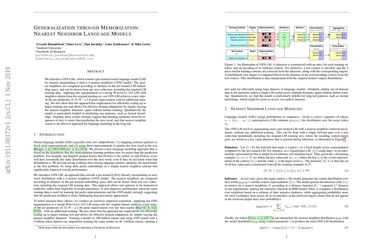
We introduce $k$NN-LMs, which extend a pre-trained neural language model (LM) by linearly interpolating it with a $k$-nearest neighbors ($k$NN) model. The nearest neighbors are computed according to distance in the pre-trained LM embedding space, and can be drawn from any text collection, including the original LM training data. Applying this augmentation to a strong Wikitext-103 LM, with neighbors drawn from the original training set, our $k$NN-LM achieves a new state-of-the-art perplexity of 15.79 - a 2.9 point improvement with no additional training. We also show that this approach has implications for efficiently scaling up to larger training sets and allows for effective domain adaptation, by simply varying the nearest neighbor datastore, again without further training. Qualitatively, the model is particularly helpful in predicting rare patterns, such as factual knowledge. Together, these results strongly suggest that learning similarity between sequences of text is easier than predicting the next word, and that nearest neighbor search is an effective approach for language modeling in the long tail.
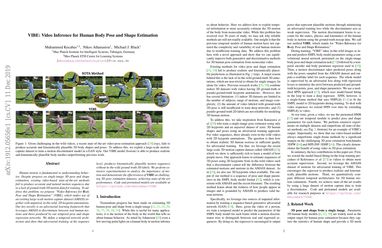
Human motion is fundamental to understanding behavior. Despite progress on single-image 3D pose and shape estimation, existing video-based state-of-the-art methods fail to produce accurate and natural motion sequences due to a lack of ground-truth 3D motion data for training. To address this problem, we propose Video Inference for Body Pose and Shape Estimation (VIBE), which makes use of an existing large-scale motion capture dataset (AMASS) together with unpaired, in-the-wild, 2D keypoint annotations. Our key novelty is an adversarial learning framework that leverages AMASS to discriminate between real human motions and those produced by our temporal pose and shape regression networks. We define a temporal network architecture and show that adversarial training, at the sequence level, produces kinematically plausible motion sequences without in-the-wild ground-truth 3D labels. We perform extensive experimentation to analyze the importance of motion and demonstrate the effectiveness of VIBE on challenging 3D pose estimation datasets, achieving state-of-the-art performance. Code and pretrained models are available at https://github.com/mkocabas/VIBE.
Representation learning is a critical ingredient for natural language processing systems. Recent Transformer language models like BERT learn powerful textual representations, but these models are targeted towards token- and sentence-level training objectives and do not leverage information on inter-document relatedness, which limits their document-level representation power. For applications on scientific documents, such as classification and recommendation, the embeddings power strong performance on end tasks. We propose SPECTER, a new method to generate document-level embedding of scientific documents based on pretraining a Transformer language model on a powerful signal of document-level relatedness: the citation graph. Unlike existing pretrained language models, SPECTER can be easily applied to downstream applications without task-specific fine-tuning. Additionally, to encourage further research on document-level models, we introduce SciDocs, a new evaluation benchmark consisting of seven document-level tasks ranging from citation prediction, to document classification and recommendation. We show that SPECTER outperforms a variety of competitive baselines on the benchmark.

Efficient fine-tuning is vital for adapting large language models (LLMs) to downstream tasks. However, it requires non-trivial efforts to implement these methods on different models. We present LlamaFactory, a unified framework that integrates a suite of cutting-edge efficient training methods. It provides a solution for flexibly customizing the fine-tuning of 100+ LLMs without the need for coding through the built-in web UI LlamaBoard. We empirically validate the efficiency and effectiveness of our framework on language modeling and text generation tasks. It has been released at https://github.com/hiyouga/LLaMA-Factory and received over 25,000 stars and 3,000 forks.

Ghosting artifacts caused by moving objects or misalignments is a key challenge in high dynamic range (HDR) imaging for dynamic scenes. Previous methods first register the input low dynamic range (LDR) images using optical flow before merging them, which are error-prone and cause ghosts in results. A very recent work tries to bypass optical flows via a deep network with skip-connections, however, which still suffers from ghosting artifacts for severe movement. To avoid the ghosting from the source, we propose a novel attention-guided end-to-end deep neural network (AHDRNet) to produce high-quality ghost-free HDR images. Unlike previous methods directly stacking the LDR images or features for merging, we use attention modules to guide the merging according to the reference image. The attention modules automatically suppress undesired components caused by misalignments and saturation and enhance desirable fine details in the non-reference images. In addition to the attention model, we use dilated residual dense block (DRDB) to make full use of the hierarchical features and increase the receptive field for hallucinating the missing details. The proposed AHDRNet is a non-flow-based method, which can also avoid the artifacts generated by optical-flow estimation error. Experiments on different datasets show that the proposed AHDRNet can achieve state-of-the-art quantitative and qualitative results.