
分享
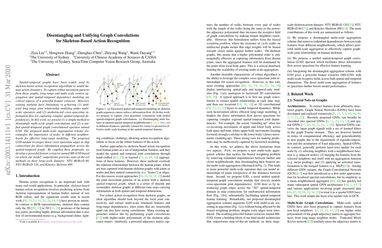
Spatial-temporal graphs have been widely used by skeleton-based action recognition algorithms to model human action dynamics. To capture robust movement patterns from these graphs, long-range and multi-scale context aggregation and spatial-temporal dependency modeling are critical aspects of a powerful feature extractor. However, existing methods have limitations in achieving (1) unbiased long-range joint relationship modeling under multi-scale operators and (2) unobstructed cross-spacetime information flow for capturing complex spatial-temporal dependencies. In this work, we present (1) a simple method to disentangle multi-scale graph convolutions and (2) a unified spatial-temporal graph convolutional operator named G3D. The proposed multi-scale aggregation scheme disentangles the importance of nodes in different neighborhoods for effective long-range modeling. The proposed G3D module leverages dense cross-spacetime edges as skip connections for direct information propagation across the spatial-temporal graph. By coupling these proposals, we develop a powerful feature extractor named MS-G3D based on which our model outperforms previous state-of-the-art methods on three large-scale datasets: NTU RGB+D 60, NTU RGB+D 120, and Kinetics Skeleton 400.
Semi-supervised learning has attracted much attention in medical image segmentation due to challenges in acquiring pixel-wise image annotations, which is a crucial step for building high-performance deep learning methods. Most existing semi-supervised segmentation approaches either tend to neglect geometric constraint in object segments, leading to incomplete object coverage, or impose strong shape prior that requires extra alignment. In this work, we propose a novel shapeaware semi-supervised segmentation strategy to leverage abundant unlabeled data and to enforce a geometric shape constraint on the segmentation output. To achieve this, we develop a multi-task deep network that jointly predicts semantic segmentation and signed distance map(SDM) of object surfaces. During training, we introduce an adversarial loss between the predicted SDMs of labeled and unlabeled data so that our network is able to capture shape-aware features more effectively. Experiments on the Atrial Segmentation Challenge dataset show that our method outperforms current state-of-the-art approaches with improved shape estimation, which validates its efficacy. Code is available at https://github.com/kleinzcy/SASSnet.
Generative adversarial networks have recently demonstrated outstanding performance in neural vocoding outperforming best autoregressive and flow-based models. In this paper, we show that this success can be extended to other tasks of conditional audio generation. In particular, building upon HiFi vocoders, we propose a novel HiFi++ general framework for neural vocoding, bandwidth extension, and speech enhancement. We show that with the improved generator architecture and simplified multi-discriminator training, HiFi++ performs on par with the state-of-the-art in these tasks while spending significantly less memory and computational resources. The effectiveness of our approach is validated through a series of extensive experiments.

Video data is often repetitive; for example, the contents of adjacent frames are usually strongly correlated. Such redundancy occurs at multiple levels of complexity, from low-level pixel values to textures and high-level semantics. We propose Event Neural Networks (EvNets), which leverage this redundancy to achieve considerable computation savings during video inference. A defining characteristic of EvNets is that each neuron has state variables that provide it with long-term memory, which allows low-cost, high-accuracy inference even in the presence of significant camera motion. We show that it is possible to transform a wide range of neural networks into EvNets without re-training. We demonstrate our method on state-of-the-art architectures for both high- and low-level visual processing, including pose recognition, object detection, optical flow, and image enhancement. We observe roughly an order-of-magnitude reduction in computational costs compared to conventional networks, with minimal reductions in model accuracy.

GPT-3.5 and GPT-4 are the two most widely used large language model (LLM) services. However, when and how these models are updated over time is opaque. Here, we evaluate the March 2023 and June 2023 versions of GPT-3.5 and GPT-4 on several diverse tasks: 1) math problems, 2) sensitive/dangerous questions, 3) opinion surveys, 4) multi-hop knowledge-intensive questions, 5) generating code, 6) US Medical License tests, and 7) visual reasoning. We find that the performance and behavior of both GPT-3.5 and GPT-4 can vary greatly over time. For example, GPT-4 (March 2023) was reasonable at identifying prime vs. composite numbers (84% accuracy) but GPT-4 (June 2023) was poor on these same questions (51% accuracy). This is partly explained by a drop in GPT-4's amenity to follow chain-of-thought prompting. Interestingly, GPT-3.5 was much better in June than in March in this task. GPT-4 became less willing to answer sensitive questions and opinion survey questions in June than in March. GPT-4 performed better at multi-hop questions in June than in March, while GPT-3.5's performance dropped on this task. Both GPT-4 and GPT-3.5 had more formatting mistakes in code generation in June than in March. We provide evidence that GPT-4's ability to follow user instructions has decreased over time, which is one common factor behind the many behavior drifts. Overall, our findings show that the behavior of the "same" LLM service can change substantially in a relatively short amount of time, highlighting the need for continuous monitoring of LLMs.

What does it take to create the Babel Fish, a tool that can help individuals translate speech between any two languages? While recent breakthroughs in text-based models have pushed machine translation coverage beyond 200 languages, unified speech-to-speech translation models have yet to achieve similar strides. More specifically, conventional speech-to-speech translation systems rely on cascaded systems that perform translation progressively, putting high-performing unified systems out of reach. To address these gaps, we introduce SeamlessM4T, a single model that supports speech-to-speech translation, speech-to-text translation, text-to-speech translation, text-to-text translation, and automatic speech recognition for up to 100 languages. To build this, we used 1 million hours of open speech audio data to learn self-supervised speech representations with w2v-BERT 2.0. Subsequently, we created a multimodal corpus of automatically aligned speech translations. Filtered and combined with human-labeled and pseudo-labeled data, we developed the first multilingual system capable of translating from and into English for both speech and text. On FLEURS, SeamlessM4T sets a new standard for translations into multiple target languages, achieving an improvement of 20% BLEU over the previous SOTA in direct speech-to-text translation. Compared to strong cascaded models, SeamlessM4T improves the quality of into-English translation by 1.3 BLEU points in speech-to-text and by 2.6 ASR-BLEU points in speech-to-speech. Tested for robustness, our system performs better against background noises and speaker variations in speech-to-text tasks compared to the current SOTA model. Critically, we evaluated SeamlessM4T on gender bias and added toxicity to assess translation safety. Finally, all contributions in this work are open-sourced and accessible at https://github.com/facebookresearch/seamless_communication

As language models are adopted by a more sophisticated and diverse set of users, the importance of guaranteeing that they provide factually correct information supported by verifiable sources is critical across fields of study. This is especially the case for high-stakes fields, such as medicine and law, where the risk of propagating false information is high and can lead to undesirable societal consequences. Previous work studying attribution and factuality has not focused on analyzing these characteristics of language model outputs in domain-specific scenarios. In this work, we conduct human evaluation of responses from a few representative systems along various axes of attribution and factuality, by bringing domain experts in the loop. Specifically, we collect expert-curated questions from 484 participants across 32 fields of study, and then ask the same experts to evaluate generated responses to their own questions. In addition, we ask experts to improve upon responses from language models. The output of our analysis is ExpertQA, a high-quality long-form QA dataset with 2177 questions spanning 32 fields, along with verified answers and attributions for claims in the answers.

As the application scenarios of mobile robots are getting more complex and challenging, scene understanding becomes increasingly crucial. A mobile robot that is supposed to operate autonomously in indoor environments must have precise knowledge about what objects are present, where they are, what their spatial extent is, and how they can be reached; i.e., information about free space is also crucial. Panoptic mapping is a powerful instrument providing such information. However, building 3D panoptic maps with high spatial resolution is challenging on mobile robots, given their limited computing capabilities. In this paper, we propose PanopticNDT - an efficient and robust panoptic mapping approach based on occupancy normal distribution transform (NDT) mapping. We evaluate our approach on the publicly available datasets Hypersim and ScanNetV2. The results reveal that our approach can represent panoptic information at a higher level of detail than other state-of-the-art approaches while enabling real-time panoptic mapping on mobile robots. Finally, we prove the real-world applicability of PanopticNDT with qualitative results in a domestic application.

We show that language model finetuning can be improved, sometimes dramatically, with a simple augmentation. NEFTune adds noise to the embedding vectors during training. Standard finetuning of LLaMA-2-7B using Alpaca achieves 29.79% on AlpacaEval, which rises to 64.69% using noisy embeddings. NEFTune also improves over strong baselines on modern instruction datasets. Models trained with Evol-Instruct see a 10% improvement, with ShareGPT an 8% improvement, and with OpenPlatypus an 8% improvement. Even powerful models further refined with RLHF such as LLaMA-2-Chat benefit from additional training with NEFTune.

We present Llemma, a large language model for mathematics. We continue pretraining Code Llama on the Proof-Pile-2, a mixture of scientific papers, web data containing mathematics, and mathematical code, yielding Llemma. On the MATH benchmark Llemma outperforms all known open base models, as well as the unreleased Minerva model suite on an equi-parameter basis. Moreover, Llemma is capable of tool use and formal theorem proving without any further finetuning. We openly release all artifacts, including 7 billion and 34 billion parameter models, the Proof-Pile-2, and code to replicate our experiments.

Large language models have demonstrated impressive universal capabilities across a wide range of open-ended tasks and have extended their utility to encompass multimodal conversations. However, existing methods encounter challenges in effectively handling both image and video understanding, particularly with limited visual tokens. In this work, we introduce Chat-UniVi, a Unified Vision-language model capable of comprehending and engaging in conversations involving images and videos through a unified visual representation. Specifically, we employ a set of dynamic visual tokens to uniformly represent images and videos. This representation framework empowers the model to efficiently utilize a limited number of visual tokens to simultaneously capture the spatial details necessary for images and the comprehensive temporal relationship required for videos. Moreover, we leverage a multi-scale representation, enabling the model to perceive both high-level semantic concepts and low-level visual details. Notably, Chat-UniVi is trained on a mixed dataset containing both images and videos, allowing direct application to tasks involving both mediums without requiring any modifications. Extensive experimental results demonstrate that Chat-UniVi consistently outperforms even existing methods exclusively designed for either images or videos. Code is available at https://github.com/PKU-YuanGroup/Chat-UniVi.

Despite the recent progress in enhancing the efficacy of image deblurring, the limited decoding capability constrains the upper limit of State-Of-The-Art (SOTA) methods. This paper proposes a pioneering work, Adaptive Patch Exiting Reversible Decoder (AdaRevD), to explore their insufficient decoding capability. By inheriting the weights of the well-trained encoder, we refactor a reversible decoder which scales up the single-decoder training to multi-decoder training while remaining GPU memory-friendly. Meanwhile, we show that our reversible structure gradually disentangles high-level degradation degree and low-level blur pattern (residual of the blur image and its sharp counterpart) from compact degradation representation. Besides, due to the spatially-variant motion blur kernels, different blur patches have various deblurring difficulties. We further introduce a classifier to learn the degradation degree of image patches, enabling them to exit at different sub-decoders for speedup. Experiments show that our AdaRevD pushes the limit of image deblurring, e.g., achieving 34.60 dB in PSNR on GoPro dataset.