
分享
Real-world videos often have complex dynamics; and methods for generating open-domain video descriptions should be sensitive to temporal structure and allow both input (sequence of frames) and output (sequence of words) of variable length. To approach this problem, we propose a novel end-to-end sequence-to-sequence model to generate captions for videos. For this we exploit recurrent neural networks, specifically LSTMs, which have demonstrated state-of-the-art performance in image caption generation. Our LSTM model is trained on video-sentence pairs and learns to associate a sequence of video frames to a sequence of words in order to generate a description of the event in the video clip. Our model naturally is able to learn the temporal structure of the sequence of frames as well as the sequence model of the generated sentences, i.e. a language model. We evaluate several variants of our model that exploit different visual features on a standard set of YouTube videos and two movie description datasets (M-VAD and MPII-MD).
The performance of automatic speech recognition (ASR) has improved tremendously due to the application of deep neural networks (DNNs). Despite this progress, building a new ASR system remains a challenging task, requiring various resources, multiple training stages and significant expertise. This paper presents our Eesen framework which drastically simplifies the existing pipeline to build state-of-the-art ASR systems. Acoustic modeling in Eesen involves learning a single recurrent neural network (RNN) predicting context-independent targets (phonemes or characters). To remove the need for pre-generated frame labels, we adopt the connectionist temporal classification (CTC) objective function to infer the alignments between speech and label sequences. A distinctive feature of Eesen is a generalized decoding approach based on weighted finite-state transducers (WFSTs), which enables the efficient incorporation of lexicons and language models into CTC decoding. Experiments show that compared with the standard hybrid DNN systems, Eesen achieves comparable word error rates (WERs), while at the same time speeding up decoding significantly.
While significant improvements have been made in recent years in terms of end-to-end automatic speech recognition (ASR) performance, such improvements were obtained through the use of very large neural networks, unfit for embedded use on edge devices. That being said, in this paper, we work on simplifying and compressing Transformer-based encoder-decoder architectures for the end-to-end ASR task. We empirically introduce a more compact Speech-Transformer by investigating the impact of discarding particular modules on the performance of the model. Moreover, we evaluate reducing the numerical precision of our network's weights and activations while maintaining the performance of the full-precision model. Our experiments show that we can reduce the number of parameters of the full-precision model and then further compress the model 4x by fully quantizing to 8-bit fixed point precision.
Aspect-Based Sentiment Analysis (ABSA) deals with the extraction of sentiments and their targets. Collecting labeled data for this task in order to help neural networks generalize better can be laborious and time-consuming. As an alternative, similar data to the real-world examples can be produced artificially through an adversarial process which is carried out in the embedding space. Although these examples are not real sentences, they have been shown to act as a regularization method which can make neural networks more robust. In this work, we apply adversarial training, which was put forward by Goodfellow et al. (2014), to the post-trained BERT (BERT-PT) language model proposed by Xu et al. (2019) on the two major tasks of Aspect Extraction and Aspect Sentiment Classification in sentiment analysis. After improving the results of post-trained BERT by an ablation study, we propose a novel architecture called BERT Adversarial Training (BAT) to utilize adversarial training in ABSA. The proposed model outperforms post-trained BERT in both tasks. To the best of our knowledge, this is the first study on the application of adversarial training in ABSA.
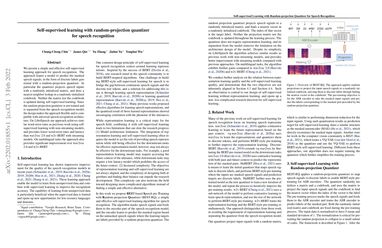
We present a simple and effective self-supervised learning approach for speech recognition. The approach learns a model to predict the masked speech signals, in the form of discrete labels generated with a random-projection quantizer. In particular the quantizer projects speech inputs with a randomly initialized matrix, and does a nearest-neighbor lookup in a randomly-initialized codebook. Neither the matrix nor the codebook is updated during self-supervised learning. Since the random-projection quantizer is not trained and is separated from the speech recognition model, the design makes the approach flexible and is compatible with universal speech recognition architecture. On LibriSpeech our approach achieves similar word-error-rates as previous work using self-supervised learning with non-streaming models, and provides lower word-error-rates and latency than wav2vec 2.0 and w2v-BERT with streaming models. On multilingual tasks the approach also provides significant improvement over wav2vec 2.0 and w2v-BERT.

How do large language models (LLMs) develop and evolve over the course of training? How do these patterns change as models scale? To answer these questions, we introduce \textit{Pythia}, a suite of 16 LLMs all trained on public data seen in the exact same order and ranging in size from 70M to 12B parameters. We provide public access to 154 checkpoints for each one of the 16 models, alongside tools to download and reconstruct their exact training dataloaders for further study. We intend \textit{Pythia} to facilitate research in many areas, and we present several case studies including novel results in memorization, term frequency effects on few-shot performance, and reducing gender bias. We demonstrate that this highly controlled setup can be used to yield novel insights toward LLMs and their training dynamics. Trained models, analysis code, training code, and training data can be found at \url{https://github.com/EleutherAI/pythia}.

This paper highlights the importance of personalization in large language models and introduces the LaMP benchmark -- a novel benchmark for training and evaluating language models for producing personalized outputs. LaMP offers a comprehensive evaluation framework with diverse language tasks and multiple entries for each user profile. It consists of seven personalized tasks, spanning three text classification and four text generation tasks. We additionally propose two retrieval augmentation approaches that retrieve personal items from each user profile for personalizing language model outputs. To this aim, we study various retrieval models, including term matching, semantic matching, and time-aware methods. Extensive experiments on LaMP for zero-shot and fine-tuned language models demonstrate the efficacy of the proposed retrieval augmentation approach and highlight the impact of personalization in various natural language tasks.

The rapid advancement of Large Language Models (LLMs) has significantly enhanced the capabilities of text generators. With the potential for misuse escalating, the importance of discerning whether texts are human-authored or generated by LLMs has become paramount. Several preceding studies have ventured to address this challenge by employing binary classifiers to differentiate between human-written and LLM-generated text. Nevertheless, the reliability of these classifiers has been subject to question. Given that consequential decisions may hinge on the outcome of such classification, it is imperative that text source detection is of high caliber. In light of this, the present paper introduces DeepTextMark, a deep learning-driven text watermarking methodology devised for text source identification. By leveraging Word2Vec and Sentence Encoding for watermark insertion, alongside a transformer-based classifier for watermark detection, DeepTextMark epitomizes a blend of blindness, robustness, imperceptibility, and reliability. As elaborated within the paper, these attributes are crucial for universal text source detection, with a particular emphasis in this paper on text produced by LLMs. DeepTextMark offers a viable "add-on" solution to prevailing text generation frameworks, requiring no direct access or alterations to the underlying text generation mechanism. Experimental evaluations underscore the high imperceptibility, elevated detection accuracy, augmented robustness, reliability, and swift execution of DeepTextMark.

Evaluating the factuality of long-form text generated by large language models (LMs) is non-trivial because (1) generations often contain a mixture of supported and unsupported pieces of information, making binary judgments of quality inadequate, and (2) human evaluation is time-consuming and costly. In this paper, we introduce FACTSCORE, a new evaluation that breaks a generation into a series of atomic facts and computes the percentage of atomic facts supported by a reliable knowledge source. We conduct an extensive human evaluation to obtain FACTSCOREs of people biographies generated by several state-of-the-art commercial LMs -- InstructGPT, ChatGPT, and the retrieval-augmented PerplexityAI -- and report new analysis demonstrating the need for such a fine-grained score (e.g., ChatGPT only achieves 58%). Since human evaluation is costly, we also introduce an automated model that estimates FACTSCORE using retrieval and a strong language model, with less than a 2% error rate. Finally, we use this automated metric to evaluate 6,500 generations from a new set of 13 recent LMs that would have cost $26K if evaluated by humans, with various findings: GPT-4 and ChatGPT are more factual than public models, and Vicuna and Alpaca are some of the best public models. FACTSCORE is available for public use via `pip install factscore`.

GPT-3.5 and GPT-4 are the two most widely used large language model (LLM) services. However, when and how these models are updated over time is opaque. Here, we evaluate the March 2023 and June 2023 versions of GPT-3.5 and GPT-4 on several diverse tasks: 1) math problems, 2) sensitive/dangerous questions, 3) opinion surveys, 4) multi-hop knowledge-intensive questions, 5) generating code, 6) US Medical License tests, and 7) visual reasoning. We find that the performance and behavior of both GPT-3.5 and GPT-4 can vary greatly over time. For example, GPT-4 (March 2023) was reasonable at identifying prime vs. composite numbers (84% accuracy) but GPT-4 (June 2023) was poor on these same questions (51% accuracy). This is partly explained by a drop in GPT-4's amenity to follow chain-of-thought prompting. Interestingly, GPT-3.5 was much better in June than in March in this task. GPT-4 became less willing to answer sensitive questions and opinion survey questions in June than in March. GPT-4 performed better at multi-hop questions in June than in March, while GPT-3.5's performance dropped on this task. Both GPT-4 and GPT-3.5 had more formatting mistakes in code generation in June than in March. We provide evidence that GPT-4's ability to follow user instructions has decreased over time, which is one common factor behind the many behavior drifts. Overall, our findings show that the behavior of the "same" LLM service can change substantially in a relatively short amount of time, highlighting the need for continuous monitoring of LLMs.

As the application scenarios of mobile robots are getting more complex and challenging, scene understanding becomes increasingly crucial. A mobile robot that is supposed to operate autonomously in indoor environments must have precise knowledge about what objects are present, where they are, what their spatial extent is, and how they can be reached; i.e., information about free space is also crucial. Panoptic mapping is a powerful instrument providing such information. However, building 3D panoptic maps with high spatial resolution is challenging on mobile robots, given their limited computing capabilities. In this paper, we propose PanopticNDT - an efficient and robust panoptic mapping approach based on occupancy normal distribution transform (NDT) mapping. We evaluate our approach on the publicly available datasets Hypersim and ScanNetV2. The results reveal that our approach can represent panoptic information at a higher level of detail than other state-of-the-art approaches while enabling real-time panoptic mapping on mobile robots. Finally, we prove the real-world applicability of PanopticNDT with qualitative results in a domestic application.

Learning from human feedback has become a pivot technique in aligning large language models (LLMs) with human preferences. However, acquiring vast and premium human feedback is bottlenecked by time, labor, and human capability, resulting in small sizes or limited topics of current datasets. This further hinders feedback learning as well as alignment research within the open-source community. To address this issue, we explore how to go beyond human feedback and collect high-quality \textit{AI feedback} automatically for a scalable alternative. Specifically, we identify \textbf{scale and diversity} as the key factors for feedback data to take effect. Accordingly, we first broaden instructions and responses in both amount and breadth to encompass a wider range of user-assistant interactions. Then, we meticulously apply a series of techniques to mitigate annotation biases for more reliable AI feedback. We finally present \textsc{UltraFeedback}, a large-scale, high-quality, and diversified AI feedback dataset, which contains over 1 million GPT-4 feedback for 250k user-assistant conversations from various aspects. Built upon \textsc{UltraFeedback}, we align a LLaMA-based model by best-of-$n$ sampling and reinforcement learning, demonstrating its exceptional performance on chat benchmarks. Our work validates the effectiveness of scaled AI feedback data in constructing strong open-source chat language models, serving as a solid foundation for future feedback learning research. Our data and models are available at https://github.com/thunlp/UltraFeedback.