
分享
This paper describes a novel text-to-speech (TTS) technique based on deep convolutional neural networks (CNN), without use of any recurrent units. Recurrent neural networks (RNN) have become a standard technique to model sequential data recently, and this technique has been used in some cutting-edge neural TTS techniques. However, training RNN components often requires a very powerful computer, or a very long time, typically several days or weeks. Recent other studies, on the other hand, have shown that CNN-based sequence synthesis can be much faster than RNN-based techniques, because of high parallelizability. The objective of this paper is to show that an alternative neural TTS based only on CNN alleviate these economic costs of training. In our experiment, the proposed Deep Convolutional TTS was sufficiently trained overnight (15 hours), using an ordinary gaming PC equipped with two GPUs, while the quality of the synthesized speech was almost acceptable.
Previous works (Donahue et al., 2018a; Engel et al., 2019a) have found that generating coherent raw audio waveforms with GANs is challenging. In this paper, we show that it is possible to train GANs reliably to generate high quality coherent waveforms by introducing a set of architectural changes and simple training techniques. Subjective evaluation metric (Mean Opinion Score, or MOS) shows the effectiveness of the proposed approach for high quality mel-spectrogram inversion. To establish the generality of the proposed techniques, we show qualitative results of our model in speech synthesis, music domain translation and unconditional music synthesis. We evaluate the various components of the model through ablation studies and suggest a set of guidelines to design general purpose discriminators and generators for conditional sequence synthesis tasks. Our model is non-autoregressive, fully convolutional, with significantly fewer parameters than competing models and generalizes to unseen speakers for mel-spectrogram inversion. Our pytorch implementation runs at more than 100x faster than realtime on GTX 1080Ti GPU and more than 2x faster than real-time on CPU, without any hardware specific optimization tricks.

Foundation models, now powering most of the exciting applications in deep learning, are almost universally based on the Transformer architecture and its core attention module. Many subquadratic-time architectures such as linear attention, gated convolution and recurrent models, and structured state space models (SSMs) have been developed to address Transformers' computational inefficiency on long sequences, but they have not performed as well as attention on important modalities such as language. We identify that a key weakness of such models is their inability to perform content-based reasoning, and make several improvements. First, simply letting the SSM parameters be functions of the input addresses their weakness with discrete modalities, allowing the model to selectively propagate or forget information along the sequence length dimension depending on the current token. Second, even though this change prevents the use of efficient convolutions, we design a hardware-aware parallel algorithm in recurrent mode. We integrate these selective SSMs into a simplified end-to-end neural network architecture without attention or even MLP blocks (Mamba). Mamba enjoys fast inference (5$\times$ higher throughput than Transformers) and linear scaling in sequence length, and its performance improves on real data up to million-length sequences. As a general sequence model backbone, Mamba achieves state-of-the-art performance across several modalities such as language, audio, and genomics. On language modeling, our Mamba-3B model outperforms Transformers of the same size and matches Transformers twice its size, both in pretraining and downstream evaluation.
Over the last decade, Convolutional Neural Network (CNN) models have been highly successful in solving complex vision problems. However, these deep models are perceived as "black box" methods considering the lack of understanding of their internal functioning. There has been a significant recent interest in developing explainable deep learning models, and this paper is an effort in this direction. Building on a recently proposed method called Grad-CAM, we propose a generalized method called Grad-CAM++ that can provide better visual explanations of CNN model predictions, in terms of better object localization as well as explaining occurrences of multiple object instances in a single image, when compared to state-of-the-art. We provide a mathematical derivation for the proposed method, which uses a weighted combination of the positive partial derivatives of the last convolutional layer feature maps with respect to a specific class score as weights to generate a visual explanation for the corresponding class label. Our extensive experiments and evaluations, both subjective and objective, on standard datasets showed that Grad-CAM++ provides promising human-interpretable visual explanations for a given CNN architecture across multiple tasks including classification, image caption generation and 3D action recognition; as well as in new settings such as knowledge distillation.
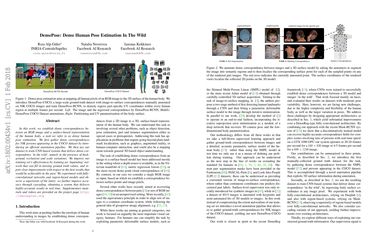
In this work, we establish dense correspondences between RGB image and a surface-based representation of the human body, a task we refer to as dense human pose estimation. We first gather dense correspondences for 50K persons appearing in the COCO dataset by introducing an efficient annotation pipeline. We then use our dataset to train CNN-based systems that deliver dense correspondence 'in the wild', namely in the presence of background, occlusions and scale variations. We improve our training set's effectiveness by training an 'inpainting' network that can fill in missing groundtruth values and report clear improvements with respect to the best results that would be achievable in the past. We experiment with fully-convolutional networks and region-based models and observe a superiority of the latter; we further improve accuracy through cascading, obtaining a system that delivers highly0accurate results in real time. Supplementary materials and videos are provided on the project page http://densepose.org
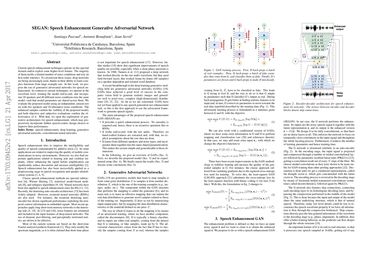
Current speech enhancement techniques operate on the spectral domain and/or exploit some higher-level feature. The majority of them tackle a limited number of noise conditions and rely on first-order statistics. To circumvent these issues, deep networks are being increasingly used, thanks to their ability to learn complex functions from large example sets. In this work, we propose the use of generative adversarial networks for speech enhancement. In contrast to current techniques, we operate at the waveform level, training the model end-to-end, and incorporate 28 speakers and 40 different noise conditions into the same model, such that model parameters are shared across them. We evaluate the proposed model using an independent, unseen test set with two speakers and 20 alternative noise conditions. The enhanced samples confirm the viability of the proposed model, and both objective and subjective evaluations confirm the effectiveness of it. With that, we open the exploration of generative architectures for speech enhancement, which may progressively incorporate further speech-centric design choices to improve their performance.
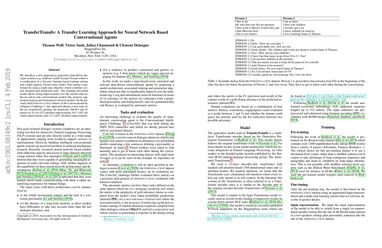
We introduce a new approach to generative data-driven dialogue systems (e.g. chatbots) called TransferTransfo which is a combination of a Transfer learning based training scheme and a high-capacity Transformer model. Fine-tuning is performed by using a multi-task objective which combines several unsupervised prediction tasks. The resulting fine-tuned model shows strong improvements over the current state-of-the-art end-to-end conversational models like memory augmented seq2seq and information-retrieval models. On the privately held PERSONA-CHAT dataset of the Conversational Intelligence Challenge 2, this approach obtains a new state-of-the-art, with respective perplexity, Hits@1 and F1 metrics of 16.28 (45 % absolute improvement), 80.7 (46 % absolute improvement) and 19.5 (20 % absolute improvement).
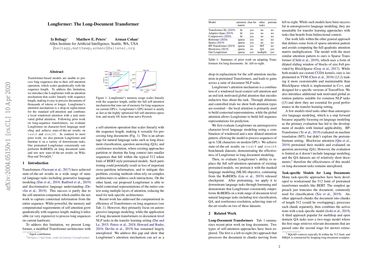
Transformer-based models are unable to process long sequences due to their self-attention operation, which scales quadratically with the sequence length. To address this limitation, we introduce the Longformer with an attention mechanism that scales linearly with sequence length, making it easy to process documents of thousands of tokens or longer. Longformer's attention mechanism is a drop-in replacement for the standard self-attention and combines a local windowed attention with a task motivated global attention. Following prior work on long-sequence transformers, we evaluate Longformer on character-level language modeling and achieve state-of-the-art results on text8 and enwik8. In contrast to most prior work, we also pretrain Longformer and finetune it on a variety of downstream tasks. Our pretrained Longformer consistently outperforms RoBERTa on long document tasks and sets new state-of-the-art results on WikiHop and TriviaQA. We finally introduce the Longformer-Encoder-Decoder (LED), a Longformer variant for supporting long document generative sequence-to-sequence tasks, and demonstrate its effectiveness on the arXiv summarization dataset.

While large-scale unsupervised language models (LMs) learn broad world knowledge and some reasoning skills, achieving precise control of their behavior is difficult due to the completely unsupervised nature of their training. Existing methods for gaining such steerability collect human labels of the relative quality of model generations and fine-tune the unsupervised LM to align with these preferences, often with reinforcement learning from human feedback (RLHF). However, RLHF is a complex and often unstable procedure, first fitting a reward model that reflects the human preferences, and then fine-tuning the large unsupervised LM using reinforcement learning to maximize this estimated reward without drifting too far from the original model. In this paper we introduce a new parameterization of the reward model in RLHF that enables extraction of the corresponding optimal policy in closed form, allowing us to solve the standard RLHF problem with only a simple classification loss. The resulting algorithm, which we call Direct Preference Optimization (DPO), is stable, performant, and computationally lightweight, eliminating the need for sampling from the LM during fine-tuning or performing significant hyperparameter tuning. Our experiments show that DPO can fine-tune LMs to align with human preferences as well as or better than existing methods. Notably, fine-tuning with DPO exceeds PPO-based RLHF in ability to control sentiment of generations, and matches or improves response quality in summarization and single-turn dialogue while being substantially simpler to implement and train.

Audio signals are sampled at high temporal resolutions, and learning to synthesize audio requires capturing structure across a range of timescales. Generative adversarial networks (GANs) have seen wide success at generating images that are both locally and globally coherent, but they have seen little application to audio generation. In this paper we introduce WaveGAN, a first attempt at applying GANs to unsupervised synthesis of raw-waveform audio. WaveGAN is capable of synthesizing one second slices of audio waveforms with global coherence, suitable for sound effect generation. Our experiments demonstrate that, without labels, WaveGAN learns to produce intelligible words when trained on a small-vocabulary speech dataset, and can also synthesize audio from other domains such as drums, bird vocalizations, and piano. We compare WaveGAN to a method which applies GANs designed for image generation on image-like audio feature representations, finding both approaches to be promising.
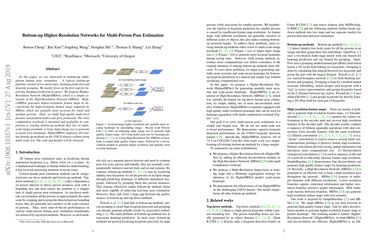
Bottom-up human pose estimation methods have difficulties in predicting the correct pose for small persons due to challenges in scale variation. In this paper, we present HigherHRNet: a novel bottom-up human pose estimation method for learning scale-aware representations using high-resolution feature pyramids. Equipped with multi-resolution supervision for training and multi-resolution aggregation for inference, the proposed approach is able to solve the scale variation challenge in bottom-up multi-person pose estimation and localize keypoints more precisely, especially for small person. The feature pyramid in HigherHRNet consists of feature map outputs from HRNet and upsampled higher-resolution outputs through a transposed convolution. HigherHRNet outperforms the previous best bottom-up method by 2.5% AP for medium person on COCO test-dev, showing its effectiveness in handling scale variation. Furthermore, HigherHRNet achieves new state-of-the-art result on COCO test-dev (70.5% AP) without using refinement or other post-processing techniques, surpassing all existing bottom-up methods. HigherHRNet even surpasses all top-down methods on CrowdPose test (67.6% AP), suggesting its robustness in crowded scene. The code and models are available at https://github.com/HRNet/Higher-HRNet-Human-Pose-Estimation.

Point clouds provide a flexible geometric representation suitable for countless applications in computer graphics; they also comprise the raw output of most 3D data acquisition devices. While hand-designed features on point clouds have long been proposed in graphics and vision, however, the recent overwhelming success of convolutional neural networks (CNNs) for image analysis suggests the value of adapting insight from CNN to the point cloud world. Point clouds inherently lack topological information so designing a model to recover topology can enrich the representation power of point clouds. To this end, we propose a new neural network module dubbed EdgeConv suitable for CNN-based high-level tasks on point clouds including classification and segmentation. EdgeConv acts on graphs dynamically computed in each layer of the network. It is differentiable and can be plugged into existing architectures. Compared to existing modules operating in extrinsic space or treating each point independently, EdgeConv has several appealing properties: It incorporates local neighborhood information; it can be stacked applied to learn global shape properties; and in multi-layer systems affinity in feature space captures semantic characteristics over potentially long distances in the original embedding. We show the performance of our model on standard benchmarks including ModelNet40, ShapeNetPart, and S3DIS.