
分享
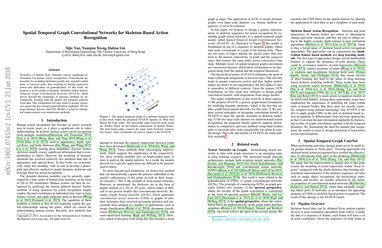
Dynamics of human body skeletons convey significant information for human action recognition. Conventional approaches for modeling skeletons usually rely on hand-crafted parts or traversal rules, thus resulting in limited expressive power and difficulties of generalization. In this work, we propose a novel model of dynamic skeletons called Spatial-Temporal Graph Convolutional Networks (ST-GCN), which moves beyond the limitations of previous methods by automatically learning both the spatial and temporal patterns from data. This formulation not only leads to greater expressive power but also stronger generalization capability. On two large datasets, Kinetics and NTU-RGBD, it achieves substantial improvements over mainstream methods.
With the capability of modeling bidirectional contexts, denoising autoencoding based pretraining like BERT achieves better performance than pretraining approaches based on autoregressive language modeling. However, relying on corrupting the input with masks, BERT neglects dependency between the masked positions and suffers from a pretrain-finetune discrepancy. In light of these pros and cons, we propose XLNet, a generalized autoregressive pretraining method that (1) enables learning bidirectional contexts by maximizing the expected likelihood over all permutations of the factorization order and (2) overcomes the limitations of BERT thanks to its autoregressive formulation. Furthermore, XLNet integrates ideas from Transformer-XL, the state-of-the-art autoregressive model, into pretraining. Empirically, under comparable experiment settings, XLNet outperforms BERT on 20 tasks, often by a large margin, including question answering, natural language inference, sentiment analysis, and document ranking.
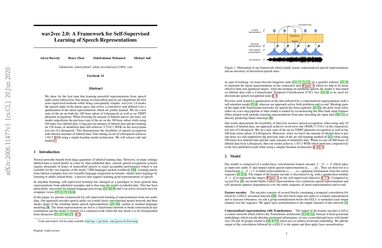
We show for the first time that learning powerful representations from speech audio alone followed by fine-tuning on transcribed speech can outperform the best semi-supervised methods while being conceptually simpler. wav2vec 2.0 masks the speech input in the latent space and solves a contrastive task defined over a quantization of the latent representations which are jointly learned. Experiments using all labeled data of Librispeech achieve 1.8/3.3 WER on the clean/other test sets. When lowering the amount of labeled data to one hour, wav2vec 2.0 outperforms the previous state of the art on the 100 hour subset while using 100 times less labeled data. Using just ten minutes of labeled data and pre-training on 53k hours of unlabeled data still achieves 4.8/8.2 WER. This demonstrates the feasibility of speech recognition with limited amounts of labeled data.
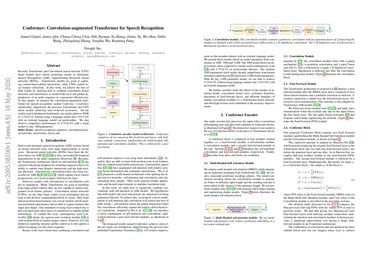
Recently Transformer and Convolution neural network (CNN) based models have shown promising results in Automatic Speech Recognition (ASR), outperforming Recurrent neural networks (RNNs). Transformer models are good at capturing content-based global interactions, while CNNs exploit local features effectively. In this work, we achieve the best of both worlds by studying how to combine convolution neural networks and transformers to model both local and global dependencies of an audio sequence in a parameter-efficient way. To this regard, we propose the convolution-augmented transformer for speech recognition, named Conformer. Conformer significantly outperforms the previous Transformer and CNN based models achieving state-of-the-art accuracies. On the widely used LibriSpeech benchmark, our model achieves WER of 2.1%/4.3% without using a language model and 1.9%/3.9% with an external language model on test/testother. We also observe competitive performance of 2.7%/6.3% with a small model of only 10M parameters.
Self-attention networks have revolutionized natural language processing and are making impressive strides in image analysis tasks such as image classification and object detection. Inspired by this success, we investigate the application of self-attention networks to 3D point cloud processing. We design self-attention layers for point clouds and use these to construct self-attention networks for tasks such as semantic scene segmentation, object part segmentation, and object classification. Our Point Transformer design improves upon prior work across domains and tasks. For example, on the challenging S3DIS dataset for large-scale semantic scene segmentation, the Point Transformer attains an mIoU of 70.4% on Area 5, outperforming the strongest prior model by 3.3 absolute percentage points and crossing the 70% mIoU threshold for the first time.

Neural sequence models are widely used to model time-series data. Equally ubiquitous is the usage of beam search (BS) as an approximate inference algorithm to decode output sequences from these models. BS explores the search space in a greedy left-right fashion retaining only the top-B candidates - resulting in sequences that differ only slightly from each other. Producing lists of nearly identical sequences is not only computationally wasteful but also typically fails to capture the inherent ambiguity of complex AI tasks. To overcome this problem, we propose Diverse Beam Search (DBS), an alternative to BS that decodes a list of diverse outputs by optimizing for a diversity-augmented objective. We observe that our method finds better top-1 solutions by controlling for the exploration and exploitation of the search space - implying that DBS is a better search algorithm. Moreover, these gains are achieved with minimal computational or memory over- head as compared to beam search. To demonstrate the broad applicability of our method, we present results on image captioning, machine translation and visual question generation using both standard quantitative metrics and qualitative human studies. Further, we study the role of diversity for image-grounded language generation tasks as the complexity of the image changes. We observe that our method consistently outperforms BS and previously proposed techniques for diverse decoding from neural sequence models.
We present a state-of-the-art speech recognition system developed using end-to-end deep learning. Our architecture is significantly simpler than traditional speech systems, which rely on laboriously engineered processing pipelines; these traditional systems also tend to perform poorly when used in noisy environments. In contrast, our system does not need hand-designed components to model background noise, reverberation, or speaker variation, but instead directly learns a function that is robust to such effects. We do not need a phoneme dictionary, nor even the concept of a "phoneme." Key to our approach is a well-optimized RNN training system that uses multiple GPUs, as well as a set of novel data synthesis techniques that allow us to efficiently obtain a large amount of varied data for training. Our system, called Deep Speech, outperforms previously published results on the widely studied Switchboard Hub5'00, achieving 16.0% error on the full test set. Deep Speech also handles challenging noisy environments better than widely used, state-of-the-art commercial speech systems.
The learning rate warmup heuristic achieves remarkable success in stabilizing training, accelerating convergence and improving generalization for adaptive stochastic optimization algorithms like RMSprop and Adam. Here, we study its mechanism in details. Pursuing the theory behind warmup, we identify a problem of the adaptive learning rate (i.e., it has problematically large variance in the early stage), suggest warmup works as a variance reduction technique, and provide both empirical and theoretical evidence to verify our hypothesis. We further propose RAdam, a new variant of Adam, by introducing a term to rectify the variance of the adaptive learning rate. Extensive experimental results on image classification, language modeling, and neural machine translation verify our intuition and demonstrate the effectiveness and robustness of our proposed method. All implementations are available at: https://github.com/LiyuanLucasLiu/RAdam.

Convolutional neural networks (CNNs) have achieved great successes in many computer vision problems. Unlike existing works that designed CNN architectures to improve performance on a single task of a single domain and not generalizable, we present IBN-Net, a novel convolutional architecture, which remarkably enhances a CNN's modeling ability on one domain (e.g. Cityscapes) as well as its generalization capacity on another domain (e.g. GTA5) without finetuning. IBN-Net carefully integrates Instance Normalization (IN) and Batch Normalization (BN) as building blocks, and can be wrapped into many advanced deep networks to improve their performances. This work has three key contributions. (1) By delving into IN and BN, we disclose that IN learns features that are invariant to appearance changes, such as colors, styles, and virtuality/reality, while BN is essential for preserving content related information. (2) IBN-Net can be applied to many advanced deep architectures, such as DenseNet, ResNet, ResNeXt, and SENet, and consistently improve their performance without increasing computational cost. (3) When applying the trained networks to new domains, e.g. from GTA5 to Cityscapes, IBN-Net achieves comparable improvements as domain adaptation methods, even without using data from the target domain. With IBN-Net, we won the 1st place on the WAD 2018 Challenge Drivable Area track, with an mIoU of 86.18%.
Neural network based end-to-end text to speech (TTS) has significantly improved the quality of synthesized speech. Prominent methods (e.g., Tacotron 2) usually first generate mel-spectrogram from text, and then synthesize speech from the mel-spectrogram using vocoder such as WaveNet. Compared with traditional concatenative and statistical parametric approaches, neural network based end-to-end models suffer from slow inference speed, and the synthesized speech is usually not robust (i.e., some words are skipped or repeated) and lack of controllability (voice speed or prosody control). In this work, we propose a novel feed-forward network based on Transformer to generate mel-spectrogram in parallel for TTS. Specifically, we extract attention alignments from an encoder-decoder based teacher model for phoneme duration prediction, which is used by a length regulator to expand the source phoneme sequence to match the length of the target mel-spectrogram sequence for parallel mel-spectrogram generation. Experiments on the LJSpeech dataset show that our parallel model matches autoregressive models in terms of speech quality, nearly eliminates the problem of word skipping and repeating in particularly hard cases, and can adjust voice speed smoothly. Most importantly, compared with autoregressive Transformer TTS, our model speeds up mel-spectrogram generation by 270x and the end-to-end speech synthesis by 38x. Therefore, we call our model FastSpeech.
Previous works (Donahue et al., 2018a; Engel et al., 2019a) have found that generating coherent raw audio waveforms with GANs is challenging. In this paper, we show that it is possible to train GANs reliably to generate high quality coherent waveforms by introducing a set of architectural changes and simple training techniques. Subjective evaluation metric (Mean Opinion Score, or MOS) shows the effectiveness of the proposed approach for high quality mel-spectrogram inversion. To establish the generality of the proposed techniques, we show qualitative results of our model in speech synthesis, music domain translation and unconditional music synthesis. We evaluate the various components of the model through ablation studies and suggest a set of guidelines to design general purpose discriminators and generators for conditional sequence synthesis tasks. Our model is non-autoregressive, fully convolutional, with significantly fewer parameters than competing models and generalizes to unseen speakers for mel-spectrogram inversion. Our pytorch implementation runs at more than 100x faster than realtime on GTX 1080Ti GPU and more than 2x faster than real-time on CPU, without any hardware specific optimization tricks.
Recent work has demonstrated that increased training dataset diversity improves general cross-domain knowledge and downstream generalization capability for large-scale language models. With this in mind, we present \textit{the Pile}: an 825 GiB English text corpus targeted at training large-scale language models. The Pile is constructed from 22 diverse high-quality subsets -- both existing and newly constructed -- many of which derive from academic or professional sources. Our evaluation of the untuned performance of GPT-2 and GPT-3 on the Pile shows that these models struggle on many of its components, such as academic writing. Conversely, models trained on the Pile improve significantly over both Raw CC and CC-100 on all components of the Pile, while improving performance on downstream evaluations. Through an in-depth exploratory analysis, we document potentially concerning aspects of the data for prospective users. We make publicly available the code used in its construction.