
分享
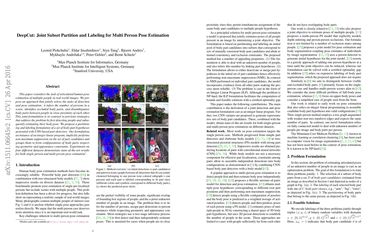
This paper considers the task of articulated human pose estimation of multiple people in real world images. We propose an approach that jointly solves the tasks of detection and pose estimation: it infers the number of persons in a scene, identifies occluded body parts, and disambiguates body parts between people in close proximity of each other. This joint formulation is in contrast to previous strategies, that address the problem by first detecting people and subsequently estimating their body pose. We propose a partitioning and labeling formulation of a set of body-part hypotheses generated with CNN-based part detectors. Our formulation, an instance of an integer linear program, implicitly performs non-maximum suppression on the set of part candidates and groups them to form configurations of body parts respecting geometric and appearance constraints. Experiments on four different datasets demonstrate state-of-the-art results for both single person and multi person pose estimation. Models and code available at http://pose.mpi-inf.mpg.de.
Emotion cause extraction (ECE), the task aimed at extracting the potential causes behind certain emotions in text, has gained much attention in recent years due to its wide applications. However, it suffers from two shortcomings: 1) the emotion must be annotated before cause extraction in ECE, which greatly limits its applications in real-world scenarios; 2) the way to first annotate emotion and then extract the cause ignores the fact that they are mutually indicative. In this work, we propose a new task: emotion-cause pair extraction (ECPE), which aims to extract the potential pairs of emotions and corresponding causes in a document. We propose a 2-step approach to address this new ECPE task, which first performs individual emotion extraction and cause extraction via multi-task learning, and then conduct emotion-cause pairing and filtering. The experimental results on a benchmark emotion cause corpus prove the feasibility of the ECPE task as well as the effectiveness of our approach.
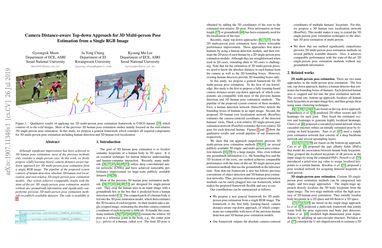
Although significant improvement has been achieved recently in 3D human pose estimation, most of the previous methods only treat a single-person case. In this work, we firstly propose a fully learning-based, camera distance-aware top-down approach for 3D multi-person pose estimation from a single RGB image. The pipeline of the proposed system consists of human detection, absolute 3D human root localization, and root-relative 3D single-person pose estimation modules. Our system achieves comparable results with the state-of-the-art 3D single-person pose estimation models without any groundtruth information and significantly outperforms previous 3D multi-person pose estimation methods on publicly available datasets. The code is available in https://github.com/mks0601/3DMPPE_ROOTNET_RELEASE , https://github.com/mks0601/3DMPPE_POSENET_RELEASE.
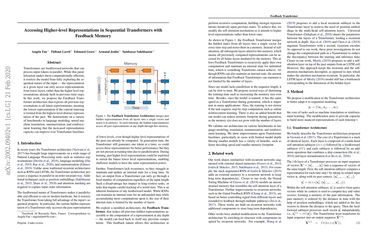
Transformers have been successfully applied to sequential, auto-regressive tasks despite being feedforward networks. Unlike recurrent neural networks, Transformers use attention to capture temporal relations while processing input tokens in parallel. While this parallelization makes them computationally efficient, it restricts the model from fully exploiting the sequential nature of the input. The representation at a given layer can only access representations from lower layers, rather than the higher level representations already available. In this work, we propose the Feedback Transformer architecture that exposes all previous representations to all future representations, meaning the lowest representation of the current timestep is formed from the highest-level abstract representation of the past. We demonstrate on a variety of benchmarks in language modeling, machine translation, and reinforcement learning that the increased representation capacity can create small, shallow models with much stronger performance than comparable Transformers.

Any-to-any voice conversion (VC) aims to convert the timbre of utterances from and to any speakers seen or unseen during training. Various any-to-any VC approaches have been proposed like AUTOVC, AdaINVC, and FragmentVC. AUTOVC, and AdaINVC utilize source and target encoders to disentangle the content and speaker information of the features. FragmentVC utilizes two encoders to encode source and target information and adopts cross attention to align the source and target features with similar phonetic content. Moreover, pre-trained features are adopted. AUTOVC used dvector to extract speaker information, and self-supervised learning (SSL) features like wav2vec 2.0 is used in FragmentVC to extract the phonetic content information. Different from previous works, we proposed S2VC that utilizes Self-Supervised features as both source and target features for VC model. Supervised phoneme posteriororgram (PPG), which is believed to be speaker-independent and widely used in VC to extract content information, is chosen as a strong baseline for SSL features. The objective evaluation and subjective evaluation both show models taking SSL feature CPC as both source and target features outperforms that taking PPG as source feature, suggesting that SSL features have great potential in improving VC.
Large-scale pre-trained language models have contributed significantly to natural language processing by demonstrating remarkable abilities as few-shot learners. However, their effectiveness depends mainly on scaling the model parameters and prompt design, hindering their implementation in most real-world applications. This study proposes a novel pluggable, extensible, and efficient approach named DifferentiAble pRompT (DART), which can convert small language models into better few-shot learners without any prompt engineering. The main principle behind this approach involves reformulating potential natural language processing tasks into the task of a pre-trained language model and differentially optimizing the prompt template as well as the target label with backpropagation. Furthermore, the proposed approach can be: (i) Plugged to any pre-trained language models; (ii) Extended to widespread classification tasks. A comprehensive evaluation of standard NLP tasks demonstrates that the proposed approach achieves a better few-shot performance. Code is available in https://github.com/zjunlp/DART.

This paper highlights the importance of personalization in large language models and introduces the LaMP benchmark -- a novel benchmark for training and evaluating language models for producing personalized outputs. LaMP offers a comprehensive evaluation framework with diverse language tasks and multiple entries for each user profile. It consists of seven personalized tasks, spanning three text classification and four text generation tasks. We additionally propose two retrieval augmentation approaches that retrieve personal items from each user profile for personalizing language model outputs. To this aim, we study various retrieval models, including term matching, semantic matching, and time-aware methods. Extensive experiments on LaMP for zero-shot and fine-tuned language models demonstrate the efficacy of the proposed retrieval augmentation approach and highlight the impact of personalization in various natural language tasks.

GPT-3.5 and GPT-4 are the two most widely used large language model (LLM) services. However, when and how these models are updated over time is opaque. Here, we evaluate the March 2023 and June 2023 versions of GPT-3.5 and GPT-4 on several diverse tasks: 1) math problems, 2) sensitive/dangerous questions, 3) opinion surveys, 4) multi-hop knowledge-intensive questions, 5) generating code, 6) US Medical License tests, and 7) visual reasoning. We find that the performance and behavior of both GPT-3.5 and GPT-4 can vary greatly over time. For example, GPT-4 (March 2023) was reasonable at identifying prime vs. composite numbers (84% accuracy) but GPT-4 (June 2023) was poor on these same questions (51% accuracy). This is partly explained by a drop in GPT-4's amenity to follow chain-of-thought prompting. Interestingly, GPT-3.5 was much better in June than in March in this task. GPT-4 became less willing to answer sensitive questions and opinion survey questions in June than in March. GPT-4 performed better at multi-hop questions in June than in March, while GPT-3.5's performance dropped on this task. Both GPT-4 and GPT-3.5 had more formatting mistakes in code generation in June than in March. We provide evidence that GPT-4's ability to follow user instructions has decreased over time, which is one common factor behind the many behavior drifts. Overall, our findings show that the behavior of the "same" LLM service can change substantially in a relatively short amount of time, highlighting the need for continuous monitoring of LLMs.

The softmax (also called softargmax) function is widely used in machine learning models to normalize real-valued scores into a probability distribution. To avoid floating-point overflow, the softmax function is conventionally implemented in three passes: the first pass to compute the normalization constant, and two other passes to compute outputs from normalized inputs. We analyze two variants of the Three-Pass algorithm and demonstrate that in a well-optimized implementation on HPC-class processors performance of all three passes is limited by memory bandwidth. We then present a novel algorithm for softmax computation in just two passes. The proposed Two-Pass algorithm avoids both numerical overflow and the extra normalization pass by employing an exotic representation for intermediate values, where each value is represented as a pair of floating-point numbers: one representing the "mantissa" and another representing the "exponent". Performance evaluation demonstrates that on out-of-cache inputs on an Intel Skylake-X processor the new Two-Pass algorithm outperforms the traditional Three-Pass algorithm by up to 28% in AVX512 implementation, and by up to 18% in AVX2 implementation. The proposed Two-Pass algorithm also outperforms the traditional Three-Pass algorithm on Intel Broadwell and AMD Zen 2 processors. To foster reproducibility, we released an open-source implementation of the new Two-Pass Softmax algorithm and other experiments in this paper as a part of XNNPACK library at GitHub.com/google/XNNPACK.

As mathematical computing becomes more democratized in high-level languages, high-performance symbolic-numeric systems are necessary for domain scientists and engineers to get the best performance out of their machine without deep knowledge of code optimization. Naturally, users need different term types either to have different algebraic properties for them, or to use efficient data structures. To this end, we developed Symbolics.jl, an extendable symbolic system which uses dynamic multiple dispatch to change behavior depending on the domain needs. In this work we detail an underlying abstract term interface which allows for speed without sacrificing generality. We show that by formalizing a generic API on actions independent of implementation, we can retroactively add optimized data structures to our system without changing the pre-existing term rewriters. We showcase how this can be used to optimize term construction and give a 113x acceleration on general symbolic transformations. Further, we show that such a generic API allows for complementary term-rewriting implementations. We demonstrate the ability to swap between classical term-rewriting simplifiers and e-graph-based term-rewriting simplifiers. We showcase an e-graph ruleset which minimizes the number of CPU cycles during expression evaluation, and demonstrate how it simplifies a real-world reaction-network simulation to halve the runtime. Additionally, we show a reaction-diffusion partial differential equation solver which is able to be automatically converted into symbolic expressions via multiple dispatch tracing, which is subsequently accelerated and parallelized to give a 157x simulation speedup. Together, this presents Symbolics.jl as a next-generation symbolic-numeric computing environment geared towards modeling and simulation.

Text-to-audio (TTA) system has recently gained attention for its ability to synthesize general audio based on text descriptions. However, previous studies in TTA have limited generation quality with high computational costs. In this study, we propose AudioLDM, a TTA system that is built on a latent space to learn the continuous audio representations from contrastive language-audio pretraining (CLAP) latents. The pretrained CLAP models enable us to train LDMs with audio embedding while providing text embedding as a condition during sampling. By learning the latent representations of audio signals and their compositions without modeling the cross-modal relationship, AudioLDM is advantageous in both generation quality and computational efficiency. Trained on AudioCaps with a single GPU, AudioLDM achieves state-of-the-art TTA performance measured by both objective and subjective metrics (e.g., frechet distance). Moreover, AudioLDM is the first TTA system that enables various text-guided audio manipulations (e.g., style transfer) in a zero-shot fashion. Our implementation and demos are available at https://audioldm.github.io.

Click-through rate (CTR) prediction is one of the fundamental tasks for online advertising and recommendation. While multi-layer perceptron (MLP) serves as a core component in many deep CTR prediction models, it has been widely recognized that applying a vanilla MLP network alone is inefficient in learning multiplicative feature interactions. As such, many two-stream interaction models (e.g., DeepFM and DCN) have been proposed by integrating an MLP network with another dedicated network for enhanced CTR prediction. As the MLP stream learns feature interactions implicitly, existing research focuses mainly on enhancing explicit feature interactions in the complementary stream. In contrast, our empirical study shows that a well-tuned two-stream MLP model that simply combines two MLPs can even achieve surprisingly good performance, which has never been reported before by existing work. Based on this observation, we further propose feature gating and interaction aggregation layers that can be easily plugged to make an enhanced two-stream MLP model, FinalMLP. In this way, it not only enables differentiated feature inputs but also effectively fuses stream-level interactions across two streams. Our evaluation results on four open benchmark datasets as well as an online A/B test in our industrial system show that FinalMLP achieves better performance than many sophisticated two-stream CTR models. Our source code will be available at MindSpore/models.