
分享
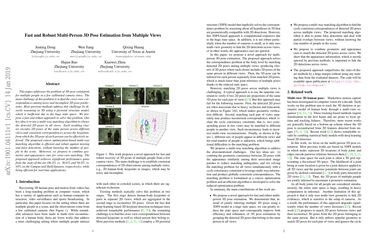
This paper addresses the problem of 3D pose estimation for multiple people in a few calibrated camera views. The main challenge of this problem is to find the cross-view correspondences among noisy and incomplete 2D pose predictions. Most previous methods address this challenge by directly reasoning in 3D using a pictorial structure model, which is inefficient due to the huge state space. We propose a fast and robust approach to solve this problem. Our key idea is to use a multi-way matching algorithm to cluster the detected 2D poses in all views. Each resulting cluster encodes 2D poses of the same person across different views and consistent correspondences across the keypoints, from which the 3D pose of each person can be effectively inferred. The proposed convex optimization based multi-way matching algorithm is efficient and robust against missing and false detections, without knowing the number of people in the scene. Moreover, we propose to combine geometric and appearance cues for cross-view matching. The proposed approach achieves significant performance gains from the state-of-the-art (96.3% vs. 90.6% and 96.9% vs. 88% on the Campus and Shelf datasets, respectively), while being efficient for real-time applications.
Financial sentiment analysis is a challenging task due to the specialized language and lack of labeled data in that domain. General-purpose models are not effective enough because of the specialized language used in a financial context. We hypothesize that pre-trained language models can help with this problem because they require fewer labeled examples and they can be further trained on domain-specific corpora. We introduce FinBERT, a language model based on BERT, to tackle NLP tasks in the financial domain. Our results show improvement in every measured metric on current state-of-the-art results for two financial sentiment analysis datasets. We find that even with a smaller training set and fine-tuning only a part of the model, FinBERT outperforms state-of-the-art machine learning methods.
While large language models a la BERT are used ubiquitously in NLP, pretraining them is considered a luxury that only a few well-funded industry labs can afford. How can one train such models with a more modest budget? We present a recipe for pretraining a masked language model in 24 hours using a single low-end deep learning server. We demonstrate that through a combination of software optimizations, design choices, and hyperparameter tuning, it is possible to produce models that are competitive with BERT-base on GLUE tasks at a fraction of the original pretraining cost.
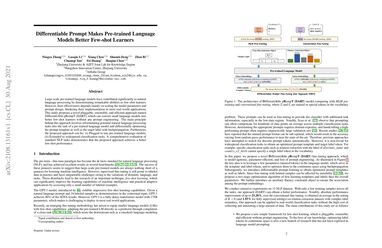
Large-scale pre-trained language models have contributed significantly to natural language processing by demonstrating remarkable abilities as few-shot learners. However, their effectiveness depends mainly on scaling the model parameters and prompt design, hindering their implementation in most real-world applications. This study proposes a novel pluggable, extensible, and efficient approach named DifferentiAble pRompT (DART), which can convert small language models into better few-shot learners without any prompt engineering. The main principle behind this approach involves reformulating potential natural language processing tasks into the task of a pre-trained language model and differentially optimizing the prompt template as well as the target label with backpropagation. Furthermore, the proposed approach can be: (i) Plugged to any pre-trained language models; (ii) Extended to widespread classification tasks. A comprehensive evaluation of standard NLP tasks demonstrates that the proposed approach achieves a better few-shot performance. Code is available in https://github.com/zjunlp/DART.
Self-supervised learning (SSL) is a long-standing goal for speech processing, since it utilizes large-scale unlabeled data and avoids extensive human labeling. Recent years witness great successes in applying self-supervised learning in speech recognition, while limited exploration was attempted in applying SSL for modeling speaker characteristics. In this paper, we aim to improve the existing SSL framework for speaker representation learning. Two methods are introduced for enhancing the unsupervised speaker information extraction. First, we apply the multi-task learning to the current SSL framework, where we integrate the utterance-wise contrastive loss with the SSL objective function. Second, for better speaker discrimination, we propose an utterance mixing strategy for data augmentation, where additional overlapped utterances are created unsupervisely and incorporate during training. We integrate the proposed methods into the HuBERT framework. Experiment results on SUPERB benchmark show that the proposed system achieves state-of-the-art performance in universal representation learning, especially for speaker identification oriented tasks. An ablation study is performed verifying the efficacy of each proposed method. Finally, we scale up training dataset to 94 thousand hours public audio data and achieve further performance improvement in all SUPERB tasks.
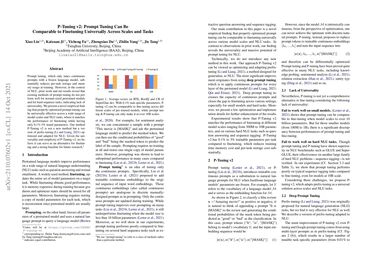
Prompt tuning, which only tunes continuous prompts with a frozen language model, substantially reduces per-task storage and memory usage at training. However, in the context of NLU, prior work reveals that prompt tuning does not perform well for normal-sized pretrained models. We also find that existing methods of prompt tuning cannot handle hard sequence labeling tasks, indicating a lack of universality. We present a novel empirical finding that properly optimized prompt tuning can be universally effective across a wide range of model scales and NLU tasks. It matches the performance of finetuning while having only 0.1%-3% tuned parameters. Our method P-Tuning v2 is an implementation of Deep Prompt Tuning \cite{li2021prefix,qin2021learning} optimized and adapted for NLU. Given the universality and simplicity of P-Tuning v2, we believe it can serve as an alternative to finetuning and a strong baseline for future research.Our code and data are released at https://github.com/THUDM/P-tuning-v2.
Recent studies have shown that multilingual pretrained language models can be effectively improved with cross-lingual alignment information from Wikipedia entities. However, existing methods only exploit entity information in pretraining and do not explicitly use entities in downstream tasks. In this study, we explore the effectiveness of leveraging entity representations for downstream cross-lingual tasks. We train a multilingual language model with 24 languages with entity representations and show the model consistently outperforms word-based pretrained models in various cross-lingual transfer tasks. We also analyze the model and the key insight is that incorporating entity representations into the input allows us to extract more language-agnostic features. We also evaluate the model with a multilingual cloze prompt task with the mLAMA dataset. We show that entity-based prompt elicits correct factual knowledge more likely than using only word representations. Our source code and pretrained models are available at https://github.com/studio-ousia/luke.

This paper highlights the importance of personalization in large language models and introduces the LaMP benchmark -- a novel benchmark for training and evaluating language models for producing personalized outputs. LaMP offers a comprehensive evaluation framework with diverse language tasks and multiple entries for each user profile. It consists of seven personalized tasks, spanning three text classification and four text generation tasks. We additionally propose two retrieval augmentation approaches that retrieve personal items from each user profile for personalizing language model outputs. To this aim, we study various retrieval models, including term matching, semantic matching, and time-aware methods. Extensive experiments on LaMP for zero-shot and fine-tuned language models demonstrate the efficacy of the proposed retrieval augmentation approach and highlight the impact of personalization in various natural language tasks.

We show that language model finetuning can be improved, sometimes dramatically, with a simple augmentation. NEFTune adds noise to the embedding vectors during training. Standard finetuning of LLaMA-2-7B using Alpaca achieves 29.79% on AlpacaEval, which rises to 64.69% using noisy embeddings. NEFTune also improves over strong baselines on modern instruction datasets. Models trained with Evol-Instruct see a 10% improvement, with ShareGPT an 8% improvement, and with OpenPlatypus an 8% improvement. Even powerful models further refined with RLHF such as LLaMA-2-Chat benefit from additional training with NEFTune.

Entity type tagging is the task of assigning category labels to each mention of an entity in a document. While standard systems focus on a small set of types, recent work (Ling and Weld, 2012) suggests that using a large fine-grained label set can lead to dramatic improvements in downstream tasks. In the absence of labeled training data, existing fine-grained tagging systems obtain examples automatically, using resolved entities and their types extracted from a knowledge base. However, since the appropriate type often depends on context (e.g. Washington could be tagged either as city or government), this procedure can result in spurious labels, leading to poorer generalization. We propose the task of context-dependent fine type tagging, where the set of acceptable labels for a mention is restricted to only those deducible from the local context (e.g. sentence or document). We introduce new resources for this task: 12,017 mentions annotated with their context-dependent fine types, and we provide baseline experimental results on this data.

We introduce Texar, an open-source toolkit aiming to support the broad set of text generation tasks that transform any inputs into natural language, such as machine translation, summarization, dialog, content manipulation, and so forth. With the design goals of modularity, versatility, and extensibility in mind, Texar extracts common patterns underlying the diverse tasks and methodologies, creates a library of highly reusable modules, and allows arbitrary model architectures and algorithmic paradigms. In Texar, model architecture, inference, and learning processes are properly decomposed. Modules at a high concept level can be freely assembled and plugged in/swapped out. The toolkit also supports a rich set of large-scale pretrained models. Texar is thus particularly suitable for researchers and practitioners to do fast prototyping and experimentation. The versatile toolkit also fosters technique sharing across different text generation tasks. Texar supports both TensorFlow and PyTorch, and is released under Apache License 2.0 at https://www.texar.io.

Click-through rate (CTR) prediction is one of the fundamental tasks for online advertising and recommendation. While multi-layer perceptron (MLP) serves as a core component in many deep CTR prediction models, it has been widely recognized that applying a vanilla MLP network alone is inefficient in learning multiplicative feature interactions. As such, many two-stream interaction models (e.g., DeepFM and DCN) have been proposed by integrating an MLP network with another dedicated network for enhanced CTR prediction. As the MLP stream learns feature interactions implicitly, existing research focuses mainly on enhancing explicit feature interactions in the complementary stream. In contrast, our empirical study shows that a well-tuned two-stream MLP model that simply combines two MLPs can even achieve surprisingly good performance, which has never been reported before by existing work. Based on this observation, we further propose feature gating and interaction aggregation layers that can be easily plugged to make an enhanced two-stream MLP model, FinalMLP. In this way, it not only enables differentiated feature inputs but also effectively fuses stream-level interactions across two streams. Our evaluation results on four open benchmark datasets as well as an online A/B test in our industrial system show that FinalMLP achieves better performance than many sophisticated two-stream CTR models. Our source code will be available at MindSpore/models.