
分享
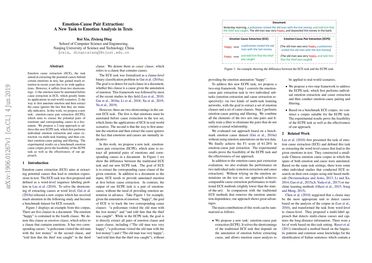
Emotion cause extraction (ECE), the task aimed at extracting the potential causes behind certain emotions in text, has gained much attention in recent years due to its wide applications. However, it suffers from two shortcomings: 1) the emotion must be annotated before cause extraction in ECE, which greatly limits its applications in real-world scenarios; 2) the way to first annotate emotion and then extract the cause ignores the fact that they are mutually indicative. In this work, we propose a new task: emotion-cause pair extraction (ECPE), which aims to extract the potential pairs of emotions and corresponding causes in a document. We propose a 2-step approach to address this new ECPE task, which first performs individual emotion extraction and cause extraction via multi-task learning, and then conduct emotion-cause pairing and filtering. The experimental results on a benchmark emotion cause corpus prove the feasibility of the ECPE task as well as the effectiveness of our approach.
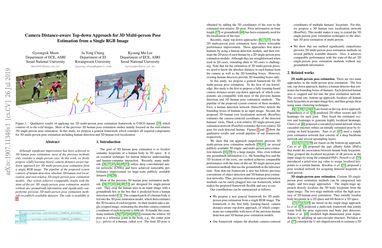
Although significant improvement has been achieved recently in 3D human pose estimation, most of the previous methods only treat a single-person case. In this work, we firstly propose a fully learning-based, camera distance-aware top-down approach for 3D multi-person pose estimation from a single RGB image. The pipeline of the proposed system consists of human detection, absolute 3D human root localization, and root-relative 3D single-person pose estimation modules. Our system achieves comparable results with the state-of-the-art 3D single-person pose estimation models without any groundtruth information and significantly outperforms previous 3D multi-person pose estimation methods on publicly available datasets. The code is available in https://github.com/mks0601/3DMPPE_ROOTNET_RELEASE , https://github.com/mks0601/3DMPPE_POSENET_RELEASE.

Any-to-any voice conversion (VC) aims to convert the timbre of utterances from and to any speakers seen or unseen during training. Various any-to-any VC approaches have been proposed like AUTOVC, AdaINVC, and FragmentVC. AUTOVC, and AdaINVC utilize source and target encoders to disentangle the content and speaker information of the features. FragmentVC utilizes two encoders to encode source and target information and adopts cross attention to align the source and target features with similar phonetic content. Moreover, pre-trained features are adopted. AUTOVC used dvector to extract speaker information, and self-supervised learning (SSL) features like wav2vec 2.0 is used in FragmentVC to extract the phonetic content information. Different from previous works, we proposed S2VC that utilizes Self-Supervised features as both source and target features for VC model. Supervised phoneme posteriororgram (PPG), which is believed to be speaker-independent and widely used in VC to extract content information, is chosen as a strong baseline for SSL features. The objective evaluation and subjective evaluation both show models taking SSL feature CPC as both source and target features outperforms that taking PPG as source feature, suggesting that SSL features have great potential in improving VC.
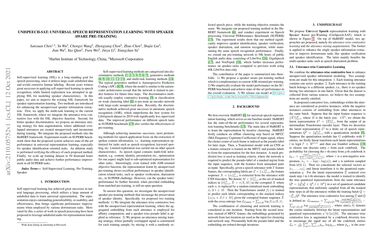
Self-supervised learning (SSL) is a long-standing goal for speech processing, since it utilizes large-scale unlabeled data and avoids extensive human labeling. Recent years witness great successes in applying self-supervised learning in speech recognition, while limited exploration was attempted in applying SSL for modeling speaker characteristics. In this paper, we aim to improve the existing SSL framework for speaker representation learning. Two methods are introduced for enhancing the unsupervised speaker information extraction. First, we apply the multi-task learning to the current SSL framework, where we integrate the utterance-wise contrastive loss with the SSL objective function. Second, for better speaker discrimination, we propose an utterance mixing strategy for data augmentation, where additional overlapped utterances are created unsupervisely and incorporate during training. We integrate the proposed methods into the HuBERT framework. Experiment results on SUPERB benchmark show that the proposed system achieves state-of-the-art performance in universal representation learning, especially for speaker identification oriented tasks. An ablation study is performed verifying the efficacy of each proposed method. Finally, we scale up training dataset to 94 thousand hours public audio data and achieve further performance improvement in all SUPERB tasks.
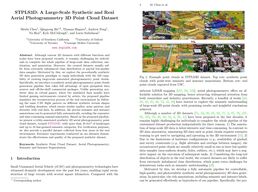
Although various 3D datasets with different functions and scales have been proposed recently, it remains challenging for individuals to complete the whole pipeline of large-scale data collection, sanitization, and annotation. Moreover, the created datasets usually suffer from extremely imbalanced class distribution or partial low-quality data samples. Motivated by this, we explore the procedurally synthetic 3D data generation paradigm to equip individuals with the full capability of creating large-scale annotated photogrammetry point clouds. Specifically, we introduce a synthetic aerial photogrammetry point clouds generation pipeline that takes full advantage of open geospatial data sources and off-the-shelf commercial packages. Unlike generating synthetic data in virtual games, where the simulated data usually have limited gaming environments created by artists, the proposed pipeline simulates the reconstruction process of the real environment by following the same UAV flight pattern on different synthetic terrain shapes and building densities, which ensure similar quality, noise pattern, and diversity with real data. In addition, the precise semantic and instance annotations can be generated fully automatically, avoiding the expensive and time-consuming manual annotation. Based on the proposed pipeline, we present a richly-annotated synthetic 3D aerial photogrammetry point cloud dataset, termed STPLS3D, with more than 16 $km^2$ of landscapes and up to 18 fine-grained semantic categories. For verification purposes, we also provide a parallel dataset collected from four areas in the real environment. Extensive experiments conducted on our datasets demonstrate the effectiveness and quality of the proposed synthetic dataset.

How do large language models (LLMs) develop and evolve over the course of training? How do these patterns change as models scale? To answer these questions, we introduce \textit{Pythia}, a suite of 16 LLMs all trained on public data seen in the exact same order and ranging in size from 70M to 12B parameters. We provide public access to 154 checkpoints for each one of the 16 models, alongside tools to download and reconstruct their exact training dataloaders for further study. We intend \textit{Pythia} to facilitate research in many areas, and we present several case studies including novel results in memorization, term frequency effects on few-shot performance, and reducing gender bias. We demonstrate that this highly controlled setup can be used to yield novel insights toward LLMs and their training dynamics. Trained models, analysis code, training code, and training data can be found at \url{https://github.com/EleutherAI/pythia}.

We introduce CogVLM, a powerful open-source visual language foundation model. Different from the popular shallow alignment method which maps image features into the input space of language model, CogVLM bridges the gap between the frozen pretrained language model and image encoder by a trainable visual expert module in the attention and FFN layers. As a result, CogVLM enables deep fusion of vision language features without sacrificing any performance on NLP tasks. CogVLM-17B achieves state-of-the-art performance on 10 classic cross-modal benchmarks, including NoCaps, Flicker30k captioning, RefCOCO, RefCOCO+, RefCOCOg, Visual7W, GQA, ScienceQA, VizWiz VQA and TDIUC, and ranks the 2nd on VQAv2, OKVQA, TextVQA, COCO captioning, etc., surpassing or matching PaLI-X 55B. Codes and checkpoints are available at https://github.com/THUDM/CogVLM.

Quality product descriptions are critical for providing competitive customer experience in an e-commerce platform. An accurate and attractive description not only helps customers make an informed decision but also improves the likelihood of purchase. However, crafting a successful product description is tedious and highly time-consuming. Due to its importance, automating the product description generation has attracted considerable interests from both research and industrial communities. Existing methods mainly use templates or statistical methods, and their performance could be rather limited. In this paper, we explore a new way to generate the personalized product description by combining the power of neural networks and knowledge base. Specifically, we propose a KnOwledge Based pErsonalized (or KOBE) product description generation model in the context of e-commerce. In KOBE, we extend the encoder-decoder framework, the Transformer, to a sequence modeling formulation using self-attention. In order to make the description both informative and personalized, KOBE considers a variety of important factors during text generation, including product aspects, user categories, and knowledge base, etc. Experiments on real-world datasets demonstrate that the proposed method out-performs the baseline on various metrics. KOBE can achieve an improvement of 9.7% over state-of-the-arts in terms of BLEU. We also present several case studies as the anecdotal evidence to further prove the effectiveness of the proposed approach. The framework has been deployed in Taobao, the largest online e-commerce platform in China.

The softmax (also called softargmax) function is widely used in machine learning models to normalize real-valued scores into a probability distribution. To avoid floating-point overflow, the softmax function is conventionally implemented in three passes: the first pass to compute the normalization constant, and two other passes to compute outputs from normalized inputs. We analyze two variants of the Three-Pass algorithm and demonstrate that in a well-optimized implementation on HPC-class processors performance of all three passes is limited by memory bandwidth. We then present a novel algorithm for softmax computation in just two passes. The proposed Two-Pass algorithm avoids both numerical overflow and the extra normalization pass by employing an exotic representation for intermediate values, where each value is represented as a pair of floating-point numbers: one representing the "mantissa" and another representing the "exponent". Performance evaluation demonstrates that on out-of-cache inputs on an Intel Skylake-X processor the new Two-Pass algorithm outperforms the traditional Three-Pass algorithm by up to 28% in AVX512 implementation, and by up to 18% in AVX2 implementation. The proposed Two-Pass algorithm also outperforms the traditional Three-Pass algorithm on Intel Broadwell and AMD Zen 2 processors. To foster reproducibility, we released an open-source implementation of the new Two-Pass Softmax algorithm and other experiments in this paper as a part of XNNPACK library at GitHub.com/google/XNNPACK.

As mathematical computing becomes more democratized in high-level languages, high-performance symbolic-numeric systems are necessary for domain scientists and engineers to get the best performance out of their machine without deep knowledge of code optimization. Naturally, users need different term types either to have different algebraic properties for them, or to use efficient data structures. To this end, we developed Symbolics.jl, an extendable symbolic system which uses dynamic multiple dispatch to change behavior depending on the domain needs. In this work we detail an underlying abstract term interface which allows for speed without sacrificing generality. We show that by formalizing a generic API on actions independent of implementation, we can retroactively add optimized data structures to our system without changing the pre-existing term rewriters. We showcase how this can be used to optimize term construction and give a 113x acceleration on general symbolic transformations. Further, we show that such a generic API allows for complementary term-rewriting implementations. We demonstrate the ability to swap between classical term-rewriting simplifiers and e-graph-based term-rewriting simplifiers. We showcase an e-graph ruleset which minimizes the number of CPU cycles during expression evaluation, and demonstrate how it simplifies a real-world reaction-network simulation to halve the runtime. Additionally, we show a reaction-diffusion partial differential equation solver which is able to be automatically converted into symbolic expressions via multiple dispatch tracing, which is subsequently accelerated and parallelized to give a 157x simulation speedup. Together, this presents Symbolics.jl as a next-generation symbolic-numeric computing environment geared towards modeling and simulation.

Text-to-audio (TTA) system has recently gained attention for its ability to synthesize general audio based on text descriptions. However, previous studies in TTA have limited generation quality with high computational costs. In this study, we propose AudioLDM, a TTA system that is built on a latent space to learn the continuous audio representations from contrastive language-audio pretraining (CLAP) latents. The pretrained CLAP models enable us to train LDMs with audio embedding while providing text embedding as a condition during sampling. By learning the latent representations of audio signals and their compositions without modeling the cross-modal relationship, AudioLDM is advantageous in both generation quality and computational efficiency. Trained on AudioCaps with a single GPU, AudioLDM achieves state-of-the-art TTA performance measured by both objective and subjective metrics (e.g., frechet distance). Moreover, AudioLDM is the first TTA system that enables various text-guided audio manipulations (e.g., style transfer) in a zero-shot fashion. Our implementation and demos are available at https://audioldm.github.io.

Click-through rate (CTR) prediction is one of the fundamental tasks for online advertising and recommendation. While multi-layer perceptron (MLP) serves as a core component in many deep CTR prediction models, it has been widely recognized that applying a vanilla MLP network alone is inefficient in learning multiplicative feature interactions. As such, many two-stream interaction models (e.g., DeepFM and DCN) have been proposed by integrating an MLP network with another dedicated network for enhanced CTR prediction. As the MLP stream learns feature interactions implicitly, existing research focuses mainly on enhancing explicit feature interactions in the complementary stream. In contrast, our empirical study shows that a well-tuned two-stream MLP model that simply combines two MLPs can even achieve surprisingly good performance, which has never been reported before by existing work. Based on this observation, we further propose feature gating and interaction aggregation layers that can be easily plugged to make an enhanced two-stream MLP model, FinalMLP. In this way, it not only enables differentiated feature inputs but also effectively fuses stream-level interactions across two streams. Our evaluation results on four open benchmark datasets as well as an online A/B test in our industrial system show that FinalMLP achieves better performance than many sophisticated two-stream CTR models. Our source code will be available at MindSpore/models.