
分享
We present a simple regularization technique for Recurrent Neural Networks (RNNs) with Long Short-Term Memory (LSTM) units. Dropout, the most successful technique for regularizing neural networks, does not work well with RNNs and LSTMs. In this paper, we show how to correctly apply dropout to LSTMs, and show that it substantially reduces overfitting on a variety of tasks. These tasks include language modeling, speech recognition, image caption generation, and machine translation.

We present a new method for synthesizing high-resolution photo-realistic images from semantic label maps using conditional generative adversarial networks (conditional GANs). Conditional GANs have enabled a variety of applications, but the results are often limited to low-resolution and still far from realistic. In this work, we generate 2048x1024 visually appealing results with a novel adversarial loss, as well as new multi-scale generator and discriminator architectures. Furthermore, we extend our framework to interactive visual manipulation with two additional features. First, we incorporate object instance segmentation information, which enables object manipulations such as removing/adding objects and changing the object category. Second, we propose a method to generate diverse results given the same input, allowing users to edit the object appearance interactively. Human opinion studies demonstrate that our method significantly outperforms existing methods, advancing both the quality and the resolution of deep image synthesis and editing.
We introduce a framework that abstracts Reinforcement Learning (RL) as a sequence modeling problem. This allows us to draw upon the simplicity and scalability of the Transformer architecture, and associated advances in language modeling such as GPT-x and BERT. In particular, we present Decision Transformer, an architecture that casts the problem of RL as conditional sequence modeling. Unlike prior approaches to RL that fit value functions or compute policy gradients, Decision Transformer simply outputs the optimal actions by leveraging a causally masked Transformer. By conditioning an autoregressive model on the desired return (reward), past states, and actions, our Decision Transformer model can generate future actions that achieve the desired return. Despite its simplicity, Decision Transformer matches or exceeds the performance of state-of-the-art model-free offline RL baselines on Atari, OpenAI Gym, and Key-to-Door tasks.
Imaging in low light is challenging due to low photon count and low SNR. Short-exposure images suffer from noise, while long exposure can induce blur and is often impractical. A variety of denoising, deblurring, and enhancement techniques have been proposed, but their effectiveness is limited in extreme conditions, such as video-rate imaging at night. To support the development of learning-based pipelines for low-light image processing, we introduce a dataset of raw short-exposure low-light images, with corresponding long-exposure reference images. Using the presented dataset, we develop a pipeline for processing low-light images, based on end-to-end training of a fully-convolutional network. The network operates directly on raw sensor data and replaces much of the traditional image processing pipeline, which tends to perform poorly on such data. We report promising results on the new dataset, analyze factors that affect performance, and highlight opportunities for future work. The results are shown in the supplementary video at https://youtu.be/qWKUFK7MWvg
Keyword spotting (KWS) is a critical component for enabling speech based user interactions on smart devices. It requires real-time response and high accuracy for good user experience. Recently, neural networks have become an attractive choice for KWS architecture because of their superior accuracy compared to traditional speech processing algorithms. Due to its always-on nature, KWS application has highly constrained power budget and typically runs on tiny microcontrollers with limited memory and compute capability. The design of neural network architecture for KWS must consider these constraints. In this work, we perform neural network architecture evaluation and exploration for running KWS on resource-constrained microcontrollers. We train various neural network architectures for keyword spotting published in literature to compare their accuracy and memory/compute requirements. We show that it is possible to optimize these neural network architectures to fit within the memory and compute constraints of microcontrollers without sacrificing accuracy. We further explore the depthwise separable convolutional neural network (DS-CNN) and compare it against other neural network architectures. DS-CNN achieves an accuracy of 95.4%, which is ~10% higher than the DNN model with similar number of parameters.
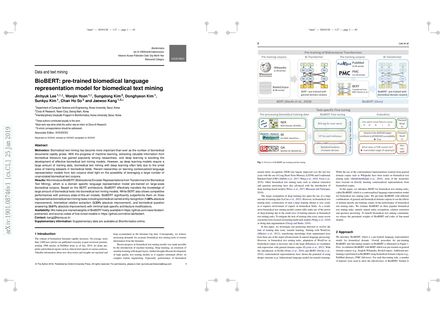
Biomedical text mining is becoming increasingly important as the number of biomedical documents rapidly grows. With the progress in natural language processing (NLP), extracting valuable information from biomedical literature has gained popularity among researchers, and deep learning has boosted the development of effective biomedical text mining models. However, directly applying the advancements in NLP to biomedical text mining often yields unsatisfactory results due to a word distribution shift from general domain corpora to biomedical corpora. In this article, we investigate how the recently introduced pre-trained language model BERT can be adapted for biomedical corpora. We introduce BioBERT (Bidirectional Encoder Representations from Transformers for Biomedical Text Mining), which is a domain-specific language representation model pre-trained on large-scale biomedical corpora. With almost the same architecture across tasks, BioBERT largely outperforms BERT and previous state-of-the-art models in a variety of biomedical text mining tasks when pre-trained on biomedical corpora. While BERT obtains performance comparable to that of previous state-of-the-art models, BioBERT significantly outperforms them on the following three representative biomedical text mining tasks: biomedical named entity recognition (0.62% F1 score improvement), biomedical relation extraction (2.80% F1 score improvement) and biomedical question answering (12.24% MRR improvement). Our analysis results show that pre-training BERT on biomedical corpora helps it to understand complex biomedical texts. We make the pre-trained weights of BioBERT freely available at https://github.com/naver/biobert-pretrained, and the source code for fine-tuning BioBERT available at https://github.com/dmis-lab/biobert.

Mobile devices such as smartphones and autonomous vehicles increasingly rely on deep neural networks (DNNs) to execute complex inference tasks such as image classification and speech recognition, among others. However, continuously executing the entire DNN on mobile devices can quickly deplete their battery. Although task offloading to cloud/edge servers may decrease the mobile device's computational burden, erratic patterns in channel quality, network, and edge server load can lead to a significant delay in task execution. Recently, approaches based on split computing (SC) have been proposed, where the DNN is split into a head and a tail model, executed respectively on the mobile device and on the edge server. Ultimately, this may reduce bandwidth usage as well as energy consumption. Another approach, called early exiting (EE), trains models to embed multiple "exits" earlier in the architecture, each providing increasingly higher target accuracy. Therefore, the trade-off between accuracy and delay can be tuned according to the current conditions or application demands. In this paper, we provide a comprehensive survey of the state of the art in SC and EE strategies by presenting a comparison of the most relevant approaches. We conclude the paper by providing a set of compelling research challenges.
While originally designed for natural language processing tasks, the self-attention mechanism has recently taken various computer vision areas by storm. However, the 2D nature of images brings three challenges for applying self-attention in computer vision. (1) Treating images as 1D sequences neglects their 2D structures. (2) The quadratic complexity is too expensive for high-resolution images. (3) It only captures spatial adaptability but ignores channel adaptability. In this paper, we propose a novel linear attention named large kernel attention (LKA) to enable self-adaptive and long-range correlations in self-attention while avoiding its shortcomings. Furthermore, we present a neural network based on LKA, namely Visual Attention Network (VAN). While extremely simple, VAN surpasses similar size vision transformers(ViTs) and convolutional neural networks(CNNs) in various tasks, including image classification, object detection, semantic segmentation, panoptic segmentation, pose estimation, etc. For example, VAN-B6 achieves 87.8% accuracy on ImageNet benchmark and set new state-of-the-art performance (58.2 PQ) for panoptic segmentation. Besides, VAN-B2 surpasses Swin-T 4% mIoU (50.1 vs. 46.1) for semantic segmentation on ADE20K benchmark, 2.6% AP (48.8 vs. 46.2) for object detection on COCO dataset. It provides a novel method and a simple yet strong baseline for the community. Code is available at https://github.com/Visual-Attention-Network.

Batch normalization is a key component of most image classification models, but it has many undesirable properties stemming from its dependence on the batch size and interactions between examples. Although recent work has succeeded in training deep ResNets without normalization layers, these models do not match the test accuracies of the best batch-normalized networks, and are often unstable for large learning rates or strong data augmentations. In this work, we develop an adaptive gradient clipping technique which overcomes these instabilities, and design a significantly improved class of Normalizer-Free ResNets. Our smaller models match the test accuracy of an EfficientNet-B7 on ImageNet while being up to 8.7x faster to train, and our largest models attain a new state-of-the-art top-1 accuracy of 86.5%. In addition, Normalizer-Free models attain significantly better performance than their batch-normalized counterparts when finetuning on ImageNet after large-scale pre-training on a dataset of 300 million labeled images, with our best models obtaining an accuracy of 89.2%. Our code is available at https://github.com/deepmind/ deepmind-research/tree/master/nfnets

In this work, we develop and release Llama 2, a collection of pretrained and fine-tuned large language models (LLMs) ranging in scale from 7 billion to 70 billion parameters. Our fine-tuned LLMs, called Llama 2-Chat, are optimized for dialogue use cases. Our models outperform open-source chat models on most benchmarks we tested, and based on our human evaluations for helpfulness and safety, may be a suitable substitute for closed-source models. We provide a detailed description of our approach to fine-tuning and safety improvements of Llama 2-Chat in order to enable the community to build on our work and contribute to the responsible development of LLMs.
Recent studies have demonstrated the efficiency of generative pretraining for English natural language understanding. In this work, we extend this approach to multiple languages and show the effectiveness of cross-lingual pretraining. We propose two methods to learn cross-lingual language models (XLMs): one unsupervised that only relies on monolingual data, and one supervised that leverages parallel data with a new cross-lingual language model objective. We obtain state-of-the-art results on cross-lingual classification, unsupervised and supervised machine translation. On XNLI, our approach pushes the state of the art by an absolute gain of 4.9% accuracy. On unsupervised machine translation, we obtain 34.3 BLEU on WMT'16 German-English, improving the previous state of the art by more than 9 BLEU. On supervised machine translation, we obtain a new state of the art of 38.5 BLEU on WMT'16 Romanian-English, outperforming the previous best approach by more than 4 BLEU. Our code and pretrained models will be made publicly available.
Although scaling up language model size has reliably improved performance on a range of NLP tasks, even the largest models currently struggle with certain reasoning tasks such as math word problems, symbolic manipulation, and commonsense reasoning. This paper explores the ability of language models to generate a coherent chain of thought -- a series of short sentences that mimic the reasoning process a person might have when responding to a question. Experiments show that inducing a chain of thought via prompting can enable sufficiently large language models to better perform reasoning tasks that otherwise have flat scaling curves. When combined with the 540B parameter PaLM model, chain of thought prompting achieves new state of the art of 58.1\% on the GSM8K benchmark of math word problems.