
分享
This paper presents a new adversarial learning method for generative conversational agents (GCA) besides a new model of GCA. Similar to previous works on adversarial learning for dialogue generation, our method assumes the GCA as a generator that aims at fooling a discriminator that labels dialogues as human-generated or machine-generated; however, in our approach, the discriminator performs token-level classification, i.e. it indicates whether the current token was generated by humans or machines. To do so, the discriminator also receives the context utterances (the dialogue history) and the incomplete answer up to the current token as input. This new approach makes possible the end-to-end training by backpropagation. A self-conversation process enables to produce a set of generated data with more diversity for the adversarial training. This approach improves the performance on questions not related to the training data. Experimental results with human and adversarial evaluations show that the adversarial method yields significant performance gains over the usual teacher forcing training.
Linguistic sequence labeling is a general modeling approach that encompasses a variety of problems, such as part-of-speech tagging and named entity recognition. Recent advances in neural networks (NNs) make it possible to build reliable models without handcrafted features. However, in many cases, it is hard to obtain sufficient annotations to train these models. In this study, we develop a novel neural framework to extract abundant knowledge hidden in raw texts to empower the sequence labeling task. Besides word-level knowledge contained in pre-trained word embeddings, character-aware neural language models are incorporated to extract character-level knowledge. Transfer learning techniques are further adopted to mediate different components and guide the language model towards the key knowledge. Comparing to previous methods, these task-specific knowledge allows us to adopt a more concise model and conduct more efficient training. Different from most transfer learning methods, the proposed framework does not rely on any additional supervision. It extracts knowledge from self-contained order information of training sequences. Extensive experiments on benchmark datasets demonstrate the effectiveness of leveraging character-level knowledge and the efficiency of co-training. For example, on the CoNLL03 NER task, model training completes in about 6 hours on a single GPU, reaching F1 score of 91.71$\pm$0.10 without using any extra annotation.
We present methodology for using dynamic evaluation to improve neural sequence models. Models are adapted to recent history via a gradient descent based mechanism, causing them to assign higher probabilities to re-occurring sequential patterns. Dynamic evaluation outperforms existing adaptation approaches in our comparisons. Dynamic evaluation improves the state-of-the-art word-level perplexities on the Penn Treebank and WikiText-2 datasets to 51.1 and 44.3 respectively, and the state-of-the-art character-level cross-entropies on the text8 and Hutter Prize datasets to 1.19 bits/char and 1.08 bits/char respectively.
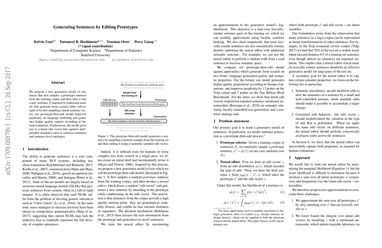
We propose a new generative model of sentences that first samples a prototype sentence from the training corpus and then edits it into a new sentence. Compared to traditional models that generate from scratch either left-to-right or by first sampling a latent sentence vector, our prototype-then-edit model improves perplexity on language modeling and generates higher quality outputs according to human evaluation. Furthermore, the model gives rise to a latent edit vector that captures interpretable semantics such as sentence similarity and sentence-level analogies.
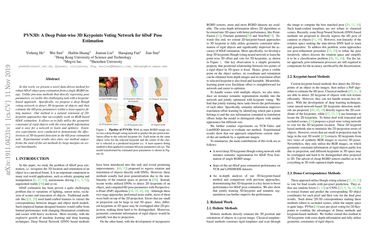
In this work, we present a novel data-driven method for robust 6DoF object pose estimation from a single RGBD image. Unlike previous methods that directly regressing pose parameters, we tackle this challenging task with a keypoint-based approach. Specifically, we propose a deep Hough voting network to detect 3D keypoints of objects and then estimate the 6D pose parameters within a least-squares fitting manner. Our method is a natural extension of 2D-keypoint approaches that successfully work on RGB based 6DoF estimation. It allows us to fully utilize the geometric constraint of rigid objects with the extra depth information and is easy for a network to learn and optimize. Extensive experiments were conducted to demonstrate the effectiveness of 3D-keypoint detection in the 6D pose estimation task. Experimental results also show our method outperforms the state-of-the-art methods by large margins on several benchmarks. Code and video are available at https://github.com/ethnhe/PVN3D.git.
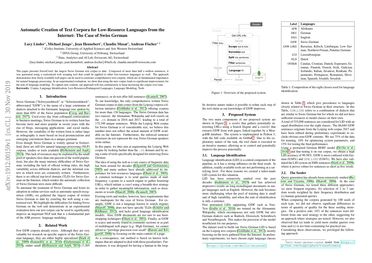
This paper presents SwissCrawl, the largest Swiss German text corpus to date. Composed of more than half a million sentences, it was generated using a customized web scraping tool that could be applied to other low-resource languages as well. The approach demonstrates how freely available web pages can be used to construct comprehensive text corpora, which are of fundamental importance for natural language processing. In an experimental evaluation, we show that using the new corpus leads to significant improvements for the task of language modeling. To capture new content, our approach will run continuously to keep increasing the corpus over time.
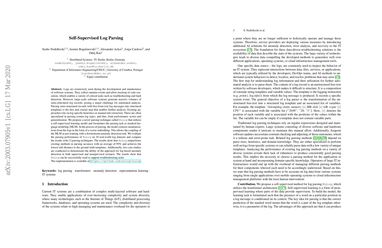
Logs are extensively used during the development and maintenance of software systems. They collect runtime events and allow tracking of code execution, which enables a variety of critical tasks such as troubleshooting and fault detection. However, large-scale software systems generate massive volumes of semi-structured log records, posing a major challenge for automated analysis. Parsing semi-structured records with free-form text log messages into structured templates is the first and crucial step that enables further analysis. Existing approaches rely on log-specific heuristics or manual rule extraction. These are often specialized in parsing certain log types, and thus, limit performance scores and generalization. We propose a novel parsing technique called NuLog that utilizes a self-supervised learning model and formulates the parsing task as masked language modeling (MLM). In the process of parsing, the model extracts summarizations from the logs in the form of a vector embedding. This allows the coupling of the MLM as pre-training with a downstream anomaly detection task. We evaluate the parsing performance of NuLog on 10 real-world log datasets and compare the results with 12 parsing techniques. The results show that NuLog outperforms existing methods in parsing accuracy with an average of 99% and achieves the lowest edit distance to the ground truth templates. Additionally, two case studies are conducted to demonstrate the ability of the approach for log-based anomaly detection in both supervised and unsupervised scenario. The results show that NuLog can be successfully used to support troubleshooting tasks. The implementation is available at https://github.com/nulog/nulog.
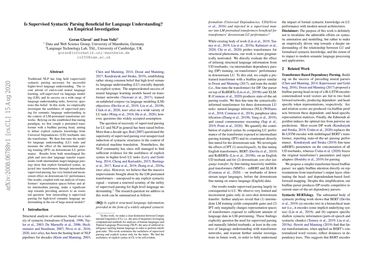
Traditional NLP has long held (supervised) syntactic parsing necessary for successful higher-level semantic language understanding (LU). The recent advent of end-to-end neural models, self-supervised via language modeling (LM), and their success on a wide range of LU tasks, however, questions this belief. In this work, we empirically investigate the usefulness of supervised parsing for semantic LU in the context of LM-pretrained transformer networks. Relying on the established fine-tuning paradigm, we first couple a pretrained transformer with a biaffine parsing head, aiming to infuse explicit syntactic knowledge from Universal Dependencies treebanks into the transformer. We then fine-tune the model for LU tasks and measure the effect of the intermediate parsing training (IPT) on downstream LU task performance. Results from both monolingual English and zero-shot language transfer experiments (with intermediate target-language parsing) show that explicit formalized syntax, injected into transformers through IPT, has very limited and inconsistent effect on downstream LU performance. Our results, coupled with our analysis of transformers' representation spaces before and after intermediate parsing, make a significant step towards providing answers to an essential question: how (un)availing is supervised parsing for high-level semantic natural language understanding in the era of large neural models?

This paper proposes a modification to RNN-Transducer (RNN-T) models for automatic speech recognition (ASR). In standard RNN-T, the emission of a blank symbol consumes exactly one input frame; in our proposed method, we introduce additional blank symbols, which consume two or more input frames when emitted. We refer to the added symbols as big blanks, and the method multi-blank RNN-T. For training multi-blank RNN-Ts, we propose a novel logit under-normalization method in order to prioritize emissions of big blanks. With experiments on multiple languages and datasets, we show that multi-blank RNN-T methods could bring relative speedups of over +90%/+139% to model inference for English Librispeech and German Multilingual Librispeech datasets, respectively. The multi-blank RNN-T method also improves ASR accuracy consistently. We will release our implementation of the method in the NeMo (https://github.com/NVIDIA/NeMo) toolkit.

This paper presents a novel end-to-end framework with Explicit box Detection for multi-person Pose estimation, called ED-Pose, where it unifies the contextual learning between human-level (global) and keypoint-level (local) information. Different from previous one-stage methods, ED-Pose re-considers this task as two explicit box detection processes with a unified representation and regression supervision. First, we introduce a human detection decoder from encoded tokens to extract global features. It can provide a good initialization for the latter keypoint detection, making the training process converge fast. Second, to bring in contextual information near keypoints, we regard pose estimation as a keypoint box detection problem to learn both box positions and contents for each keypoint. A human-to-keypoint detection decoder adopts an interactive learning strategy between human and keypoint features to further enhance global and local feature aggregation. In general, ED-Pose is conceptually simple without post-processing and dense heatmap supervision. It demonstrates its effectiveness and efficiency compared with both two-stage and one-stage methods. Notably, explicit box detection boosts the pose estimation performance by 4.5 AP on COCO and 9.9 AP on CrowdPose. For the first time, as a fully end-to-end framework with a L1 regression loss, ED-Pose surpasses heatmap-based Top-down methods under the same backbone by 1.2 AP on COCO and achieves the state-of-the-art with 76.6 AP on CrowdPose without bells and whistles. Code is available at https://github.com/IDEA-Research/ED-Pose.

This paper introduces a novel Token-and-Duration Transducer (TDT) architecture for sequence-to-sequence tasks. TDT extends conventional RNN-Transducer architectures by jointly predicting both a token and its duration, i.e. the number of input frames covered by the emitted token. This is achieved by using a joint network with two outputs which are independently normalized to generate distributions over tokens and durations. During inference, TDT models can skip input frames guided by the predicted duration output, which makes them significantly faster than conventional Transducers which process the encoder output frame by frame. TDT models achieve both better accuracy and significantly faster inference than conventional Transducers on different sequence transduction tasks. TDT models for Speech Recognition achieve better accuracy and up to 2.82X faster inference than conventional Transducers. TDT models for Speech Translation achieve an absolute gain of over 1 BLEU on the MUST-C test compared with conventional Transducers, and its inference is 2.27X faster. In Speech Intent Classification and Slot Filling tasks, TDT models improve the intent accuracy by up to over 1% (absolute) over conventional Transducers, while running up to 1.28X faster. Our implementation of the TDT model will be open-sourced with the NeMo (https://github.com/NVIDIA/NeMo) toolkit.

Generative Artificial Intelligence (AI) has enabled the development of sophisticated models that are capable of producing high-caliber text, images, and other outputs through the utilization of large pre-trained models. Nevertheless, assessing the quality of the generation is an even more arduous task than the generation itself, and this issue has not been given adequate consideration recently. This paper proposes a novel evaluation framework, GPTScore, which utilizes the emergent abilities (e.g., zero-shot instruction) of generative pre-trained models to score generated texts. There are 19 pre-trained models explored in this paper, ranging in size from 80M (e.g., FLAN-T5-small) to 175B (e.g., GPT3). Experimental results on four text generation tasks, 22 evaluation aspects, and corresponding 37 datasets demonstrate that this approach can effectively allow us to achieve what one desires to evaluate for texts simply by natural language instructions. This nature helps us overcome several long-standing challenges in text evaluation--how to achieve customized, multi-faceted evaluation without the need for annotated samples. We make our code publicly available at https://github.com/jinlanfu/GPTScore.