
分享
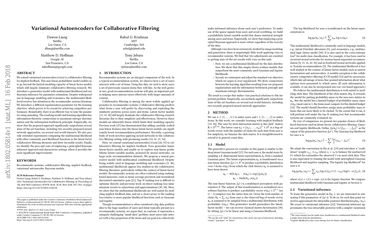
We extend variational autoencoders (VAEs) to collaborative filtering for implicit feedback. This non-linear probabilistic model enables us to go beyond the limited modeling capacity of linear factor models which still largely dominate collaborative filtering research.We introduce a generative model with multinomial likelihood and use Bayesian inference for parameter estimation. Despite widespread use in language modeling and economics, the multinomial likelihood receives less attention in the recommender systems literature. We introduce a different regularization parameter for the learning objective, which proves to be crucial for achieving competitive performance. Remarkably, there is an efficient way to tune the parameter using annealing. The resulting model and learning algorithm has information-theoretic connections to maximum entropy discrimination and the information bottleneck principle. Empirically, we show that the proposed approach significantly outperforms several state-of-the-art baselines, including two recently-proposed neural network approaches, on several real-world datasets. We also provide extended experiments comparing the multinomial likelihood with other commonly used likelihood functions in the latent factor collaborative filtering literature and show favorable results. Finally, we identify the pros and cons of employing a principled Bayesian inference approach and characterize settings where it provides the most significant improvements.
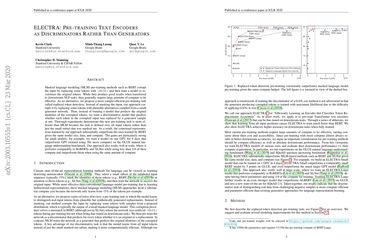
Masked language modeling (MLM) pre-training methods such as BERT corrupt the input by replacing some tokens with [MASK] and then train a model to reconstruct the original tokens. While they produce good results when transferred to downstream NLP tasks, they generally require large amounts of compute to be effective. As an alternative, we propose a more sample-efficient pre-training task called replaced token detection. Instead of masking the input, our approach corrupts it by replacing some tokens with plausible alternatives sampled from a small generator network. Then, instead of training a model that predicts the original identities of the corrupted tokens, we train a discriminative model that predicts whether each token in the corrupted input was replaced by a generator sample or not. Thorough experiments demonstrate this new pre-training task is more efficient than MLM because the task is defined over all input tokens rather than just the small subset that was masked out. As a result, the contextual representations learned by our approach substantially outperform the ones learned by BERT given the same model size, data, and compute. The gains are particularly strong for small models; for example, we train a model on one GPU for 4 days that outperforms GPT (trained using 30x more compute) on the GLUE natural language understanding benchmark. Our approach also works well at scale, where it performs comparably to RoBERTa and XLNet while using less than 1/4 of their compute and outperforms them when using the same amount of compute.
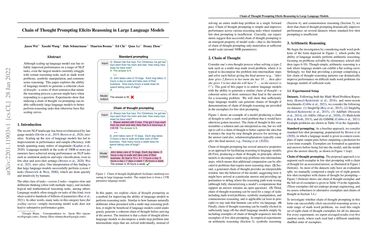
Although scaling up language model size has reliably improved performance on a range of NLP tasks, even the largest models currently struggle with certain reasoning tasks such as math word problems, symbolic manipulation, and commonsense reasoning. This paper explores the ability of language models to generate a coherent chain of thought -- a series of short sentences that mimic the reasoning process a person might have when responding to a question. Experiments show that inducing a chain of thought via prompting can enable sufficiently large language models to better perform reasoning tasks that otherwise have flat scaling curves. When combined with the 540B parameter PaLM model, chain of thought prompting achieves new state of the art of 58.1\% on the GSM8K benchmark of math word problems.
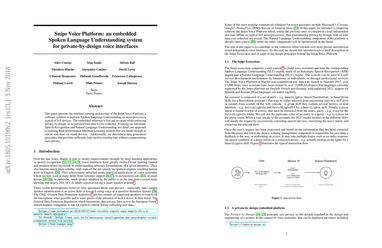
This paper presents the machine learning architecture of the Snips Voice Platform, a software solution to perform Spoken Language Understanding on microprocessors typical of IoT devices. The embedded inference is fast and accurate while enforcing privacy by design, as no personal user data is ever collected. Focusing on Automatic Speech Recognition and Natural Language Understanding, we detail our approach to training high-performance Machine Learning models that are small enough to run in real-time on small devices. Additionally, we describe a data generation procedure that provides sufficient, high-quality training data without compromising user privacy.
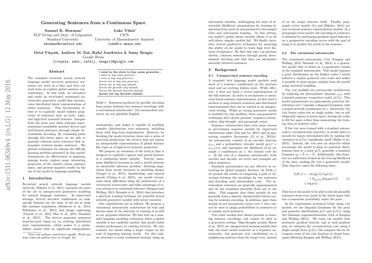
The standard recurrent neural network language model (RNNLM) generates sentences one word at a time and does not work from an explicit global sentence representation. In this work, we introduce and study an RNN-based variational autoencoder generative model that incorporates distributed latent representations of entire sentences. This factorization allows it to explicitly model holistic properties of sentences such as style, topic, and high-level syntactic features. Samples from the prior over these sentence representations remarkably produce diverse and well-formed sentences through simple deterministic decoding. By examining paths through this latent space, we are able to generate coherent novel sentences that interpolate between known sentences. We present techniques for solving the difficult learning problem presented by this model, demonstrate its effectiveness in imputing missing words, explore many interesting properties of the model's latent sentence space, and present negative results on the use of the model in language modeling.
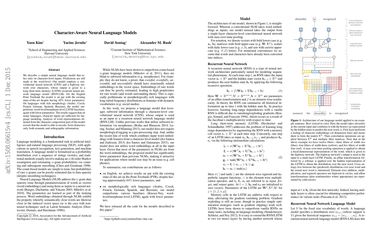
We describe a simple neural language model that relies only on character-level inputs. Predictions are still made at the word-level. Our model employs a convolutional neural network (CNN) and a highway network over characters, whose output is given to a long short-term memory (LSTM) recurrent neural network language model (RNN-LM). On the English Penn Treebank the model is on par with the existing state-of-the-art despite having 60% fewer parameters. On languages with rich morphology (Arabic, Czech, French, German, Spanish, Russian), the model outperforms word-level/morpheme-level LSTM baselines, again with fewer parameters. The results suggest that on many languages, character inputs are sufficient for language modeling. Analysis of word representations obtained from the character composition part of the model reveals that the model is able to encode, from characters only, both semantic and orthographic information.
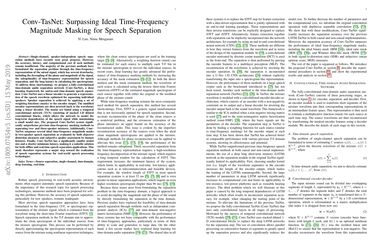
Single-channel, speaker-independent speech separation methods have recently seen great progress. However, the accuracy, latency, and computational cost of such methods remain insufficient. The majority of the previous methods have formulated the separation problem through the time-frequency representation of the mixed signal, which has several drawbacks, including the decoupling of the phase and magnitude of the signal, the suboptimality of time-frequency representation for speech separation, and the long latency in calculating the spectrograms. To address these shortcomings, we propose a fully-convolutional time-domain audio separation network (Conv-TasNet), a deep learning framework for end-to-end time-domain speech separation. Conv-TasNet uses a linear encoder to generate a representation of the speech waveform optimized for separating individual speakers. Speaker separation is achieved by applying a set of weighting functions (masks) to the encoder output. The modified encoder representations are then inverted back to the waveforms using a linear decoder. The masks are found using a temporal convolutional network (TCN) consisting of stacked 1-D dilated convolutional blocks, which allows the network to model the long-term dependencies of the speech signal while maintaining a small model size. The proposed Conv-TasNet system significantly outperforms previous time-frequency masking methods in separating two- and three-speaker mixtures. Additionally, Conv-TasNet surpasses several ideal time-frequency magnitude masks in two-speaker speech separation as evaluated by both objective distortion measures and subjective quality assessment by human listeners. Finally, Conv-TasNet has a significantly smaller model size and a shorter minimum latency, making it a suitable solution for both offline and real-time speech separation applications.
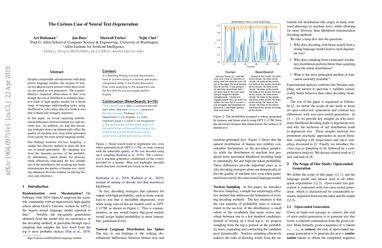
Despite considerable advancements with deep neural language models, the enigma of neural text degeneration persists when these models are tested as text generators. The counter-intuitive empirical observation is that even though the use of likelihood as training objective leads to high quality models for a broad range of language understanding tasks, using likelihood as a decoding objective leads to text that is bland and strangely repetitive. In this paper, we reveal surprising distributional differences between human text and machine text. In addition, we find that decoding strategies alone can dramatically effect the quality of machine text, even when generated from exactly the same neural language model. Our findings motivate Nucleus Sampling, a simple but effective method to draw the best out of neural generation. By sampling text from the dynamic nucleus of the probability distribution, which allows for diversity while effectively truncating the less reliable tail of the distribution, the resulting text better demonstrates the quality of human text, yielding enhanced diversity without sacrificing fluency and coherence.

Large "instruction-tuned" language models (i.e., finetuned to respond to instructions) have demonstrated a remarkable ability to generalize zero-shot to new tasks. Nevertheless, they depend heavily on human-written instruction data that is often limited in quantity, diversity, and creativity, therefore hindering the generality of the tuned model. We introduce Self-Instruct, a framework for improving the instruction-following capabilities of pretrained language models by bootstrapping off their own generations. Our pipeline generates instructions, input, and output samples from a language model, then filters invalid or similar ones before using them to finetune the original model. Applying our method to the vanilla GPT3, we demonstrate a 33% absolute improvement over the original model on Super-NaturalInstructions, on par with the performance of InstructGPT-001, which was trained with private user data and human annotations. For further evaluation, we curate a set of expert-written instructions for novel tasks, and show through human evaluation that tuning GPT3 with Self-Instruct outperforms using existing public instruction datasets by a large margin, leaving only a 5% absolute gap behind InstructGPT-001. Self-Instruct provides an almost annotation-free method for aligning pre-trained language models with instructions, and we release our large synthetic dataset to facilitate future studies on instruction tuning. Our code and data are available at https://github.com/yizhongw/self-instruct.

The cost of vision-and-language pre-training has become increasingly prohibitive due to end-to-end training of large-scale models. This paper proposes BLIP-2, a generic and efficient pre-training strategy that bootstraps vision-language pre-training from off-the-shelf frozen pre-trained image encoders and frozen large language models. BLIP-2 bridges the modality gap with a lightweight Querying Transformer, which is pre-trained in two stages. The first stage bootstraps vision-language representation learning from a frozen image encoder. The second stage bootstraps vision-to-language generative learning from a frozen language model. BLIP-2 achieves state-of-the-art performance on various vision-language tasks, despite having significantly fewer trainable parameters than existing methods. For example, our model outperforms Flamingo80B by 8.7% on zero-shot VQAv2 with 54x fewer trainable parameters. We also demonstrate the model's emerging capabilities of zero-shot image-to-text generation that can follow natural language instructions.

We focus on the challenging task of real-time semantic segmentation in this paper. It finds many practical applications and yet is with fundamental difficulty of reducing a large portion of computation for pixel-wise label inference. We propose an image cascade network (ICNet) that incorporates multi-resolution branches under proper label guidance to address this challenge. We provide in-depth analysis of our framework and introduce the cascade feature fusion unit to quickly achieve high-quality segmentation. Our system yields real-time inference on a single GPU card with decent quality results evaluated on challenging datasets like Cityscapes, CamVid and COCO-Stuff.

Policy gradient methods are an appealing approach in reinforcement learning because they directly optimize the cumulative reward and can straightforwardly be used with nonlinear function approximators such as neural networks. The two main challenges are the large number of samples typically required, and the difficulty of obtaining stable and steady improvement despite the nonstationarity of the incoming data. We address the first challenge by using value functions to substantially reduce the variance of policy gradient estimates at the cost of some bias, with an exponentially-weighted estimator of the advantage function that is analogous to TD(lambda). We address the second challenge by using trust region optimization procedure for both the policy and the value function, which are represented by neural networks. Our approach yields strong empirical results on highly challenging 3D locomotion tasks, learning running gaits for bipedal and quadrupedal simulated robots, and learning a policy for getting the biped to stand up from starting out lying on the ground. In contrast to a body of prior work that uses hand-crafted policy representations, our neural network policies map directly from raw kinematics to joint torques. Our algorithm is fully model-free, and the amount of simulated experience required for the learning tasks on 3D bipeds corresponds to 1-2 weeks of real time.